
The 13 National Plumbing Failure Families
The American Plumbing Failure Pattern Index organizes residential plumbing risk into 13 repeatable national failure families.
Each failure family represents a specific way plumbing systems break under environmental pressure.
Some failure families attack the system from outside the pipe.
Others attack from inside the pipe.
Some develop suddenly.
Others remain hidden for years before visible damage appears.
Most homes experience multiple failure families simultaneously.
That combination creates the home’s failure stack.
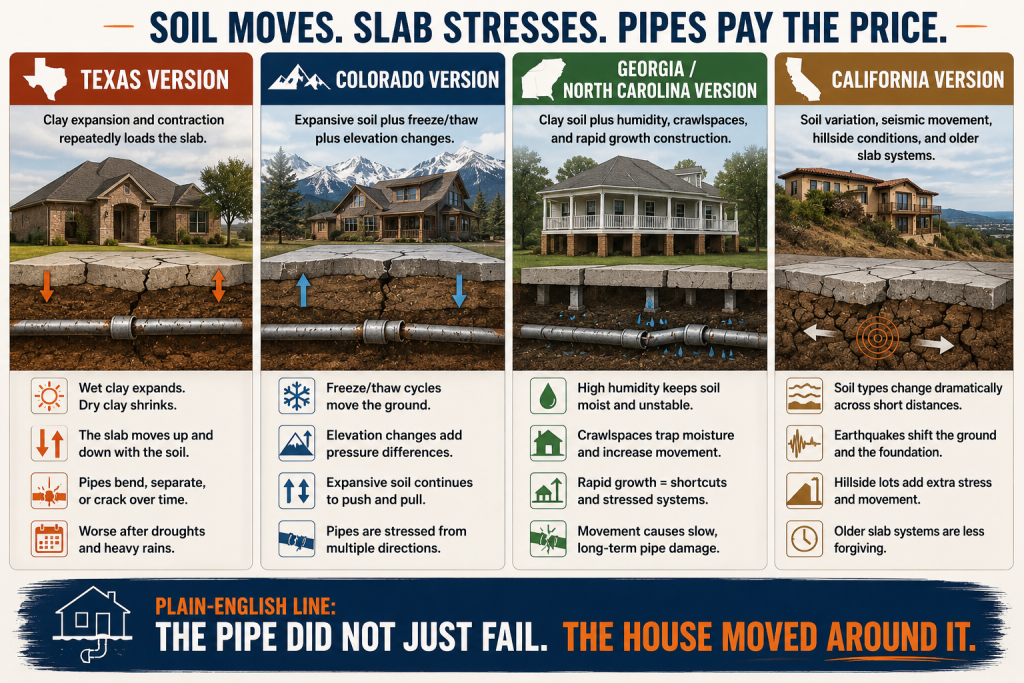
1. Expansive Soil / Slab Stress Failure
Definition
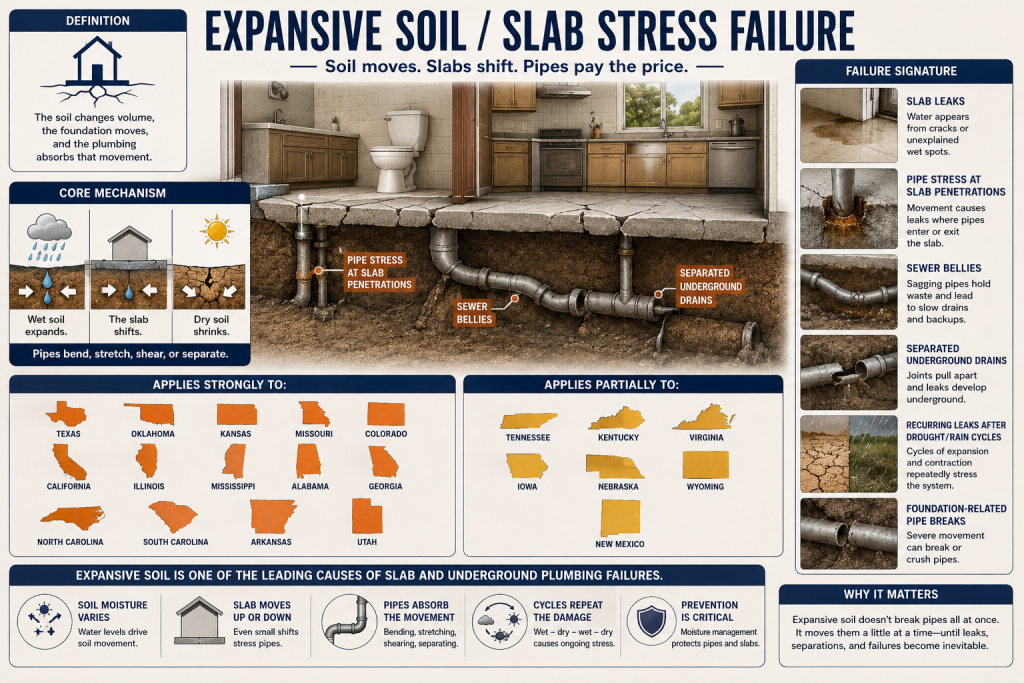
The soil changes volume underneath the home, causing slab movement and underground plumbing stress.
Wet soil expands.
Dry soil contracts.
The foundation shifts.
The plumbing system absorbs that movement.
Common Symptoms
- slab leaks
- warm floors
- sewer bellies
- recurring underground leaks
- pipe stress near slab penetrations
- foundation-adjacent plumbing damage
Strong States
Texas
Colorado
California
Georgia
North Carolina
Oklahoma
Kansas
Utah
Plain-English Translation
The pipe often fails because the ground underneath the home keeps moving around it.
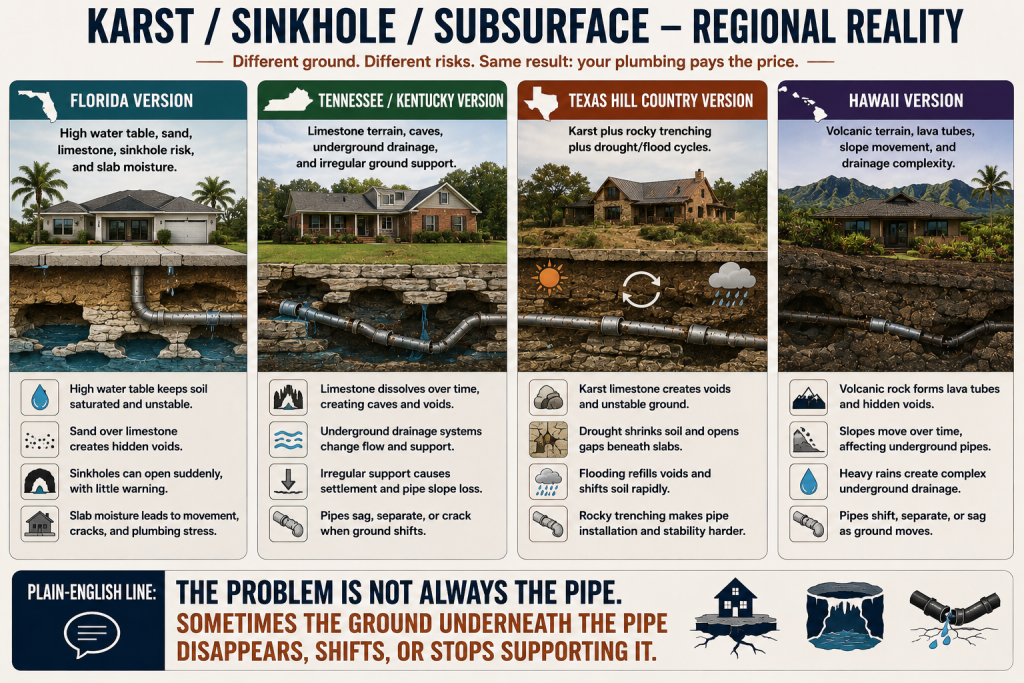
2. Karst / Sinkhole / Subsurface Void Failure
Definition
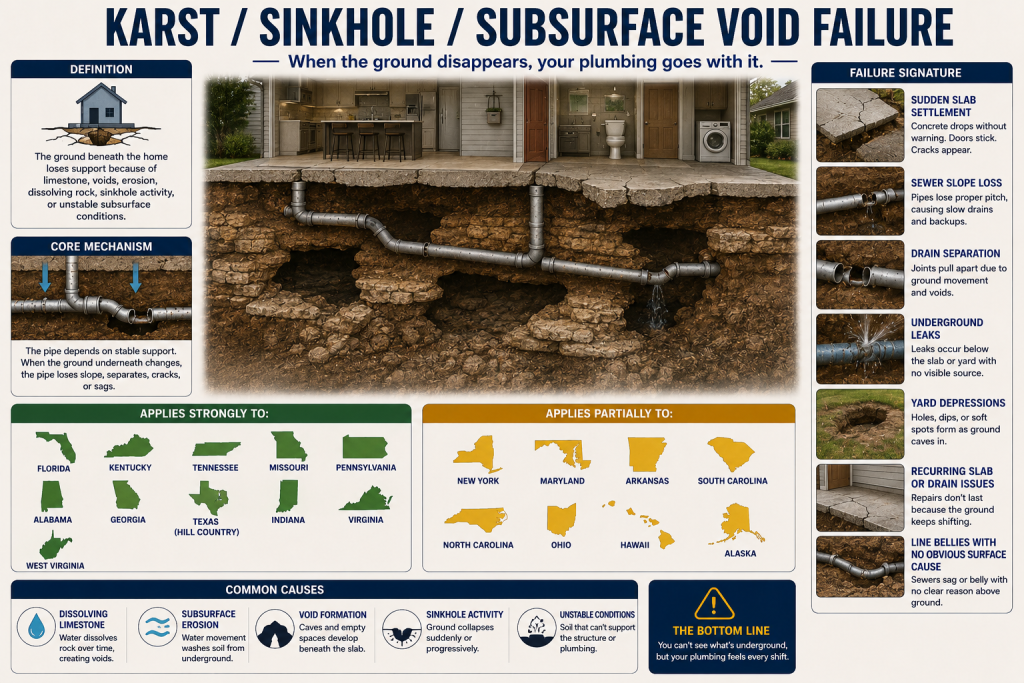
The plumbing system loses stable underground support because of limestone dissolution, sinkhole activity, erosion, underground voids, or unstable subsurface terrain.
The pipe depends on stable support.
The support underneath the pipe changes first.
Common Symptoms
- sewer slope loss
- drain separation
- recurring underground leaks
- yard depressions
- unexplained settlement
- recurring sewer instability
Strong States
Florida
Tennessee
Kentucky
Missouri
Pennsylvania
Texas Hill Country
Alabama
Georgia
Hawaii
Plain-English Translation
Sometimes the plumbing problem is not the pipe. The support underneath the pipe changed first.
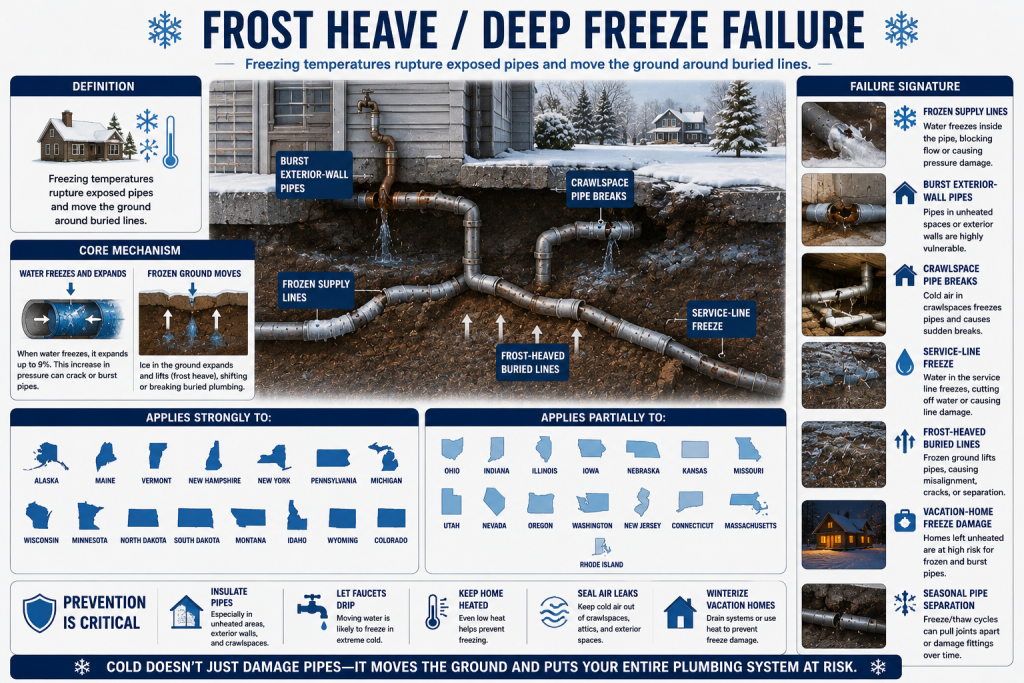
3. Frost Heave / Deep Freeze Failure
Definition
Extreme cold freezes water inside plumbing systems and shifts frozen ground around buried lines.
Freeze pressure expands inside the pipe while frozen soil simultaneously stresses the outside of the system.
Common Symptoms
- burst pipes
- frozen service lines
- crawlspace freeze damage
- outdoor fixture cracking
- seasonal pipe separation
- freeze-related leaks
Strong States
Minnesota
North Dakota
South Dakota
Montana
Alaska
Maine
Michigan
Wisconsin
Colorado
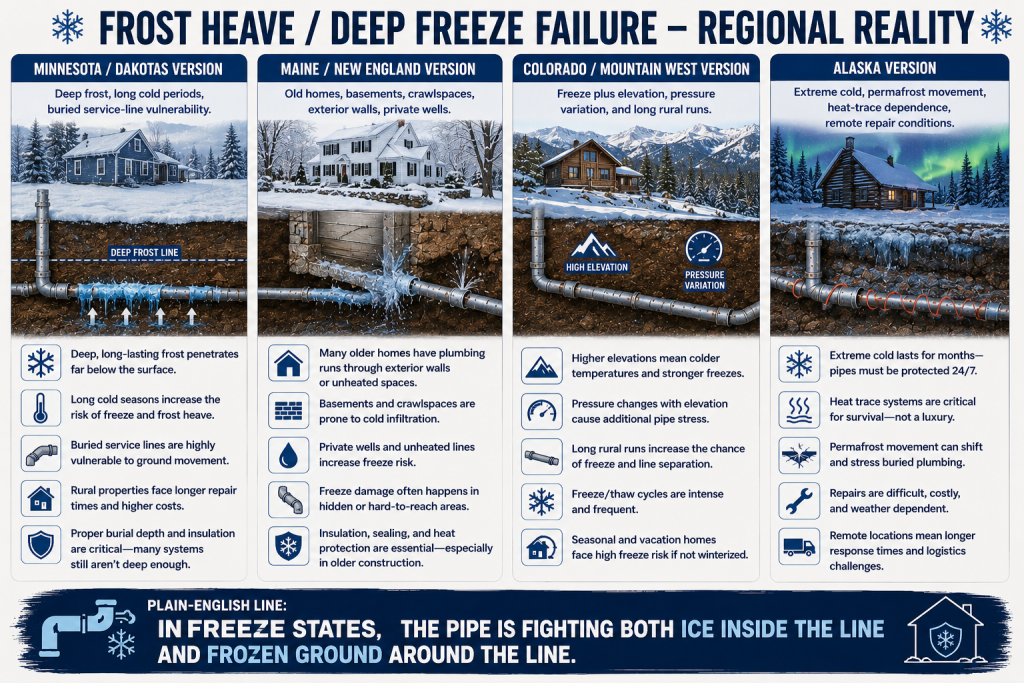
Plain-English Translation
In freeze states, the plumbing system is fighting pressure from both inside and outside the pipe at the same time.
4. Heat / Thermal Expansion Failure
Definition
Extreme heat and repeated temperature swings expand, dry, pressure-load, and weaken plumbing systems over time.
Heat changes how materials behave.
Expansion cycles gradually create stress throughout the system.
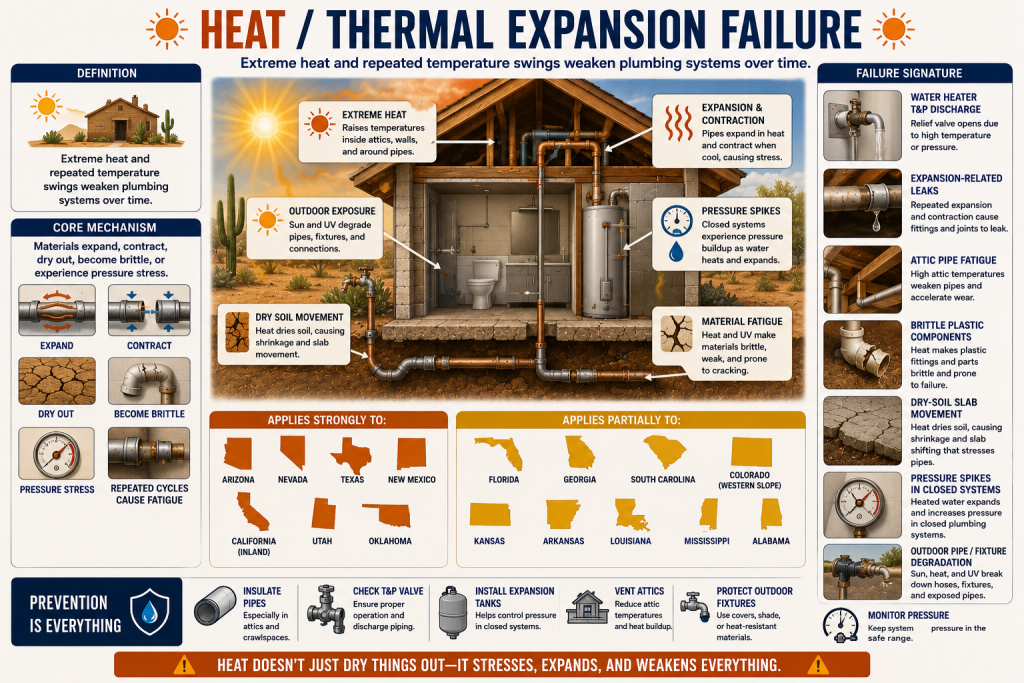
Common Symptoms
- expansion-related leaks
- attic pipe fatigue
- pressure spikes
- brittle plastic components
- water heater stress
- outdoor fixture degradation
Strong States
Arizona
Nevada
Texas
New Mexico
California inland
Utah
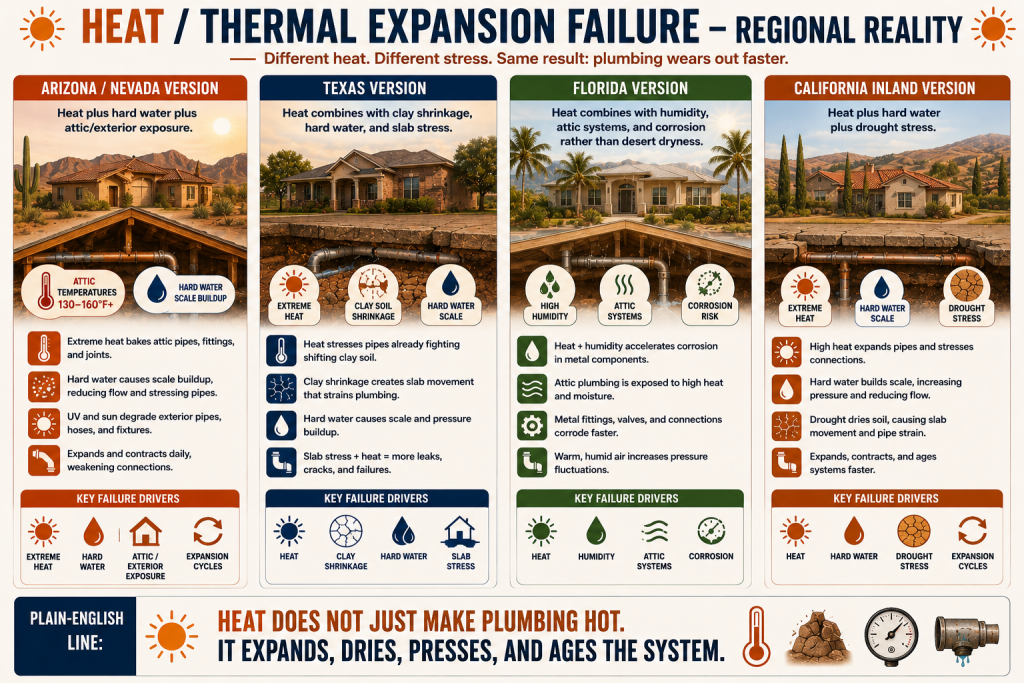
Plain-English Translation
Heat does not just make plumbing hot. It continuously expands and stresses the system over time.
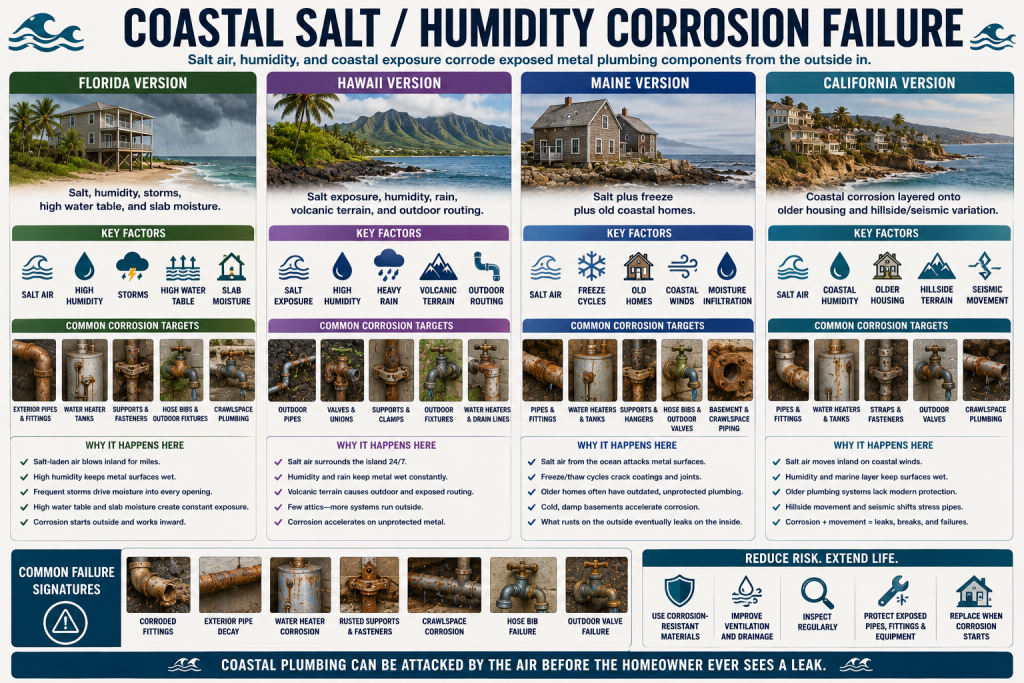
5. Coastal Salt / Humidity Corrosion Failure
Definition
Salt exposure, humidity, and coastal air accelerate corrosion on plumbing materials from the outside inward.
The environment itself becomes corrosive.
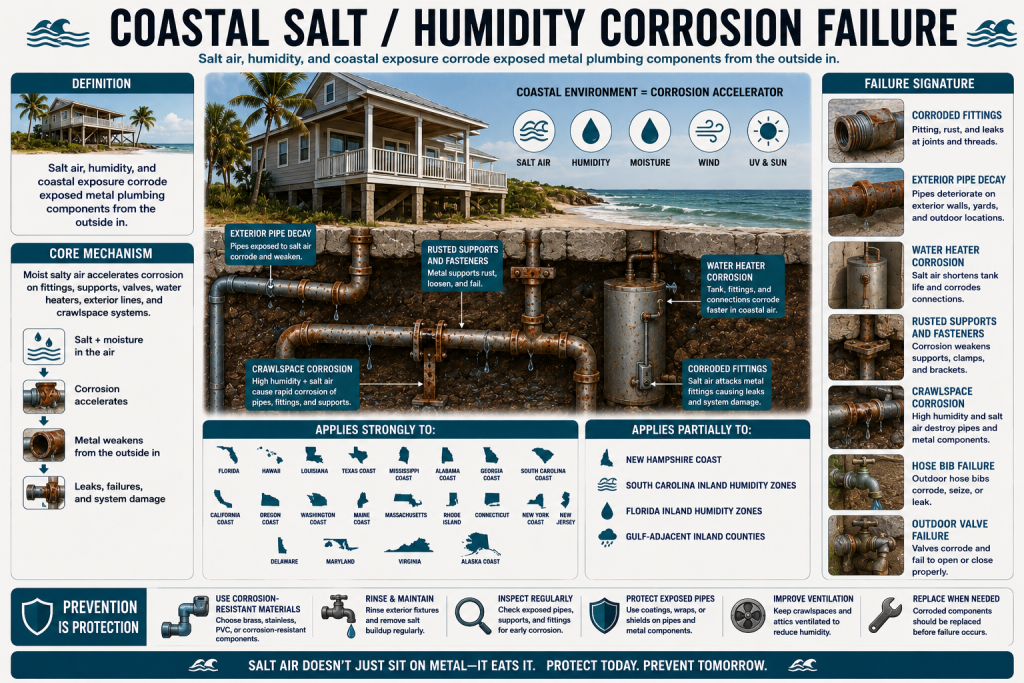
Common Symptoms
- corroded fittings
- rusted supports
- hose bib deterioration
- crawlspace corrosion
- outdoor valve failure
- water heater corrosion
Strong States
Florida
Hawaii
Louisiana
Texas coast
California coast
Georgia coast
South Carolina coast
North Carolina coast
Plain-English Translation
Coastal plumbing systems are often attacked by the air surrounding them before the homeowner sees a visible leak.
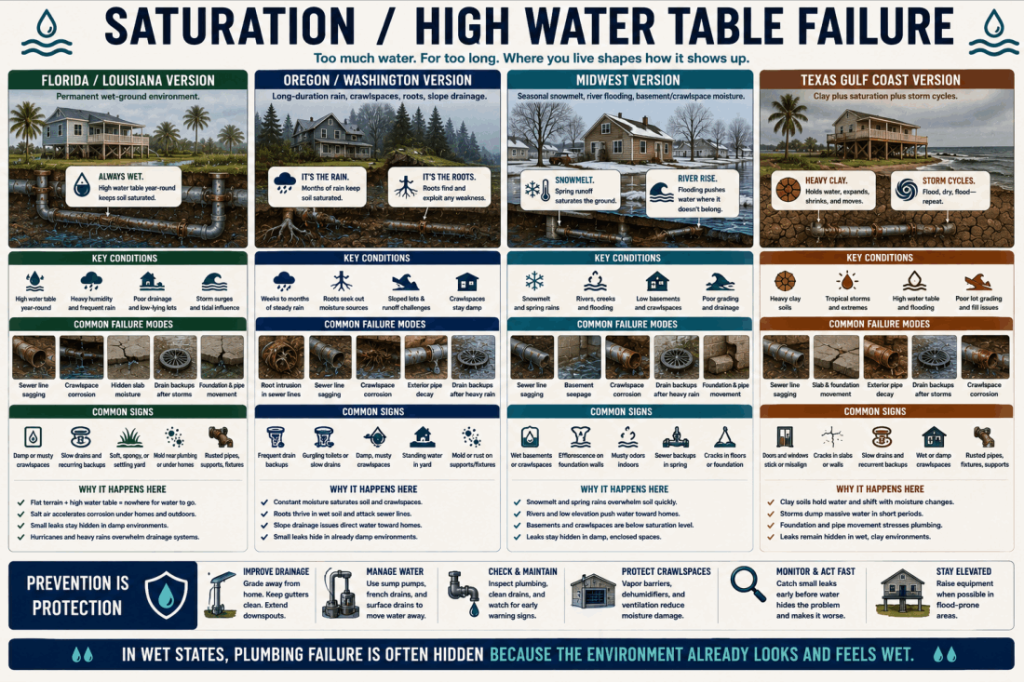
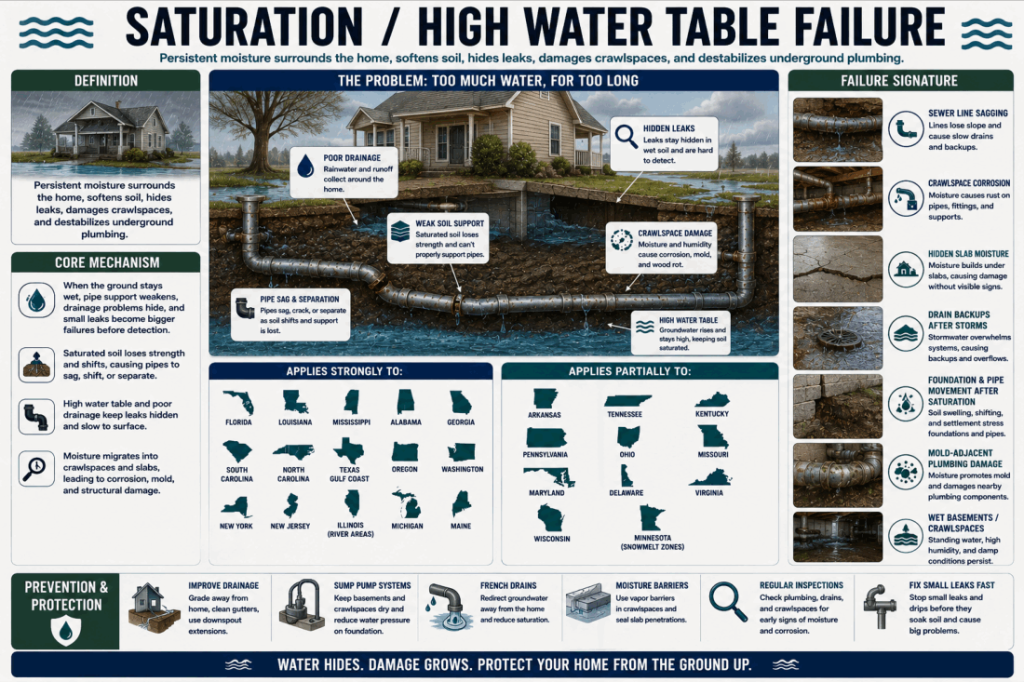
6. Saturation / High Water Table Failure
Definition
Persistent moisture weakens underground support conditions and hides plumbing deterioration underneath wet environments.
The plumbing system continuously operates inside saturated conditions.
Common Symptoms
- sewer sagging
- crawlspace moisture
- hidden slab moisture
- recurring drain backups
- wet basements
- mold-adjacent plumbing damage
Strong States
Florida
Louisiana
Mississippi
Georgia
Oregon
Washington
Texas Gulf Coast
Plain-English Translation
In wet environments, plumbing failures often stay hidden because the entire environment already looks wet.
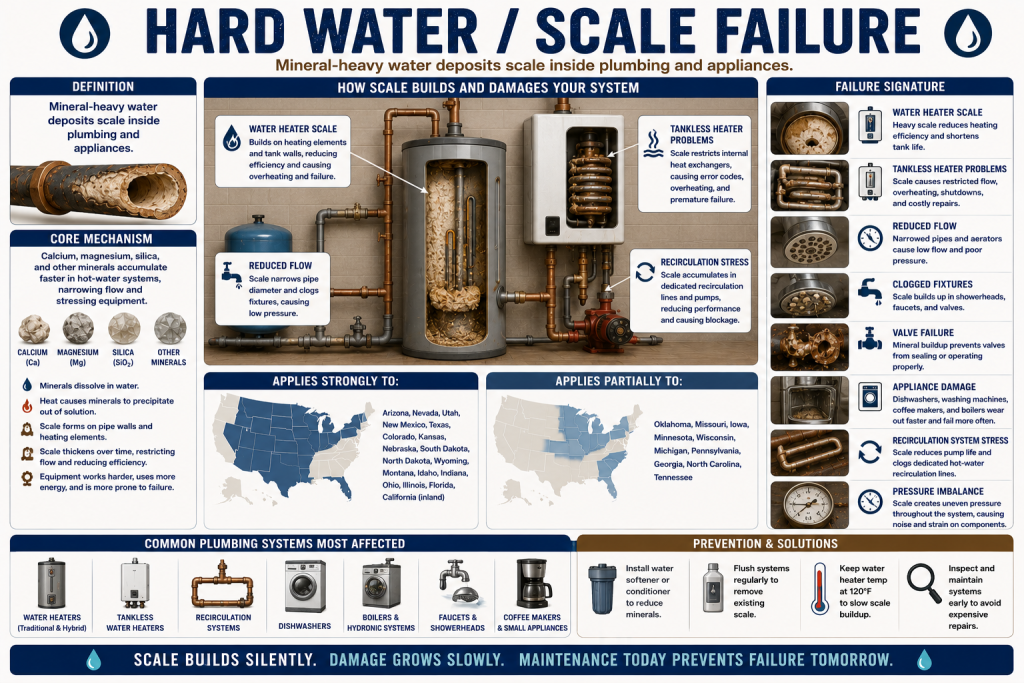
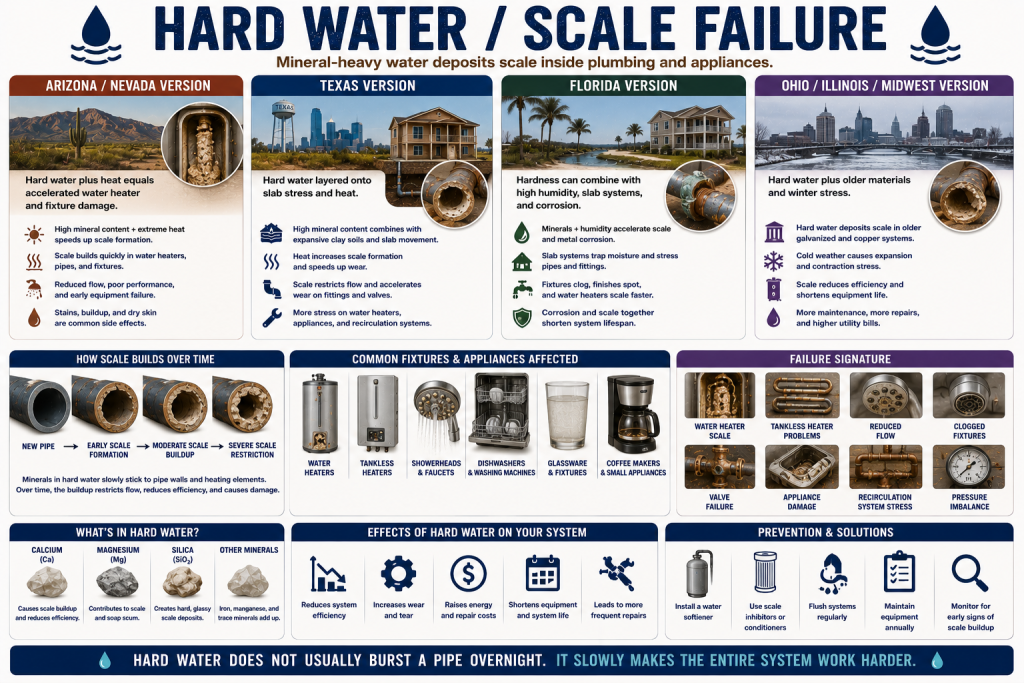
7. Hard Water / Scale Failure
Definition
Mineral-heavy water slowly restricts plumbing systems internally through scale accumulation and sediment buildup.
The system gradually loses efficiency while internal restriction increases.
Common Symptoms
- low water pressure
- fixture buildup
- water heater sediment
- tankless scaling
- appliance damage
- recurring valve problems
Strong States
Arizona
Nevada
Utah
Texas
Colorado
Florida
California inland
Ohio
Illinois
Plain-English Translation
Hard water usually does not destroy plumbing overnight. It slowly forces the entire system to work harder every year.
8. Acidic / Aggressive Water Corrosion Failure
Definition
Low-pH or chemically aggressive water slowly dissolves plumbing materials internally.
The system may appear normal while corrosion quietly progresses inside the pipe walls.
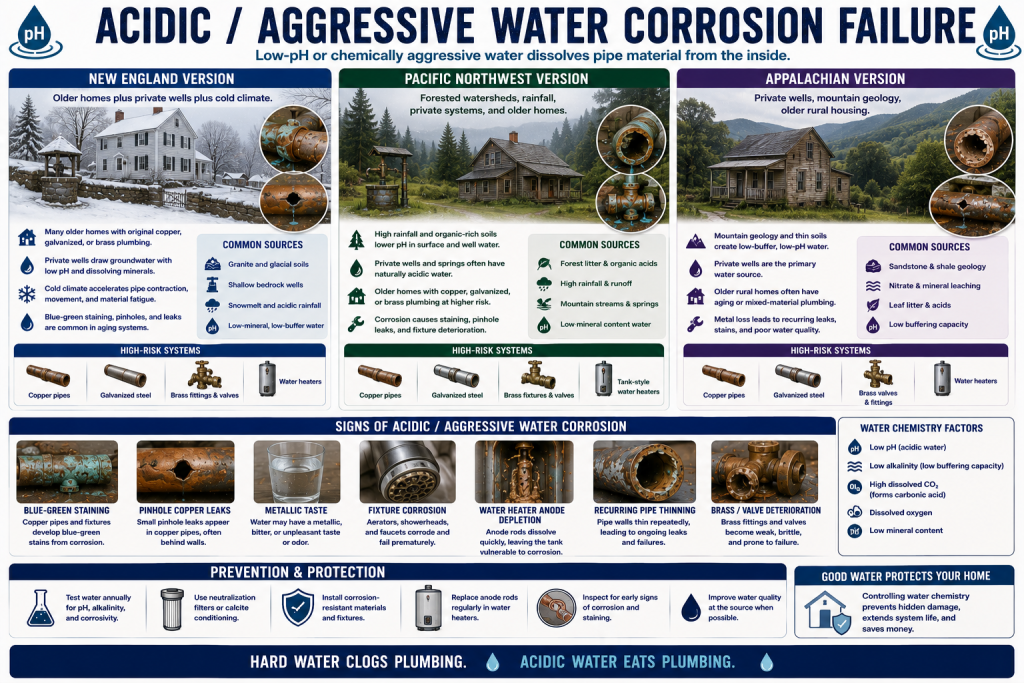
Common Symptoms
- pinhole copper leaks
- blue-green staining
- metallic taste
- fixture corrosion
- recurring copper failures
- valve deterioration
Strong States
Maine
New Hampshire
Vermont
Massachusetts
Oregon
Washington
Pennsylvania rural areas
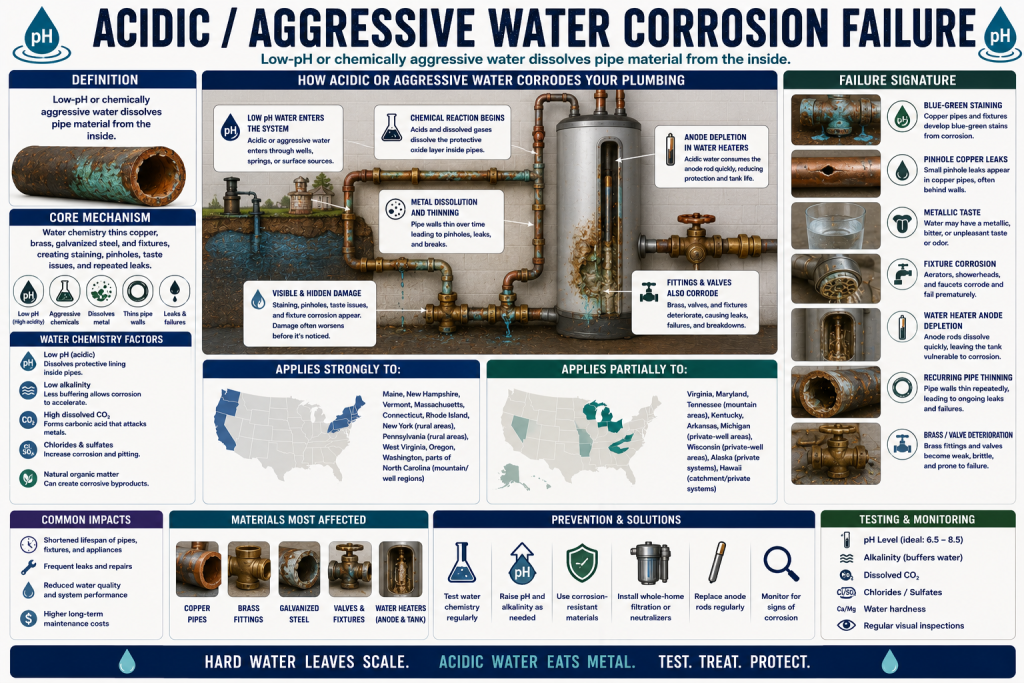
Plain-English Translation
Some water slowly clogs plumbing. Aggressive water slowly dissolves it.
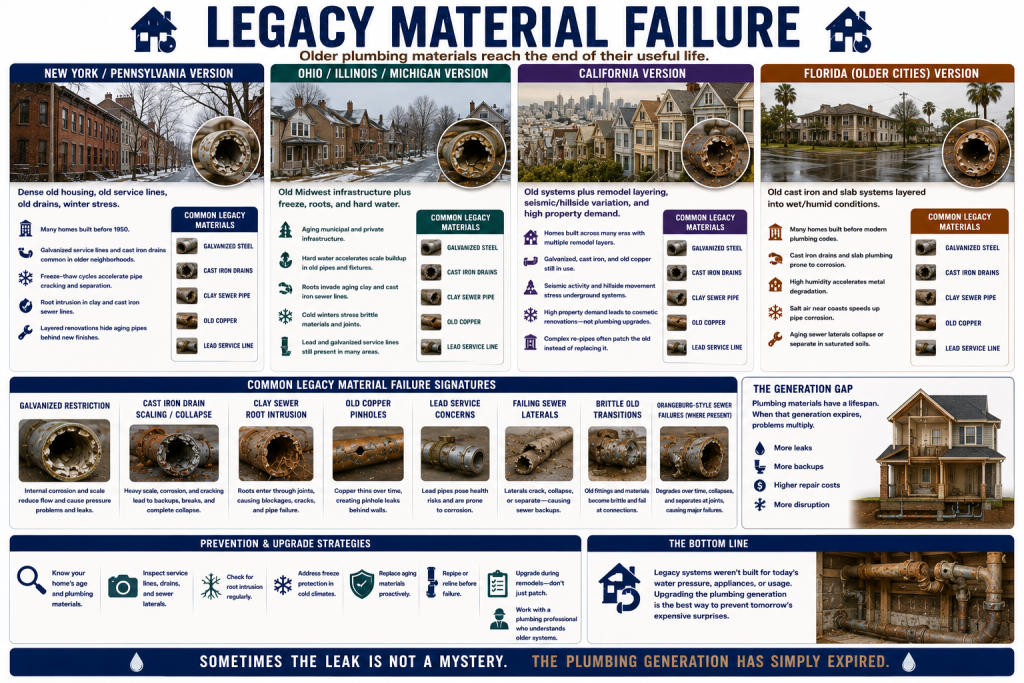
9. Legacy Material Failure
Definition
Older plumbing materials reach the end of their functional lifespan.
The material generation itself becomes unstable over time.
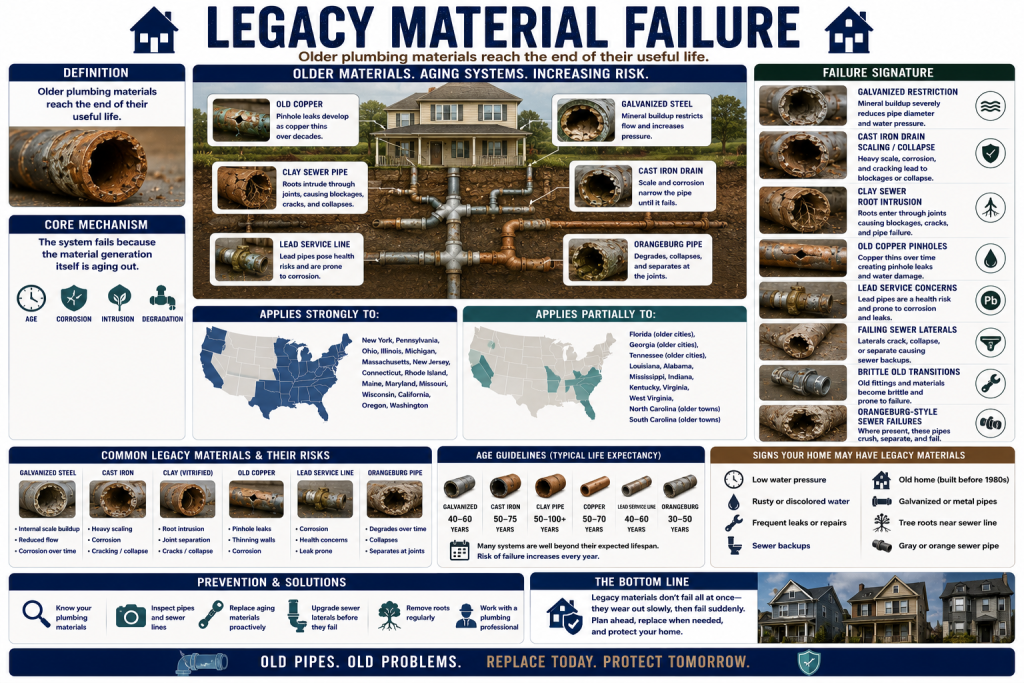
Common Symptoms
- galvanized restriction
- cast iron deterioration
- clay sewer intrusion
- sewer lateral collapse
- old copper failures
- brittle transitions
Strong States
New York
Pennsylvania
Ohio
Illinois
Michigan
Massachusetts
New Jersey
California
Plain-English Translation
Sometimes the plumbing system is not failing unexpectedly. The material generation itself has simply aged out.
10. Root / Vegetation Intrusion Failure
Definition
Roots enter cracks, joints, offsets, and aging sewer systems searching for moisture.
The root rarely creates the original weakness.
It expands the weakness that already existed.
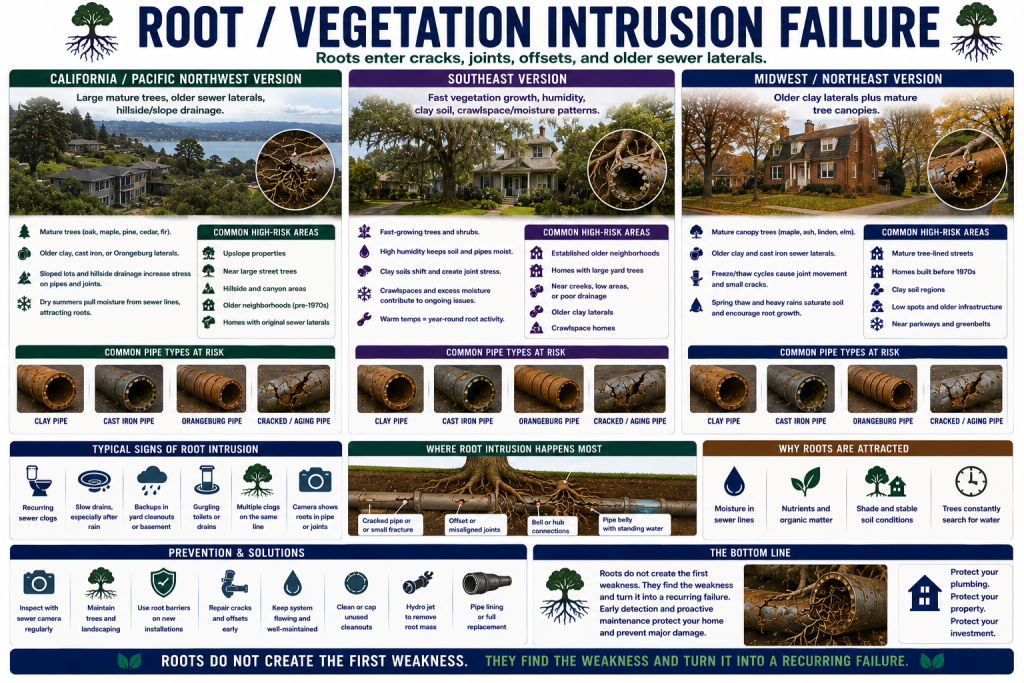
Common Symptoms
- recurring sewer clogs
- yard cleanout backups
- slow drains
- sewer bellies
- recurring root cutting
- mature-neighborhood drain failures
Strong States
California
Oregon
Washington
Georgia
Tennessee
Florida
Ohio
Illinois
Pennsylvania

Plain-English Translation
Roots usually find the plumbing weakness before the homeowner does.
11. Boom-Build Installation Failure
Definition
Rapid-growth housing markets create predictable installation weaknesses caused by speed-driven construction conditions.
Large-scale subdivision growth often prioritizes speed over long-term system durability.

Common Symptoms
- poor support
- bad slope
- weak slab penetrations
- inconsistent material transitions
- undersized systems
- recurring layout problems
Strong States
Texas
Florida
Arizona
Nevada
Georgia
North Carolina
Tennessee
Colorado
Utah

Plain-English Translation
Some homes inherit plumbing weaknesses the day construction is completed.
12. Complex-System / Luxury Load Failure
Definition
Modern homes create larger, more complex plumbing networks with more pressure zones, fixtures, long runs, and interconnected systems.
As system complexity increases, the number of failure points also increases.

Common Symptoms
- pressure imbalance
- recirculation failure
- long hot-water waits
- booster pump issues
- hidden leaks
- manifold instability
- irrigation/backflow problems
Strong States
California
Florida
Texas
Colorado
Arizona
Utah
Nevada
Hawaii

Plain-English Translation
More plumbing convenience usually creates more plumbing failure points.
13. Human-System Failure
Definition
Plumbing systems fail because of installation mistakes, poor repair sequencing, incompatible materials, deferred maintenance, DIY modifications, or rushed construction decisions.
The environment creates pressure.
Human decisions often weaken the system first.
Common Symptoms
- recurring repairs
- failed transitions
- unsupported piping
- bad slope
- hidden non-code work
- pressure imbalance
- repeated leak locations
Strong States
ALL states.
Especially fast-growth markets and remodel-heavy regions.
Plain-English Translation
Some plumbing systems fail because of the environment. Others fail because the system was weakened long before the environment applied pressure.
Pattern Stacking
Most homes do not experience one failure family alone.
The patterns stack together.
Texas often combines:
- slab stress
- heat expansion
- hard water
- boom-build installation
- complex demand load
Florida often combines:
- saturation
- sinkhole conditions
- humidity corrosion
- slab systems
- coastal exposure
California often combines:
- legacy materials
- hillside movement
- remodel layering
- hard water
- demand overload
The plumbing system reflects the combined pressure of the environment surrounding the home.
Failure Timeline
Most plumbing failures follow the same progression.
Stage 1 — Environmental Pressure
The environment begins stressing the system.
Stage 2 — Material Stress
The plumbing materials weaken internally.
Stage 3 — Symptom Phase
The homeowner notices small recurring issues.
Stage 4 — Recurring Failure
Repairs happen repeatedly while the environmental pressure remains active.
Stage 5 — Damage Event
The hidden pattern becomes visible plumbing damage.
Most plumbing emergencies are not sudden events.
They are the final stage of long-term environmental pressure.
Why This Helps Homeowners
Most homeowners search symptoms.
The plumbing system operates through patterns.
Understanding the failure family affecting the home helps homeowners:
- recognize recurring risk
- understand why repairs repeat
- identify hidden environmental pressure
- predict future plumbing failures
- understand why certain states fail differently
- make better long-term repair decisions
- recognize when full-system replacement becomes logical
The goal is not only fixing plumbing after it breaks.
The goal is understanding why the system keeps failing in the first place.
Final Positioning Statement
Plumbing systems do not fail randomly. Every home sits inside overlapping environmental pressures that repeatedly attack the same weak points over time. Once the failure family is understood, plumbing problems become far more predictable before major damage occurs.