

Root / Vegetation Intrusion Failure
Definition
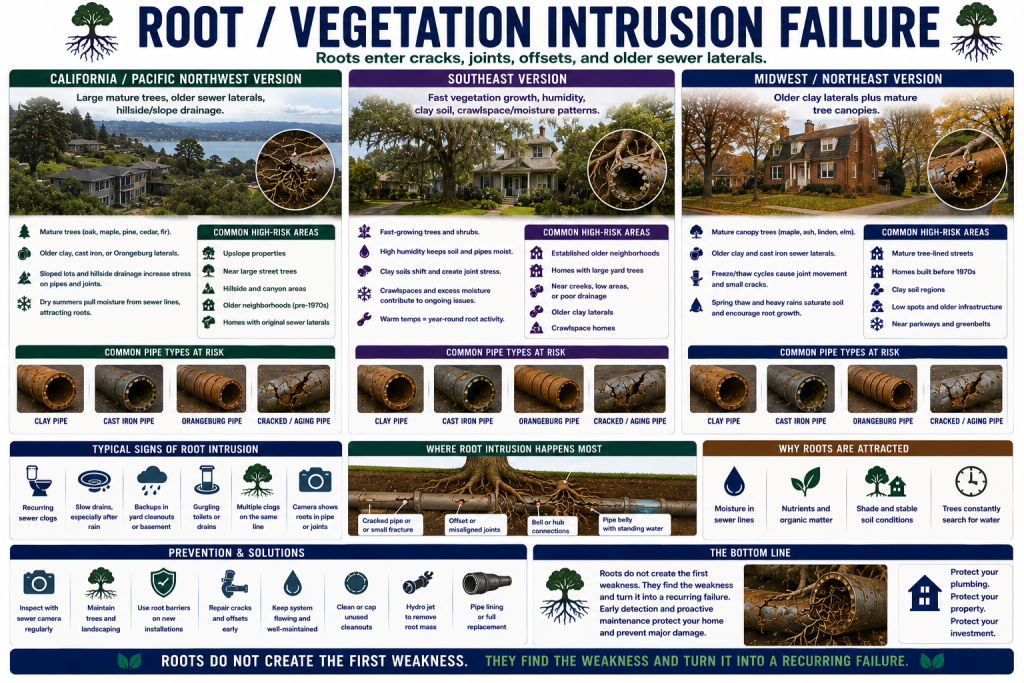
Root / Vegetation Intrusion Failure occurs when tree roots, vegetation systems, and underground root networks infiltrate weakened plumbing systems searching for moisture, oxygen, and nutrients.
Roots rarely create the original plumbing weakness.
They usually exploit an existing one.
Small cracks.
Separated joints.
Old clay connections.
Corroded cast iron.
Loose fittings.
Minor underground leaks.
Once roots locate moisture escaping from the plumbing system, they begin expanding into the pipe interior.
As the roots grow, blockage pressure increases and the plumbing system gradually loses hydraulic flow capacity.
The visible sewer backup is often the final stage of long-term underground intrusion.
How Roots Attack Plumbing
Root-related plumbing failures develop slowly over time.
The plumbing system may continue functioning while underground intrusion quietly expands.
Root / Vegetation Intrusion conditions include:
- tree-root intrusion
- mature vegetation pressure
- clay sewer separation
- cast iron cracking
- leaking sewer joints
- trench settlement
- underground moisture attraction
- root expansion inside pipes
- sewer-joint instability
- aging sewer laterals
- drainage-path migration
- drought-driven root expansion
- moisture-seeking root growth
- landscape-root pressure
Roots affect:
- sewer laterals
- underground drains
- cleanouts
- cast iron systems
- clay sewer systems
- aging PVC joints
- septic connections
- storm-drain interfaces
- underground support stability
The plumbing system may continue draining while root mass quietly expands inside the pipe.
Why This Failure Family Matters
Most homeowners think roots crush plumbing systems from the outside.
In most cases, roots enter through plumbing weaknesses that already existed.
This is why older sewer systems repeatedly experience:
- recurring backups
- root cutting cycles
- slow drains
- sewer odor
- underground settlement
- wet yard areas
- drain instability
- recurring excavation
The roots are often revealing a larger infrastructure problem already developing underground.
Older clay and cast iron systems are especially vulnerable because separated joints and aging materials create easier entry points for roots over time.
Strong Root / Vegetation Intrusion States
California
Oregon
Washington
Georgia
Tennessee
Florida
Ohio
Illinois
Pennsylvania
North Carolina
South Carolina
Virginia
New Jersey
Michigan
Missouri
California Version
California root intrusion failures frequently combine:
- mature landscaping
- older clay sewer laterals
- drought cycles
- hillside movement
- aging urban infrastructure
- remodel layering
Roots aggressively seek moisture during dry periods, especially in older sewer systems with separated joints.

Pacific Northwest Version
Oregon and Washington combine mature vegetation, heavy rainfall, older sewer infrastructure, and root-heavy environments.
Long-duration moisture exposure often accelerates underground root expansion.
Southeast Version
Georgia, Tennessee, North Carolina, and surrounding Southeast regions combine mature trees, humidity, clay movement, crawlspaces, and aging sewer systems.
Root intrusion frequently layers onto already stressed underground infrastructure.
Midwest Version
Illinois, Ohio, Michigan, and surrounding Midwest states combine mature urban tree systems, freeze cycles, aging clay laterals, and older cast iron systems.
Seasonal movement often weakens sewer joints before roots enter the system.
Florida Version
Florida combines aggressive vegetation growth, saturation, sandy instability, slab systems, and aging sewer infrastructure.
Roots often exploit underground movement and moisture-heavy conditions simultaneously.
Failure Signature
Common Root / Vegetation Intrusion symptoms include:
- recurring sewer backups
- slow drains
- recurring root cutting
- sewer odor
- wet yard areas
- lush grass patches
- cleanout overflow
- drain gurgling
- intermittent backups
- sewer bellies
- underground pipe separation
- recurring clogs after cleaning
- root masses inside drains
- recurring excavation areas
Tree roots are among the most common causes of sewer blockages in older systems.
Failure Timeline
Stage 1 — Plumbing Weakness
The plumbing system develops an underground vulnerability.
Examples:
- loose joints
- cracked clay pipe
- cast iron deterioration
- sewer separation
- minor underground leaks
No visible root intrusion exists yet.
Stage 2 — Root Detection
Roots locate moisture escaping from the plumbing system.
Examples:
- vapor release
- leaking joints
- groundwater attraction
- nutrient exposure
Small roots begin entering the system.
Stage 3 — Intrusion Expansion
The root system expands inside the plumbing network.
Examples:
- flow restriction
- root mass accumulation
- drain slowing
- partial blockage
- sewer instability
Stage 4 — Recurring Failure
Repairs occur.
The root pressure remains active.
Examples:
“The roots came back again.”
“The sewer backed up again.”
“We already cut roots out of this line.”
Stage 5 — Damage Event
The intrusion becomes visible structural plumbing failure.
Examples:
- sewer collapse
- major blockage
- underground separation
- recurring sewage backup
- excavation conditions
- full sewer replacement
Foundation Interaction
Root intrusion affects different foundation systems differently.
Slab-on-Grade Homes
Most vulnerable to:
- hidden sewer intrusion
- under-slab root expansion
- difficult detection
Crawlspace Homes
Most vulnerable to:
- exposed drain instability
- support movement
- vegetation-adjacent intrusion
Basement Homes
Most vulnerable to:
- sewer lateral intrusion
- old-stack interaction
- mature-tree pressure
Hillside Homes
Most vulnerable to:
- slope-root interaction
- shifting sewer alignment
- long-run instability
Pipe Material Interaction
Roots affect plumbing materials differently.
Clay Sewer
Most vulnerable to:
- separated joints
- root penetration
- offset connections
- collapse after intrusion
Cast Iron
Most vulnerable to:
- corrosion openings
- cracking
- joint instability
- long-term deterioration
Orangeburg Pipe
Most vulnerable to:
- deformation
- crushing
- root penetration
- saturation-related collapse
PVC / ABS
Most vulnerable to:
- poor joints
- separation
- improper installation
- unsupported movement
Modern properly installed PVC systems are generally far more resistant to root intrusion than older clay or cast iron systems.
Detection Difficulty Score
Root intrusion failures are often difficult to detect because the plumbing system may continue partially functioning while blockage pressure increases underground.
Easy to Detect:
- recurring backups
- root masses
- lush grass patches
- cleanout overflow
Medium Detection:
- recurring slow drains
- sewer odor
- partial blockage
- isolated wet areas
Hard to Detect:
- early-stage intrusion
- underground joint separation
- hidden root expansion
- long-run sewer instability
Most Vulnerable Homes
- older homes
- homes with clay sewer laterals
- mature-tree properties
- heavily landscaped homes
- aging sewer systems
- homes with recurring drain problems
- hillside properties
- older urban neighborhoods
- homes with large-root tree species nearby
Failure Visibility
Root / Vegetation Intrusion Failures often remain hidden because the plumbing system may continue partially draining while underground blockage pressure increases.
Many homeowners only recognize the pattern after repeated backups begin occurring.
The visible sewer problem is often the final stage of long-term underground intrusion.
Homeowner Translation
The plumbing system may not be failing because roots suddenly attacked the pipe.
The underground plumbing system may have already developed weaknesses that roots slowly exploited over time.
Contractor Translation
Root / Vegetation Intrusion Failures occur when underground vegetation systems exploit weakened plumbing joints, cracked sewer materials, separated connections, or aging infrastructure conditions to access moisture and expand inside the drainage network.
The visible sewer backup is often the final stage of long-term underground intrusion and infrastructure deterioration.
Final Positioning Line
Root-intrusion plumbing failures usually begin long before the first major sewer backup appears. Underground vegetation quietly expands into weakened plumbing systems until years of hidden intrusion finally become visible blockage and structural sewer damage.