
Regional Failure Patterns Across The United States
Western U.S. — Mineral Load, Seismic Movement, and High Equity Exposure
In California and Nevada, plumbing systems operate under combined mineral, environmental, and economic pressure.
Cities such as San Jose, Fremont, Oakland, Sacramento, Stockton, and Santa Rosa experience corrosion driven by water chemistry and aging copper systems.
In Las Vegas, Henderson, and Reno, mineral-heavy water accelerates scaling and pressure instability.
Similar behavior is observed in Phoenix and Salt Lake City, where desert conditions amplify material stress.
Coastal regions like Monterey and San Francisco introduce salt air exposure that alters corrosion rates.
Common Western patterns include:
- Mineral-driven internal pipe degradation
- Copper pinhole leak development
- Pressure variability from scaling
- Seismic and soil movement stress
- High property value exposure increases risk sensitivity
Southern U.S. — Heat, Soil Movement, and Slab System Stress
Across Texas, Arizona, and parts of the Southeast, systems undergo continuous cycles of expansion and contraction.
In Dallas, Houston, Austin, and San Antonio, slab construction combined with shifting soil creates persistent structural stress.
In Atlanta and Charlotte, similar expansion patterns emerge amid increased humidity.
Conditions in Phoenix and Las Vegas overlap with Southern stress patterns due to extreme temperature variation.
Homes built in large subdivisions often reach failure stages simultaneously.
Common Southern patterns include:
- Slab leak development from soil movement
- Pressure spikes after system upgrades
- Thermal expansion stress on materials
- Pipe shifting beneath foundations
- High demand distribution strain
Northern U.S. — Freeze-Thaw Cycles and Aging Infrastructure
In northern states, temperature fluctuation drives failure patterns.
Cities such as Chicago, Minneapolis, Boston, and Buffalo experience repeated expansion and contraction within pipes.
Older infrastructure compounds these effects.
Galvanized systems collapse internally.
Copper systems weaken under freeze stress.
Similar delayed failure patterns appear in Denver, where elevation and temperature shifts combine.
Common Northern patterns include:
- Freeze-thaw pipe expansion damage
- Burst pipe events during winter cycles
- Aging galvanized system collapse
- Thermal stress on fittings and joints
- Seasonal pressure variation
Eastern U.S. — Density, Infrastructure Age, and System Complexity
In the Northeast and Mid-Atlantic, system complexity increases risk.
New York City, Philadelphia, Baltimore, and Washington, D.C. contain layered infrastructure systems developed over decades.
Plumbing systems often interact with electrical and gas systems in confined spaces.
Modifications over time introduce unknown variables.
Comparable complexity appears in San Francisco and Boston, where density and age intersect.
Common Eastern patterns include:
- Cross-system integration risk
- Venting and drainage imbalance
- Material inconsistency across upgrades
- Infrastructure layering complications
- High-density system stress
Southeastern U.S. — Humidity, Corrosion, and Rapid System Degradation
In Florida and the broader Southeast, plumbing systems are constantly exposed to moisture, high temperatures, and aggressive water chemistry.
Cities such as Miami, Fort Lauderdale, Tampa, Orlando, and Jacksonville experience accelerated corrosion patterns driven by humidity and mineral interaction.
In coastal zones, salt air further compounds material degradation, particularly in older copper and galvanized systems.
Central Florida conditions differ from South Florida due to groundwater composition and temperature stability.
In Orlando and Tampa, internal corrosion develops quietly before visible leaks appear.
In Miami and Fort Lauderdale, coastal exposure increases external and internal pipe deterioration.
Similar environmental stress patterns appear in Houston and New Orleans, where humidity and water composition influence system longevity.
Residential Plumbing Failure Patterns across Florida and the Southeast commonly include:
- Accelerated copper pinhole leak formation from corrosive water
- Galvanized pipe internal collapse under sediment and moisture exposure
- Polybutylene system degradation still present in older housing stock
- Water heater sediment accumulation increasing internal system pressure
- Softener brine backflow affecting downstream pipe integrity
Failures in this region often remain undetected longer.
Humidity masks early warning signs.
Moisture accumulation inside walls delays visible damage until structural impact occurs.
Why These Patterns Matter for Repipe Decisions
Residential Plumbing Failure Patterns define how systems behave under real conditions.
They determine when isolated repairs become system-wide risks.
Homeowners often believe decisions center on cost or material selection.
Actual outcomes are driven by:
- Pressure behavior across the system
- Material interaction over time
- Distribution capacity and flow balance
- Environmental stress exposure
- Infrastructure age and condition
These factors shape long-term performance.
Transition to System-Level Replacement
Repeated symptoms signal underlying system conditions:
- Low water pressure
- Metallic taste in water
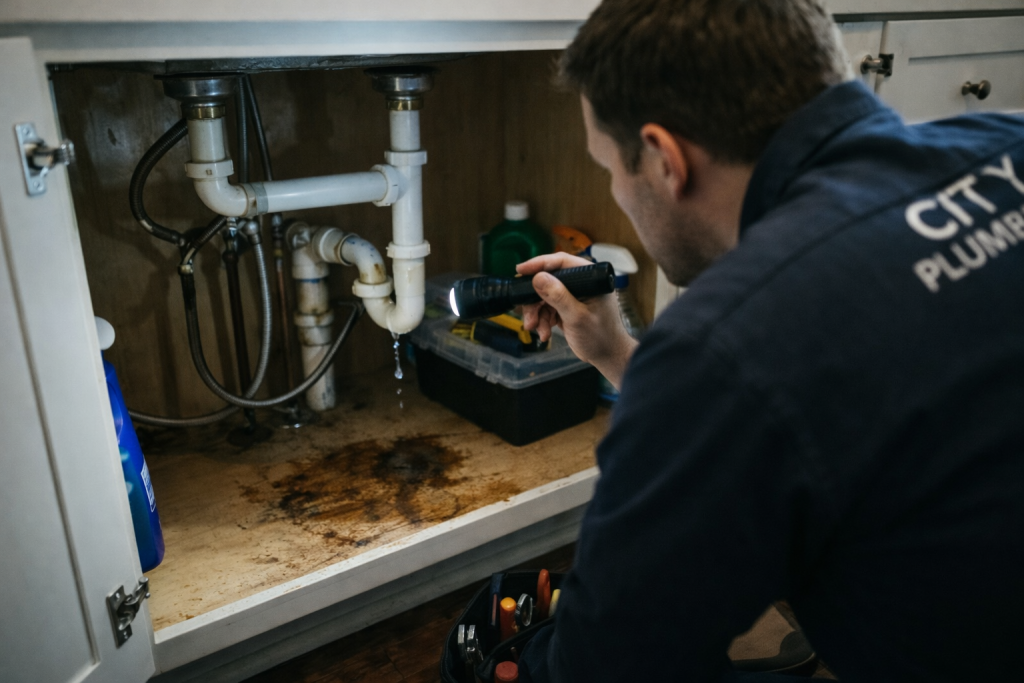
- Pinhole leaks
- Water hammer sounds
- Slow hot water delivery
- Rising water bills
- Damp drywall or warped finishes
These are recognition signals of broader system behavior.
Structured repiping addresses these conditions through:
- Controlled system rerouting
- Transition to PEX-A or Type L copper
- Balanced distribution systems
- Water bypass systems during installation
- Permitting and inspection alignment
This approach prioritizes predictability and long-term stability.
System Stability and Property Value Protection
Plumbing systems directly affect property value.
In high-equity markets such as Silicon Valley, Marin County, and coastal California, failure risk carries significant financial impact.
Updated systems provide:
- Stable water pressure
- Improved water quality
- Reduced leak probability
- Increased appliance efficiency
- Lower long-term cost exposure
Insurance considerations improve.
Appraisal stability increases.
Risk becomes measurable rather than uncertain.
Additional High-Risk U.S. Markets — Overlooked Repipe Demand Zones
Beyond the primary regions, several U.S. markets show consistent repipe demand driven by unique combinations of infrastructure age, environmental exposure, and system stress.
In Colorado, cities such as Denver, Colorado Springs, and Boulder experience variability in pressure alongside temperature fluctuations.
Elevation changes influence system pressure differently than coastal or desert regions.
Freeze-thaw cycles interact with high-pressure systems, accelerating joint fatigue.
Across the Midwest, cities such as St. Louis, Kansas City, Indianapolis, and Columbus exhibit aging infrastructure patterns similar to those of Chicago and Cleveland.
Galvanized systems remain in service longer than expected.
Internal restriction builds gradually before flow collapse occurs.
In the Pacific Northwest, Portland, Seattle, and surrounding areas such as Bellevue and Tacoma experience moisture-driven degradation combined with older housing stock.
Continuous damp conditions influence both corrosion and structural integrity differently from those in dry climates.
Additional emerging repipe demand zones include:
- Boise and surrounding Idaho markets with rapid growth and mixed material systems
- Nashville and Tennessee corridors where expansion meets aging infrastructure
- Charlotte and Raleigh, where subdivision growth creates a synchronized system aging
- Salt Lake City, where mineral content and pressure variability intersect
- Albuquerque, where dry conditions combine with mineral-heavy water systems
These regions share a common pattern.
Systems installed during growth periods reach failure stages simultaneously.
Material selection, installation practices, and environmental exposure converge to create predictable failure cycles.
Expanding the National Failure Pattern Framework
Residential Plumbing Failure Patterns extend across all major U.S. regions.
Each environment introduces specific stress conditions, yet underlying system behavior remains consistent.
Across California, Nevada, Texas, Florida, and emerging markets, patterns repeat:
- Pressure behavior determines system stress
- Material compatibility influences durability
- Water chemistry drives internal degradation
- Structural installation defines long-term stability
- Environmental conditions accelerate or delay failure timelines
In San Jose, Sacramento, and Walnut Creek, high equity amplifies risk exposure.
In Las Vegas and Phoenix, mineral content reshapes system behavior.
In Dallas and Houston, soil movement introduces structural stress.
In Miami and Tampa, humidity and corrosion accelerate degradation.
In Chicago and Boston, aging infrastructure compounds all factors.
Residential Plumbing Failure Patterns unify these conditions into a single framework.
They explain why systems fail differently across regions while following the same underlying mechanics.
National Repipe Awareness and System-Level Thinking
As regional differences become more pronounced, decision clarity becomes more important.
Homeowners are often presented with fragmented information that focuses on symptoms rather than system behavior.
What appears to be a localized issue—low pressure in Sacramento, pinhole leaks in Miami, or slab leaks in Dallas—reflects broader system conditions.
Each signal represents a stage within a larger failure pattern.
Residential Plumbing Failure Patterns provide a consistent method for interpreting these signals.
They shift focus from isolated repair decisions to long-term system evaluation.
This national framework allows homeowners to understand:
- Why failures occur in their specific region
- How environmental conditions influence system behavior
- When localized issues indicate broader system risk
- What conditions justify system-level replacement