
Frost Heave / Deep Freeze Failure
Definition
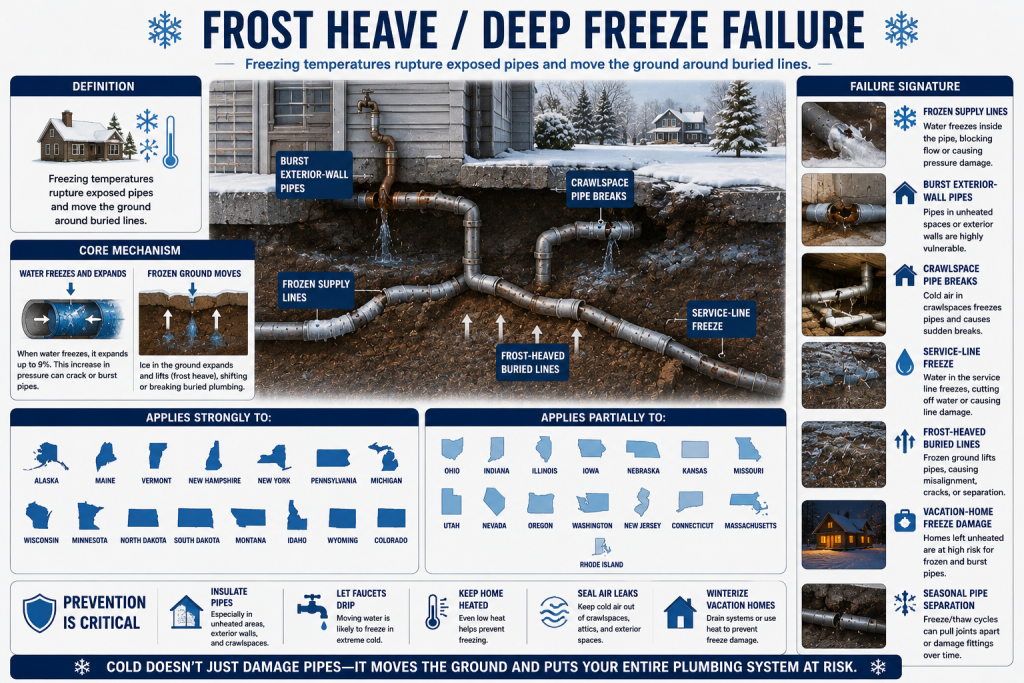
Frost Heave / Deep Freeze Failure occurs when freezing temperatures and frozen ground place pressure on plumbing systems from both inside and outside the pipe.
Water expands as it freezes.
That expansion creates extreme internal pressure inside supply lines, fittings, valves, fixtures, and appliances.
At the same time, frozen soil expands around buried plumbing systems and changes underground support conditions.
The plumbing system experiences pressure from multiple directions simultaneously.
The visible pipe break is often the final stage of long-term freeze exposure.
How Deep Freeze Attacks Plumbing
Freeze-related plumbing stress develops through repeated cold exposure and environmental loading.
The system may initially survive seasonal winter conditions.
Over time, repeated freeze cycles weaken vulnerable areas.
Deep Freeze Failure conditions include:
- frozen supply lines
- frost heave
- deep frost penetration
- freeze/thaw cycling
- frozen crawlspaces
- exposed piping
- attic freeze exposure
- buried service-line freezing
- intermittent heating
- snowmelt saturation
- permafrost movement
- long-duration cold exposure
- rural system exposure
- heat-trace dependence
The plumbing system may continue functioning while hidden freeze stress quietly accumulates each winter.
Why This Failure Family Matters
Most homeowners think frozen pipes are sudden accidents.
Many freeze failures develop because the plumbing system was repeatedly exposed to environmental stress long before visible rupture occurred.
This is why the same areas often freeze repeatedly.
The environmental exposure remains active.
The pipe may thaw and survive temporarily.
The underlying vulnerability usually remains.
Freeze-related plumbing failures also extend far beyond burst pipes.
Cold exposure affects:
- underground support conditions
- drain alignment
- crawlspace systems
- pressure behavior
- water heaters
- exterior fixtures
- well systems
- septic interaction
- long-run plumbing stability
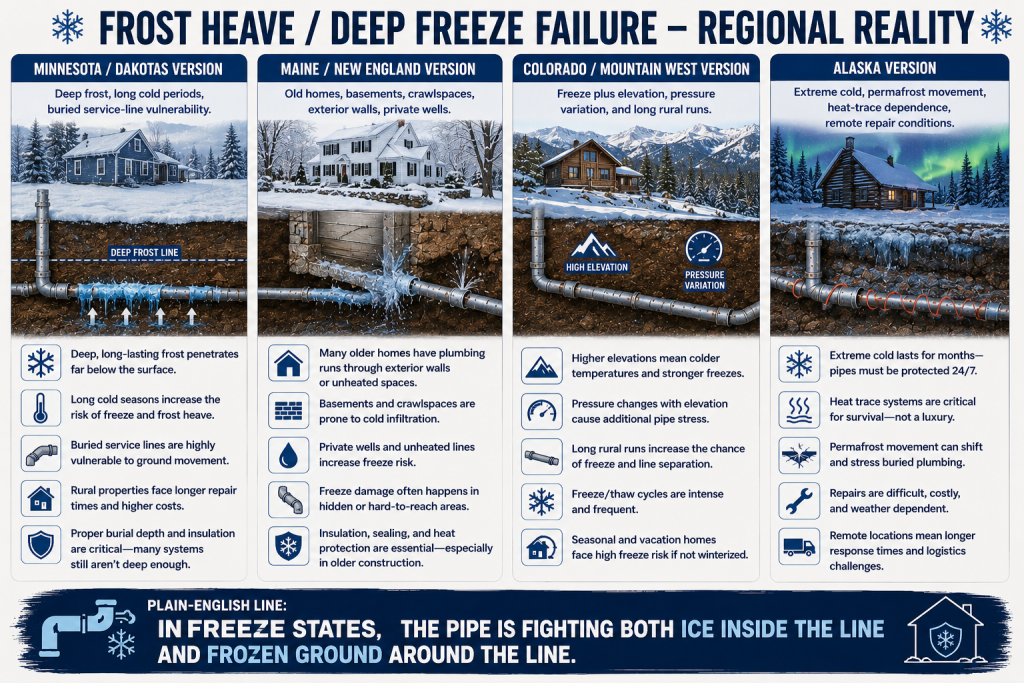
Strong Frost Heave / Deep Freeze States
Alaska
Maine
Vermont
New Hampshire
New York
Pennsylvania
Michigan
Wisconsin
Minnesota
North Dakota
South Dakota
Montana
Idaho
Wyoming
Colorado
Minnesota / Dakotas Version
Deep frost penetration, extended winter exposure, and long-duration freezing create extreme underground pressure conditions.
Buried service lines and exposed rural plumbing systems are especially vulnerable.
Freeze depth itself becomes a major environmental force.
Maine / New England Version
Older homes, basements, crawlspaces, private wells, aging infrastructure, and rural exposure create layered freeze risk across many New England regions.
Many systems were built decades before modern insulation and freeze-protection standards existed.
Colorado / Mountain West Version
Colorado combines freeze pressure, elevation variation, long underground runs, snowmelt saturation, and large temperature swings.
The plumbing system may experience repeated freeze/thaw loading throughout the same season.
Alaska Version
Alaska plumbing systems often operate inside extreme survival environments.
Permafrost movement, remote infrastructure exposure, heat-trace dependence, buried-line vulnerability, and long-duration subzero temperatures create some of the harshest plumbing conditions in the country.
Great Lakes / Midwest Version
Michigan, Wisconsin, and surrounding northern states frequently combine freeze exposure with aging infrastructure, mature housing stock, basements, and older service lines.
Winter stress often layers onto already aging plumbing systems.
Failure Signature
Common Frost Heave / Deep Freeze symptoms include:
- burst pipes
- frozen supply lines
- frozen service lines
- crawlspace freeze damage
- outdoor fixture cracking
- seasonal pipe separation
- frozen drains
- pressure irregularities
- recurring winter leaks
- attic pipe failure
- foundation-adjacent freeze damage
- underground line movement
- recurring winter water loss
- snowmelt-related sewer instability
Failure Timeline
Stage 1 — Environmental Cold Exposure
The plumbing system begins experiencing prolonged cold stress.
Examples:
- deep freeze
- frost penetration
- exposed crawlspaces
- attic exposure
- snow accumulation
- intermittent heating
No visible plumbing failure exists yet.
Stage 2 — Freeze Stress
The plumbing system begins absorbing internal and external pressure.
Examples:
- water expansion
- pipe contraction
- frost-heave movement
- underground loading
- insulation failure
- frozen valves
Stage 3 — Symptom Phase
The homeowner notices winter-related plumbing behavior changes.
Examples:
- reduced winter flow
- frozen fixtures
- inconsistent water pressure
- pipe noises
- slow winter drains
- cold-zone plumbing instability
Stage 4 — Recurring Failure
Repairs occur.
The freeze exposure remains active.
Examples:
“The same pipe froze again.”
“The crawlspace line burst again.”
“The service line keeps freezing during winter.”
Stage 5 — Damage Event
The freeze-related stress becomes visible plumbing failure.
Examples:
- burst pipe
- basement flooding
- underground service-line rupture
- frozen drain collapse
- crawlspace flooding
- major winter water damage
- repeated seasonal plumbing loss
Foundation Interaction
Freeze conditions affect different foundation systems differently.
Crawlspace Homes
Most vulnerable to:
- exposed pipe freezing
- support movement
- cold-air exposure
- insulation failure
Basement Homes
Most vulnerable to:
- frozen foundation penetrations
- old drain stack stress
- freeze-related seepage interaction
Slab-on-Grade Homes
Most vulnerable to:
- slab-edge freeze stress
- underground line movement
- frozen shallow runs
Rural / Long-Run Systems
Most vulnerable to:
- buried service-line freezing
- well-system instability
- septic interaction
- snowmelt loading
Pipe Material Interaction
Freeze exposure affects plumbing materials differently.
Copper
Most vulnerable to:
- freeze expansion rupture
- repeated contraction stress
- solder-joint failure
CPVC
Most vulnerable to:
- brittleness during cold exposure
- cracking under freeze pressure
PEX
Most vulnerable to:
- poor installation
- unsupported expansion movement
- freeze-install mistakes
Cast Iron
Most vulnerable to:
- freeze-related cracking
- underground stress loading
Detection Difficulty Score
Some freeze failures appear suddenly.
Others develop slowly through repeated winter exposure.
Easy to Detect:
- burst pipe
- frozen fixture
- visible freeze flooding
Medium Detection:
- recurring winter pressure changes
- crawlspace freeze exposure
- shallow-line instability
Hard to Detect:
- frost-heave movement
- underground freeze loading
- hidden seasonal stress
- long-term buried-line instability
Most Vulnerable Homes
- older homes
- vacation homes
- crawlspace homes
- rural properties
- mountain homes
- homes with exposed piping
- poorly insulated systems
- homes with intermittent heating
- long underground service runs
- older basement systems
Failure Visibility
Freeze-related failures are often highly visible once rupture occurs.
But the environmental stress usually develops long before the visible burst pipe appears.
Many systems survive multiple freeze cycles before finally failing during one extreme weather event.
The visible plumbing emergency is often the final stage of repeated seasonal stress.
Homeowner Translation
The plumbing system may not be failing because of one isolated winter event.
The system may have been slowly weakened by repeated freeze exposure for years.
Contractor Translation
Frost Heave / Deep Freeze failures occur when internal freeze expansion, frost-related ground movement, cold exposure, and seasonal thermal loading alter plumbing stability, pressure behavior, and structural integrity across the system.
The visible plumbing failure is often the final stage of repeated environmental freeze stress.
Final Positioning Line
Freeze-related plumbing failures usually begin long before the pipe bursts. Winter exposure quietly loads the system season after season until one extreme event finally turns hidden stress into visible damage.