
Home Failure Intelligence
The American Plumbing Failure Pattern Index

Core idea:
Plumbing does not fail randomly. It fails when local soil, water, weather, construction era, and household demand repeatedly attack the same weak points.
The real system is not “common plumbing problems.”
The real system is:
Every state has a failure stack.
A failure stack is the combination of forces that repeatedly create plumbing problems in that state.
The 5 National Forces
1. Ground Force
How the earth attacks plumbing.

Includes:
- expansive clay
- slab movement
- frost heave
- hillside creep
- karst/sinkhole movement
- erosion
- seismic movement
- permafrost movement
- settlement
- subsidence
- poor fill
- rocky trenching stress
This force explains why Texas, Florida, Colorado, California, Tennessee, Kentucky, Missouri, Pennsylvania, Alaska, and Hawaii can all have ground-related plumbing failures — but for completely different reasons.
2. Water Chemistry Force
How water attacks pipes from inside.
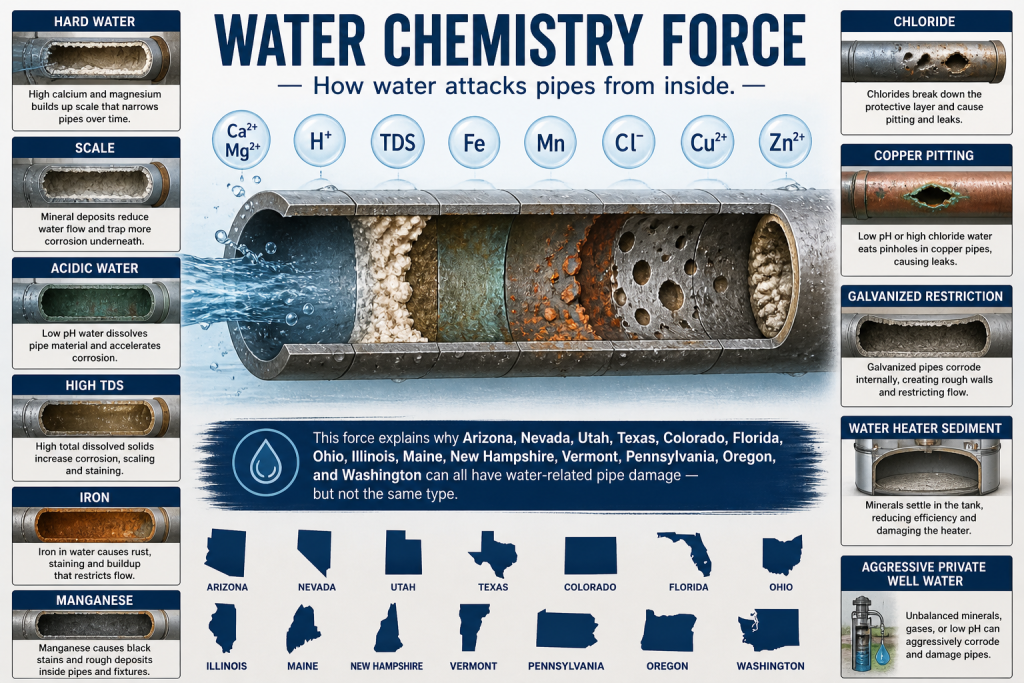
Includes:
- hard water
- scale
- acidic water
- high TDS
- iron
- manganese
- chloride
- copper pitting
- galvanized restriction
- water heater sediment
- aggressive private well water
This force explains why Arizona, Nevada, Utah, Texas, Colorado, Florida, Ohio, Illinois, Maine, New Hampshire, Vermont, Pennsylvania, Oregon, and Washington can all have water-related pipe damage — but not the same type.
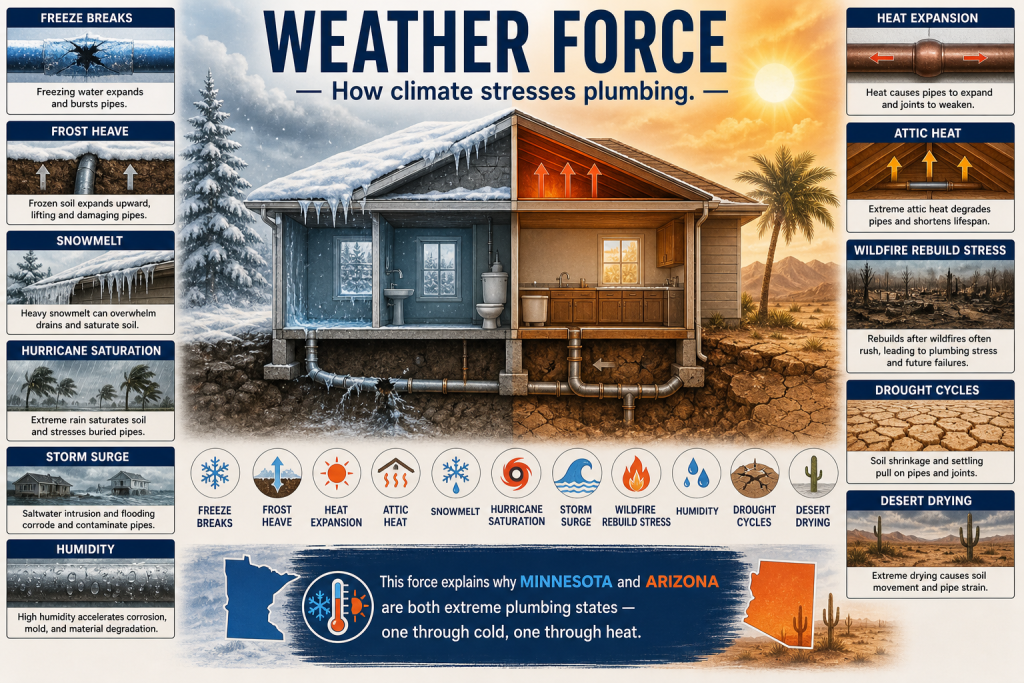
3. Weather Force
How climate stresses plumbing.
Includes:
- freeze breaks
- frost heave
- heat expansion
- attic heat
- snowmelt
- hurricane saturation
- storm surge
- wildfire rebuild stress
- humidity
- drought cycles
- desert drying
This force explains why Minnesota and Arizona are both extreme plumbing states — one through cold, one through heat.
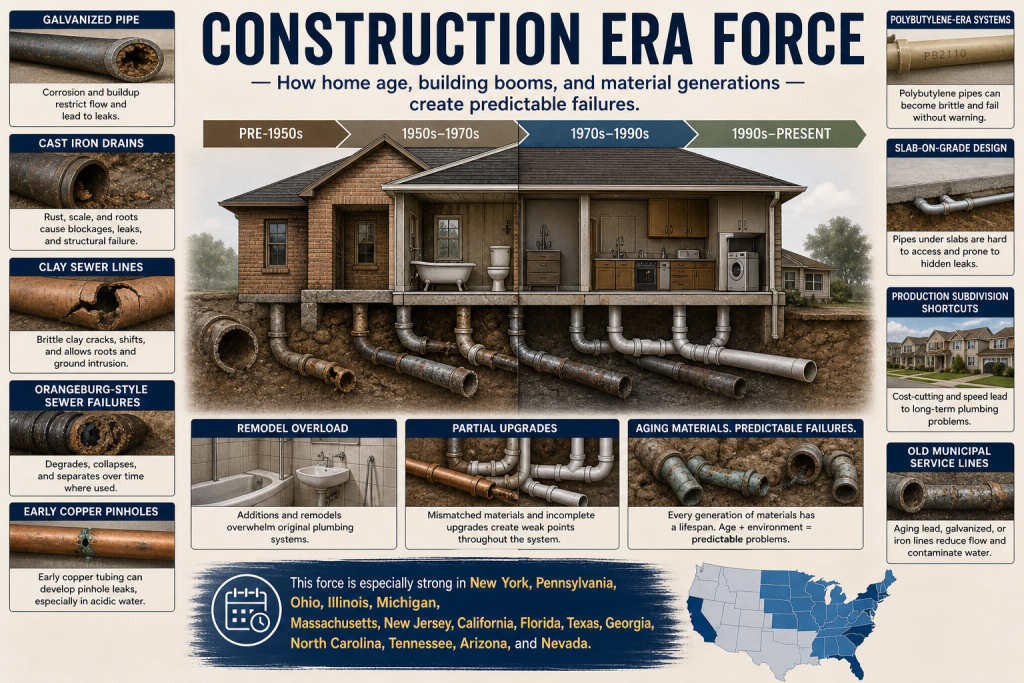
4. Construction Era Force
How home age, building booms, and material generations create predictable failures.
Includes:
- galvanized pipe
- cast iron drains
- clay sewer lines
- Orangeburg-style sewer failures where present
- early copper pinholes
- polybutylene-era systems
- slab-on-grade design
- production subdivision shortcuts
- old municipal service lines
- remodel overload
- partial upgrades
This force is especially strong in New York, Pennsylvania, Ohio, Illinois, Michigan, Massachusetts, New Jersey, California, Florida, Texas, Georgia, North Carolina, Tennessee, Arizona, and Nevada.
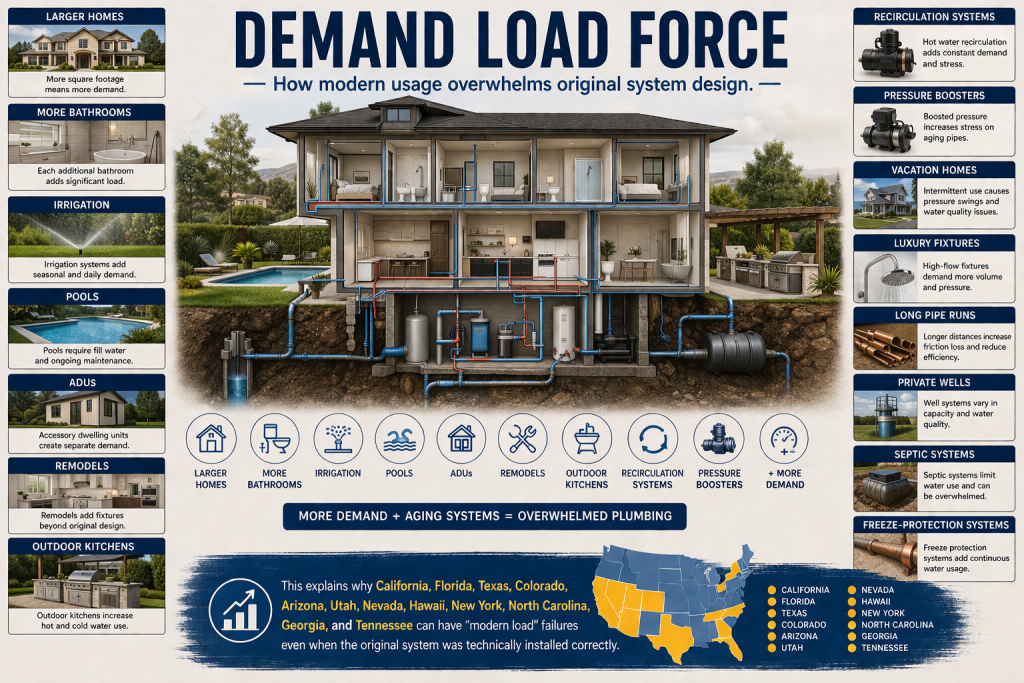
5. Demand Load Force
How modern usage overwhelms original system design.
Includes:
- larger homes
- more bathrooms
- irrigation
- pools
- ADUs
- remodels
- outdoor kitchens
- recirculation systems
- pressure boosters
- vacation homes
- luxury fixtures
- long pipe runs
- private wells
- septic systems
- freeze-protection systems
This explains why California, Florida, Texas, Colorado, Arizona, Utah, Nevada, Hawaii, New York, North Carolina, Georgia, and Tennessee can have “modern load” failures even when the original system was technically installed correctly.
The 13 National Plumbing Failure Families
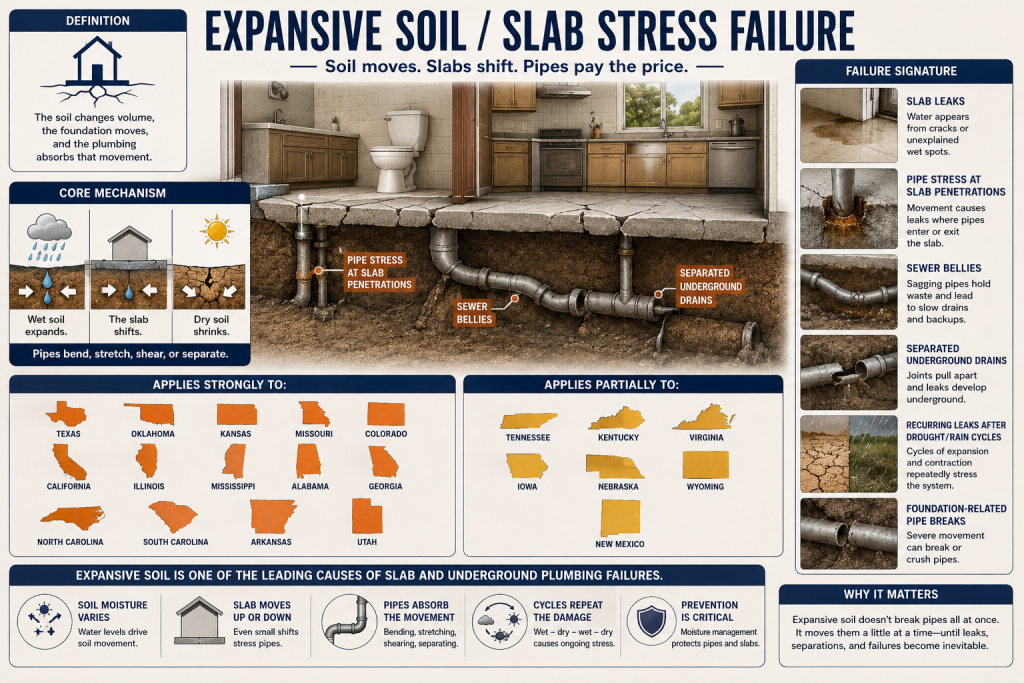
1. Expansive Soil / Slab Stress Failure
Definition:
The soil changes volume, the foundation moves, and the plumbing absorbs that movement.
Core mechanism:
Wet soil expands. Dry soil shrinks. The slab shifts. Pipes bend, stretch, shear, or separate.
Applies strongly to:
Texas, Oklahoma, Kansas, Missouri, Colorado, California, Illinois, Mississippi, Alabama, Georgia, North Carolina, South Carolina, Arkansas, Utah.
Applies partially to:
Tennessee, Kentucky, Virginia, Iowa, Nebraska, Wyoming, New Mexico.
Failure signature:
- slab leaks
- pipe stress at slab penetrations
- sewer bellies
- separated underground drains
- recurring leaks after drought/rain cycles
- foundation-related pipe breaks
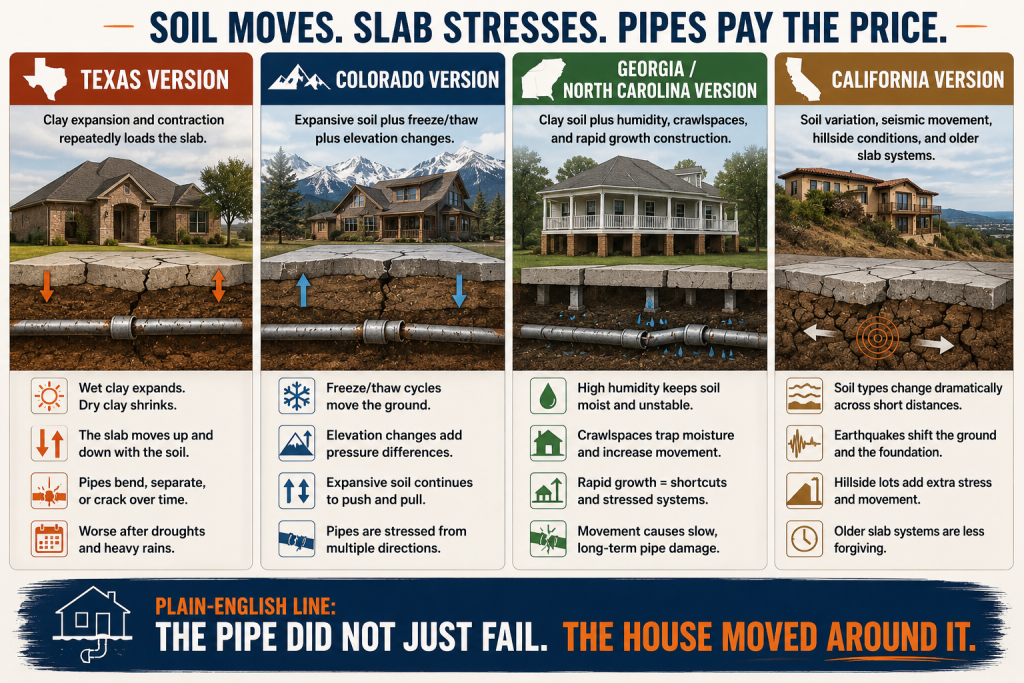
Texas version:
Clay expansion and contraction repeatedly loads the slab.
Colorado version:
Expansive soil plus freeze/thaw plus elevation changes.
Georgia / North Carolina version:
Clay soil plus humidity, crawlspaces, and rapid growth construction.
California version:
Soil variation, seismic movement, hillside conditions, and older slab systems.
Plain-English:
The pipe did not just fail. The house moved around it.
2. Karst / Sinkhole / Subsurface Void Failure
Definition:
The ground beneath the home loses support because of limestone, voids, erosion, dissolving rock, sinkhole activity, or unstable subsurface conditions.
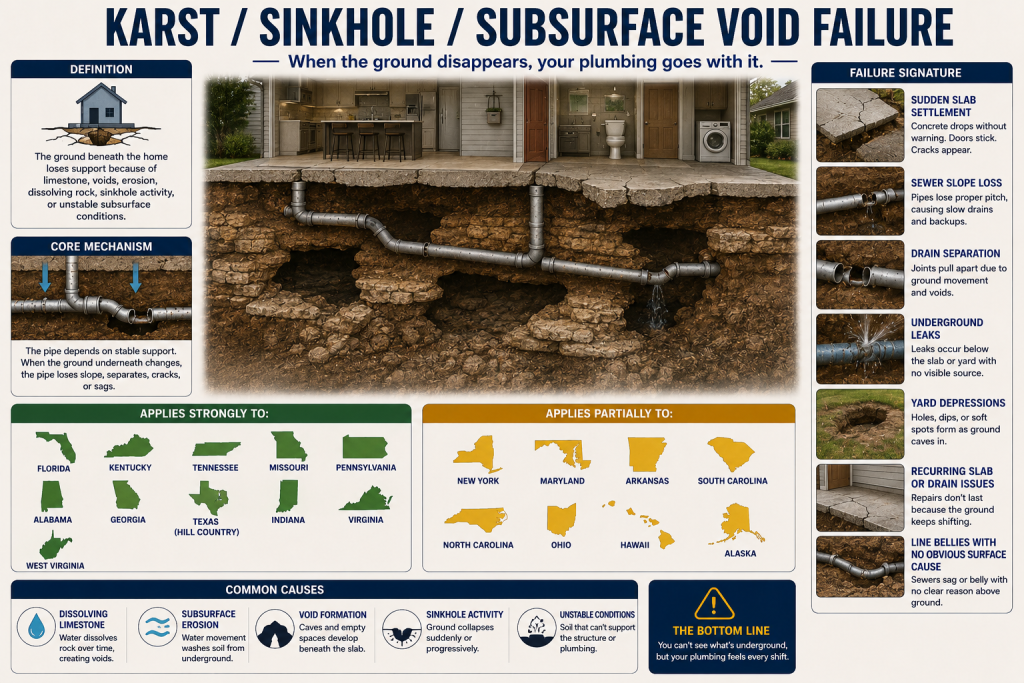
Core mechanism:
The pipe depends on stable support. When the ground underneath changes, the pipe loses slope, separates, cracks, or sags.
Applies strongly to:
Florida, Kentucky, Tennessee, Missouri, Pennsylvania, Alabama, Georgia, Texas Hill Country, Indiana, Virginia, West Virginia.
Applies partially to:
New York, Maryland, Arkansas, South Carolina, North Carolina, Ohio, Hawaii, Alaska.
Failure signature:
- sudden slab settlement
- sewer slope loss
- drain separation
- underground leaks
- yard depressions
- recurring slab or drain issues
- line bellies with no obvious surface cause
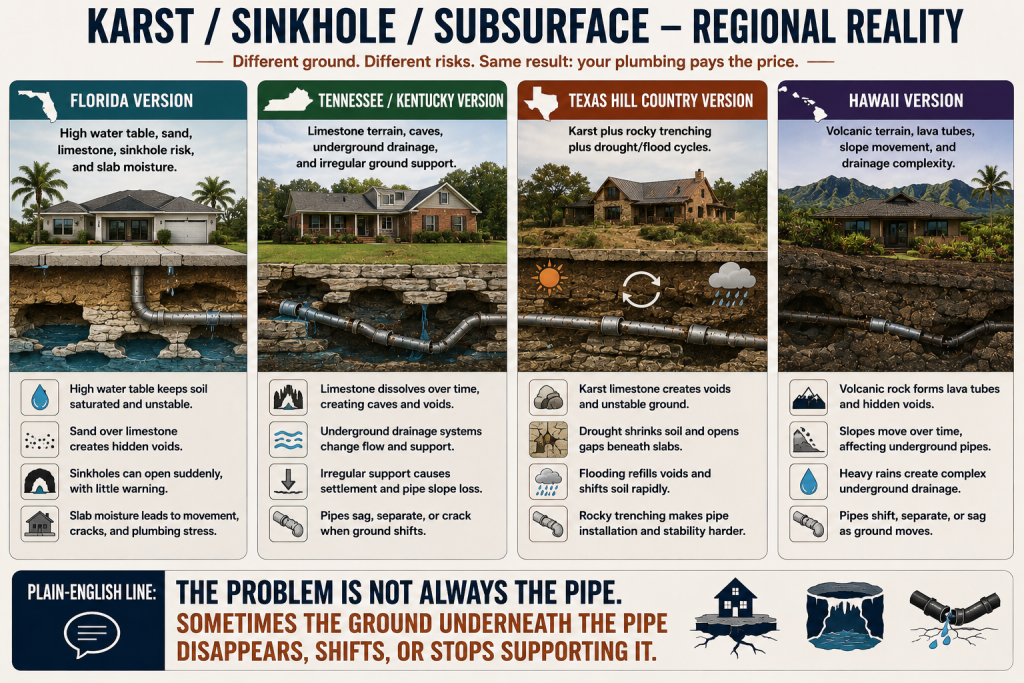
Florida version:
High water table, sand, limestone, sinkhole risk, and slab moisture.
Tennessee / Kentucky version:
Limestone terrain, caves, underground drainage, and irregular ground support.
Texas Hill Country version:
Karst plus rocky trenching plus drought/flood cycles.
Hawaii version:
Volcanic terrain, lava tubes, slope movement, and drainage complexity.
In Plain-English:
The problem is not always the pipe. Sometimes the ground underneath the pipe disappears, shifts, or stops supporting it.
3. Frost Heave / Deep Freeze Failure
Definition:
Freezing temperatures rupture exposed pipes and move the ground around buried lines.
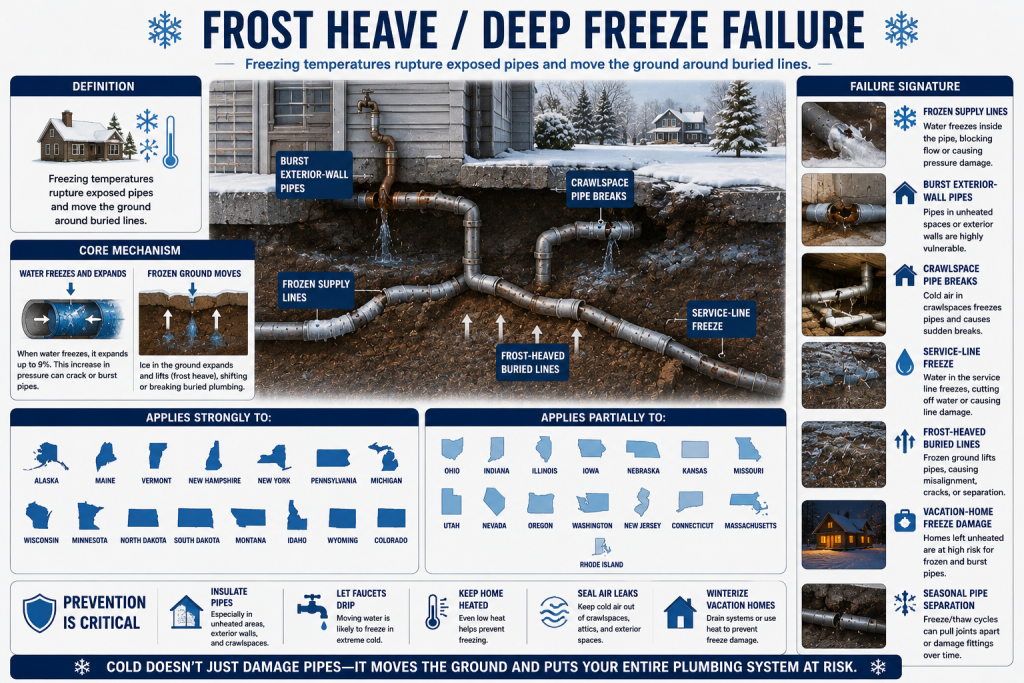
Core mechanism:
Water freezes, expands, and increases pressure inside pipes. Frozen ground can also lift and shift buried plumbing.
Applies strongly to:
Alaska, Maine, Vermont, New Hampshire, New York, Pennsylvania, Michigan, Wisconsin, Minnesota, North Dakota, South Dakota, Montana, Idaho, Wyoming, Colorado.
Applies partially to:
Ohio, Indiana, Illinois, Iowa, Nebraska, Kansas, Missouri, Utah, Nevada, Oregon, Washington, New Jersey, Connecticut, Massachusetts, Rhode Island.
Failure signature:
- frozen supply lines
- burst exterior-wall pipes
- crawlspace pipe breaks
- service-line freeze
- frost-heaved buried lines
- vacation-home freeze damage
- seasonal pipe separation
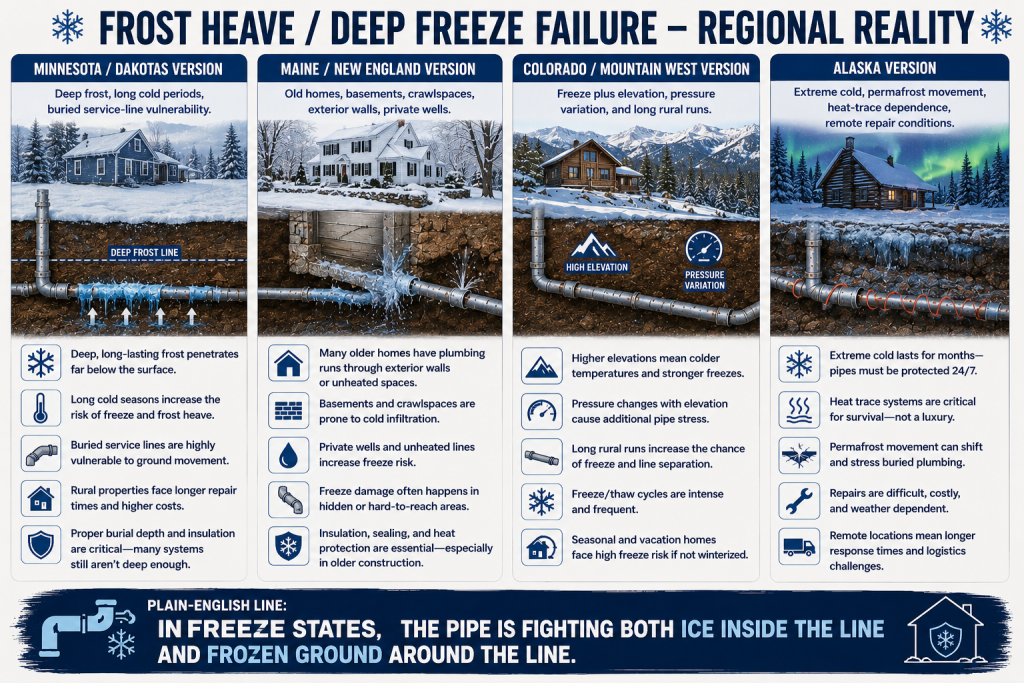
Minnesota / Dakotas version:
Deep frost, long cold periods, buried service-line vulnerability.
Maine / New England version:
Old homes, basements, crawlspaces, exterior walls, private wells.
Colorado / Mountain West version:
Freeze plus elevation, pressure variation, and long rural runs.
Alaska version:
Extreme cold, permafrost movement, heat-trace dependence, remote repair conditions.
Plain-English:
In freeze states, the pipe is fighting both ice inside the line and frozen ground around the line.
4. Heat / Thermal Expansion Failure
Definition:
Extreme heat and repeated temperature swings weaken plumbing systems over time.
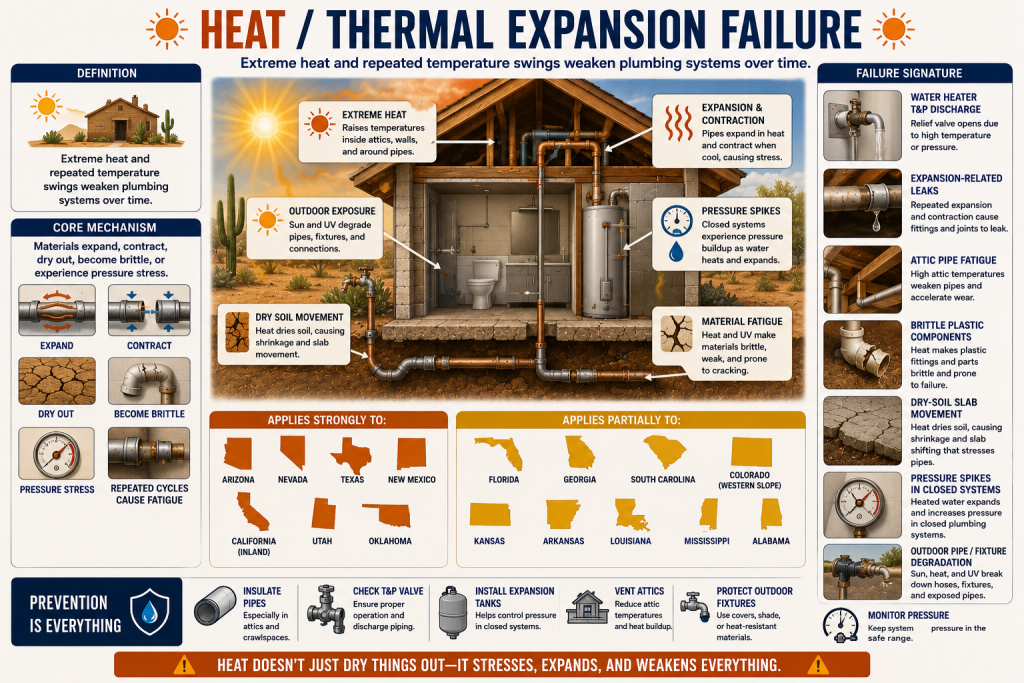
Core mechanism:
Materials expand, contract, dry out, become brittle, or experience pressure stress.
Applies strongly to:
Arizona, Nevada, Texas, New Mexico, California inland, Utah, Oklahoma.
Applies partially to:
Florida, Georgia, South Carolina, Colorado western slope, Kansas, Arkansas, Louisiana, Mississippi, Alabama.
Failure signature:
- water heater T&P discharge
- expansion-related leaks
- attic pipe fatigue
- brittle plastic components
- dry-soil slab movement
- pressure spikes in closed systems
- outdoor pipe/fixture degradation
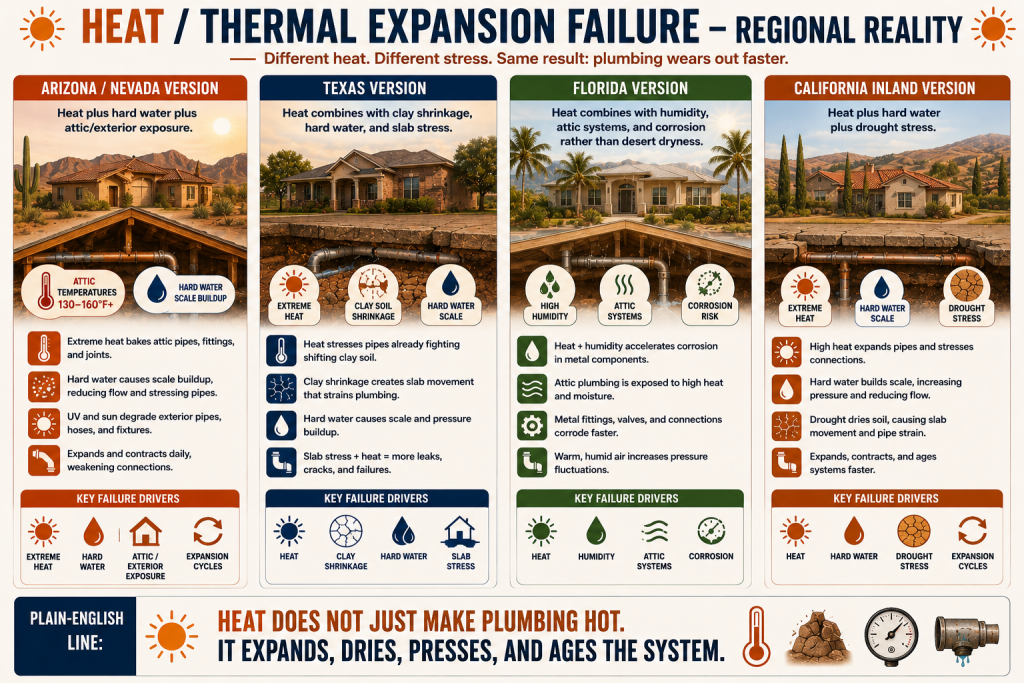
Arizona / Nevada version:
Heat plus hard water plus attic/exterior exposure.
Texas version:
Heat combines with clay shrinkage, hard water, and slab stress.
Florida version:
Heat combines with humidity, attic systems, and corrosion rather than desert dryness.
California inland version:
Heat plus hard water plus drought stress.
Plain-English:
Heat does not just make plumbing hot. It expands, dries, pressures, and ages the system.
5. Coastal Salt / Humidity Corrosion Failure
Definition:
Salt air, humidity, and coastal exposure corrode exposed metal plumbing components from the outside in.
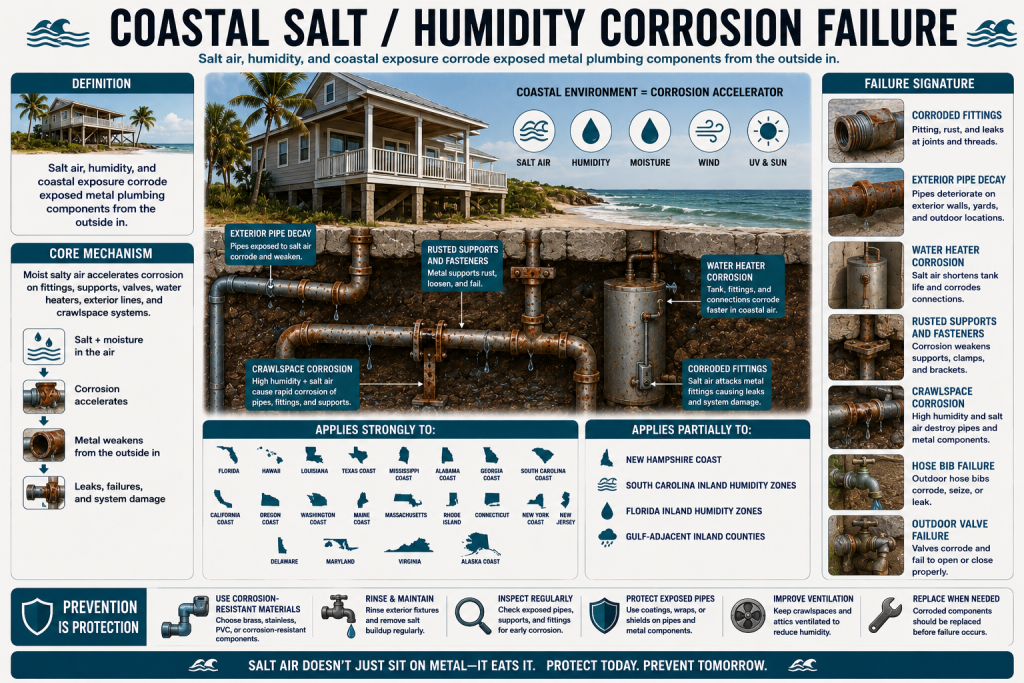
Core mechanism:
Moist salty air accelerates corrosion on fittings, supports, valves, water heaters, exterior lines, and crawlspace systems.
Applies strongly to:
Florida, Hawaii, Louisiana, Texas coast, Mississippi coast, Alabama coast, Georgia coast, South Carolina coast, North Carolina coast, California coast, Oregon coast, Washington coast, Maine coast, Massachusetts, Rhode Island, Connecticut, New York coast, New Jersey, Delaware, Maryland, Virginia, Alaska coast.
Applies partially to:
New Hampshire coast, South Carolina inland humidity zones, Florida inland humidity zones, Gulf-adjacent inland counties.
Failure signature:
- corroded fittings
- exterior pipe decay
- water heater corrosion
- rusted supports and fasteners
- crawlspace corrosion
- hose bib failure
- outdoor valve failure
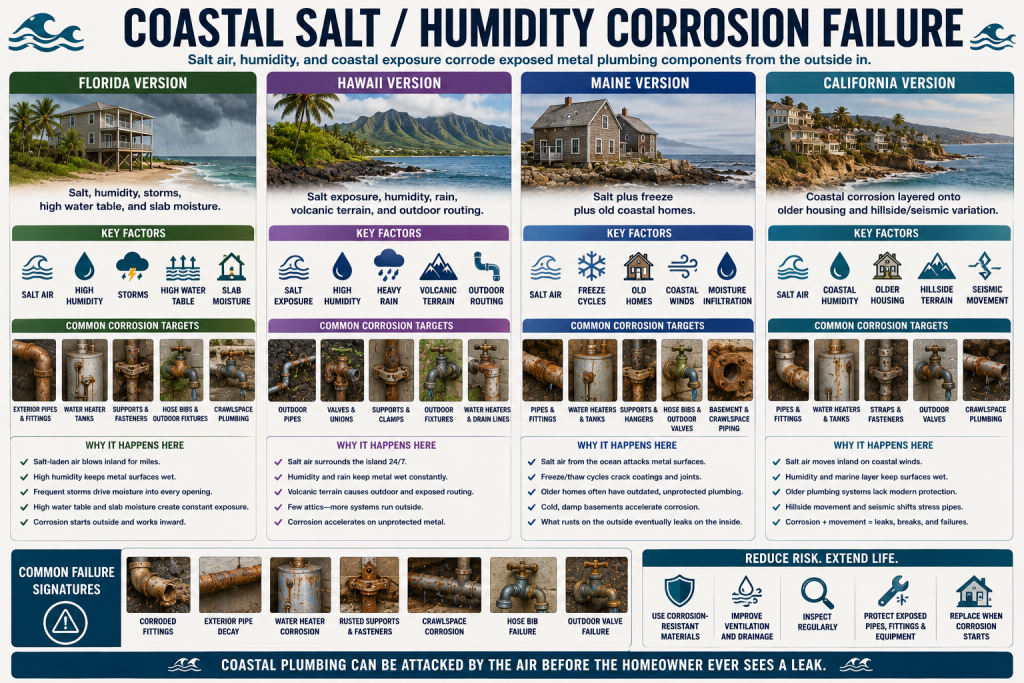
Florida version:
Salt, humidity, storms, high water table, and slab moisture.
Hawaii version:
Salt exposure, humidity, rain, volcanic terrain, and outdoor routing.
Maine version:
Salt plus freeze plus old coastal homes.
California version:
Coastal corrosion layered onto older housing and hillside/seismic variation.
Plain-English line:
Coastal plumbing can be attacked by the air before the homeowner ever sees a leak.
6. Saturation / High Water Table Failure
Definition:
Persistent moisture surrounds the home, softens soil, hides leaks, damages crawlspaces, and destabilizes underground plumbing.
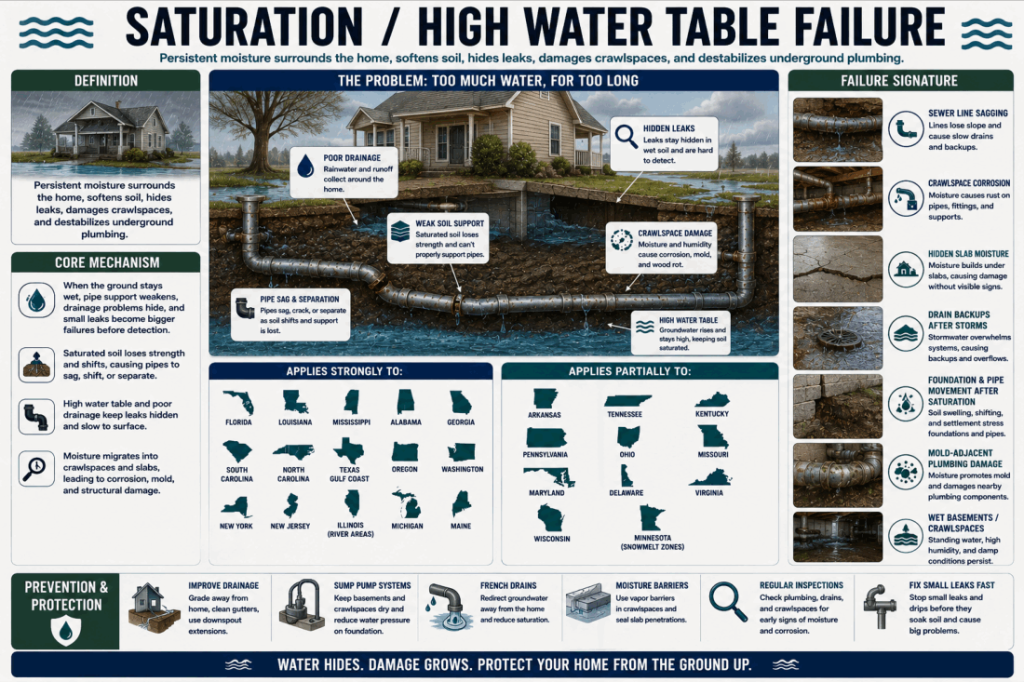
Core mechanism:
When the ground stays wet, pipe support weakens, drainage problems hide, and small leaks become bigger failures before detection.
Applies strongly to:
Florida, Louisiana, Mississippi, Alabama, Georgia, South Carolina, North Carolina, Texas Gulf Coast, Oregon, Washington, New York, New Jersey, Illinois river areas, Michigan, Maine.
Applies partially to:
Arkansas, Tennessee, Kentucky, Pennsylvania, Ohio, Missouri, Maryland, Delaware, Virginia, Wisconsin, Minnesota snowmelt zones.
Failure signature:
- sewer line sagging
- crawlspace corrosion
- hidden slab moisture
- drain backups after storms
- foundation and pipe movement after saturation
- mold-adjacent plumbing damage
- wet basements/crawlspaces
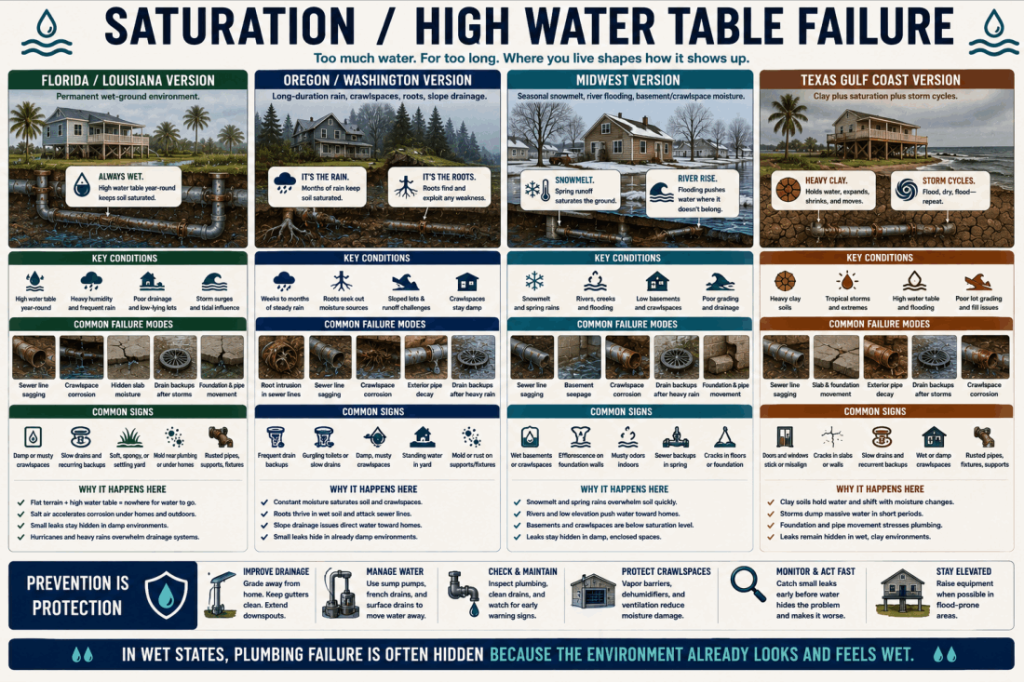
Florida / Louisiana version:
Permanent wet-ground environment.
Oregon / Washington version:
Long-duration rain, crawlspaces, roots, slope drainage.
Midwest version:
Seasonal snowmelt, river flooding, basement/crawlspace moisture.
Texas Gulf Coast version:
Clay plus saturation plus storm cycles.
Plain-English line:
In wet states, plumbing failure is often hidden because the environment already looks and feels wet.
7. Hard Water / Scale Failure
Definition:
Mineral-heavy water deposits scale inside plumbing and appliances.
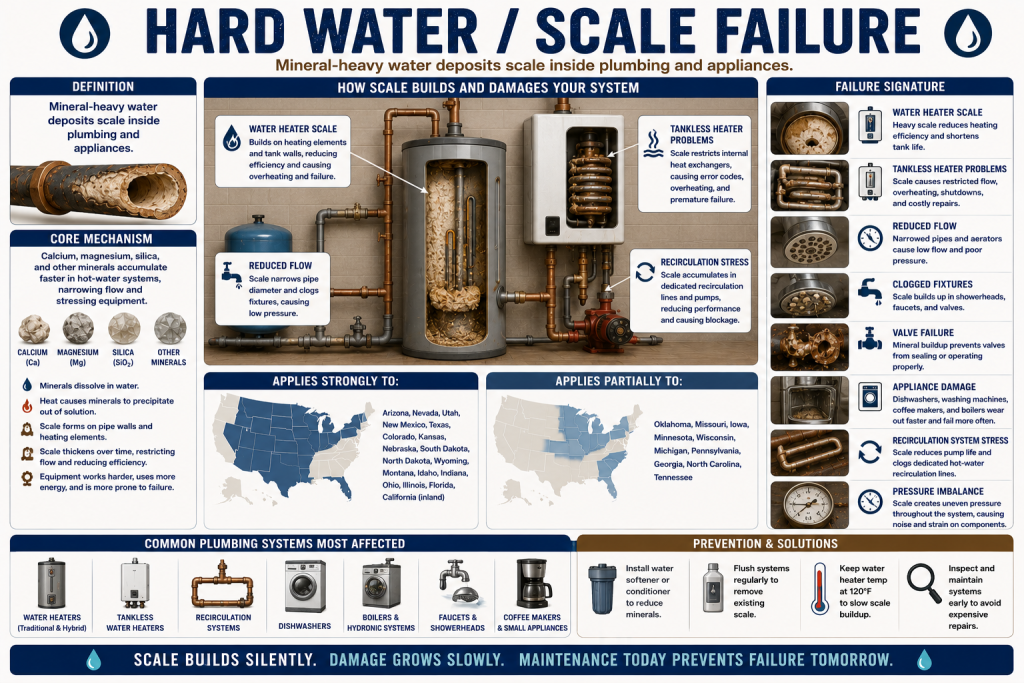
Core mechanism:
Calcium, magnesium, silica, and other minerals accumulate faster in hot-water systems, narrowing flow and stressing equipment.
Applies strongly to:
Arizona, Nevada, Utah, New Mexico, Texas, Colorado, Kansas, Nebraska, South Dakota, North Dakota, Wyoming, Montana, Idaho, Indiana, Ohio, Illinois, Florida, California inland.
Applies partially to:
Oklahoma, Missouri, Iowa, Minnesota, Wisconsin, Michigan, Pennsylvania, Georgia, North Carolina, Tennessee.
Failure signature:
- water heater scale
- tankless heater problems
- reduced flow
- clogged fixtures
- valve failure
- appliance damage
- recirculation system stress
- pressure imbalance
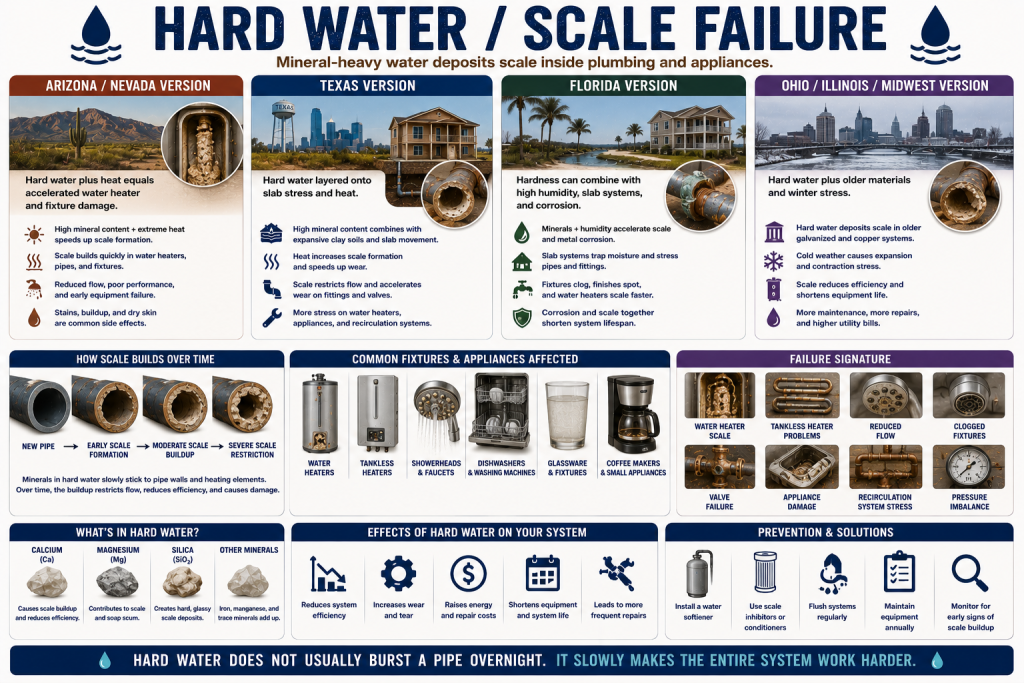
Arizona / Nevada version:
Hard water plus heat equals accelerated water heater and fixture damage.
Texas version:
Hard water layered onto slab stress and heat.
Florida version:
Hardness can combine with high humidity, slab systems, and corrosion.
Ohio / Illinois / Midwest version:
Hard water plus older materials and winter stress.
Plain-English line:
Hard water does not usually burst a pipe overnight. It slowly makes the entire system work harder.
8. Acidic / Aggressive Water Corrosion Failure
Definition:
Low-pH or chemically aggressive water dissolves pipe material from the inside.
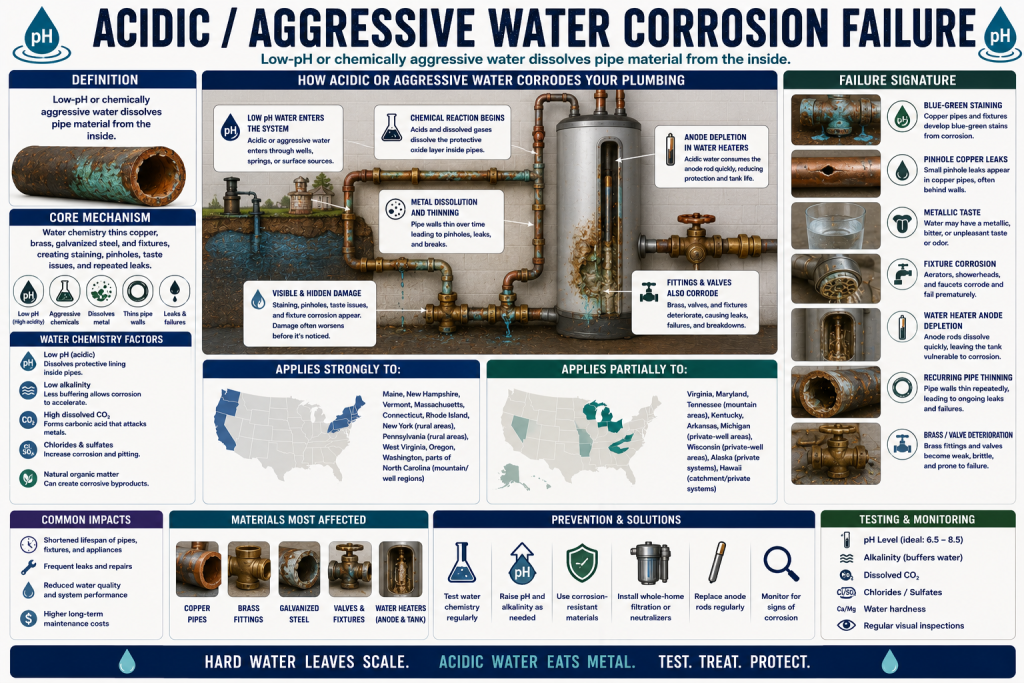
Core mechanism:
Water chemistry thins copper, brass, galvanized steel, and fixtures, creating staining, pinholes, taste issues, and repeated leaks.
Applies strongly to:
Maine, New Hampshire, Vermont, Massachusetts, Connecticut, Rhode Island, New York rural areas, Pennsylvania rural areas, West Virginia, Oregon, Washington, parts of North Carolina mountain/well regions.
Applies partially to:
Virginia, Maryland, Tennessee mountain areas, Kentucky, Arkansas, Michigan private-well areas, Wisconsin private-well areas, Alaska private systems, Hawaii catchment/private systems.
Failure signature:
- blue-green staining
- pinhole copper leaks
- metallic taste
- fixture corrosion
- water heater anode depletion
- recurring pipe thinning
- brass/valve deterioration
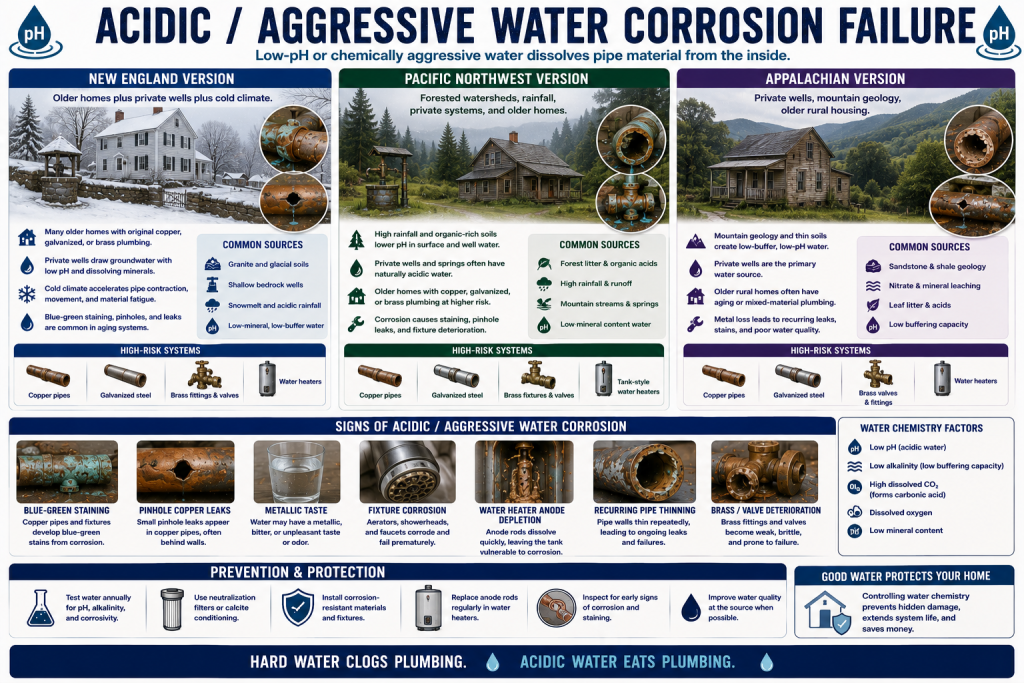
New England version:
Older homes plus private wells plus cold climate.
Pacific Northwest version:
Forested watersheds, rainfall, private systems, and older homes.
Appalachian version:
Private wells, mountain geology, older rural housing.
Plain-English line:
Hard water clogs plumbing. Acidic water eats plumbing.
9. Legacy Material Failure
Definition:
Older plumbing materials reach the end of their useful life.
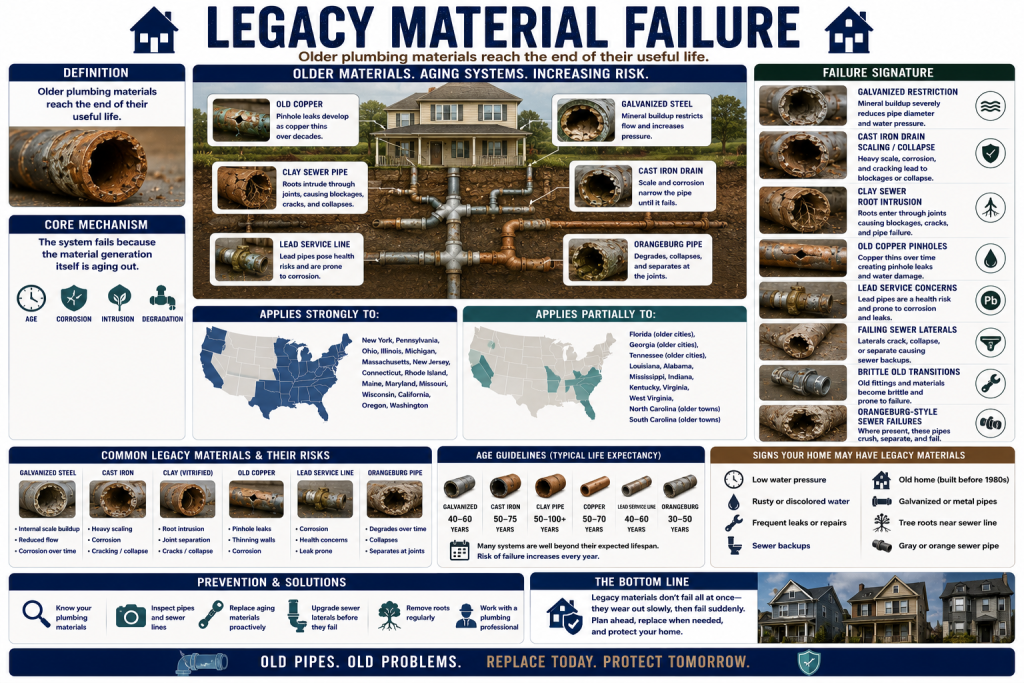
Core mechanism:
The system fails because the material generation itself is aging out.
Applies strongly to:
New York, Pennsylvania, Ohio, Illinois, Michigan, Massachusetts, New Jersey, Connecticut, Rhode Island, Maine, Maryland, Missouri, Wisconsin, California, Oregon, Washington.
Applies partially to:
Florida older cities, Georgia older cities, Tennessee older cities, Louisiana, Alabama, Mississippi, Indiana, Kentucky, Virginia, West Virginia, North Carolina older towns, South Carolina older towns.
Failure signature:
- galvanized restriction
- cast iron drain scaling/collapse
- clay sewer root intrusion
- old copper pinholes
- lead service concerns
- failing sewer laterals
- brittle old transitions
- Orangeburg-style sewer failures where present
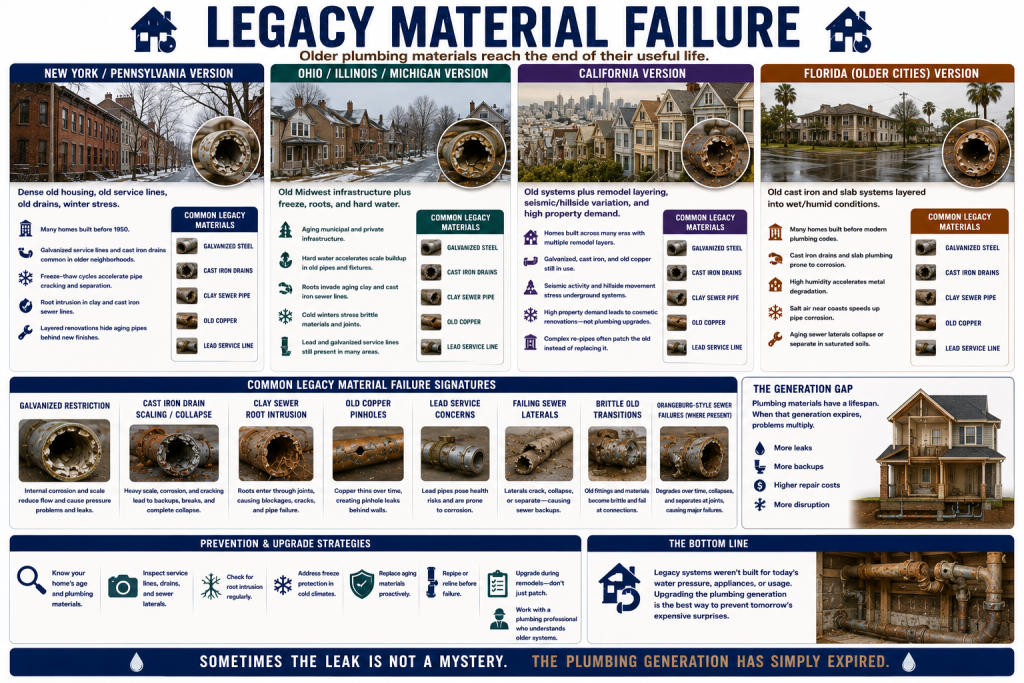
New York / Pennsylvania version:
Dense old housing, old service lines, old drains, winter stress.
Ohio / Illinois / Michigan version:
Old Midwest infrastructure plus freeze, roots, and hard water.
California version:
Old systems plus remodel layering, seismic/hillside variation, and high property demand.
Florida older cities version:
Old cast iron and slab systems layered into wet/humid conditions.
Plain-English line:
Sometimes the leak is not a mystery. The plumbing generation has simply expired.
10. Root / Vegetation Intrusion Failure
Definition:
Roots enter cracks, joints, offsets, and older sewer laterals.

Core mechanism:
Roots seek moisture. Old clay, cast iron, Orangeburg, or cracked sewer lines become easy targets.
Applies strongly to:
California, Oregon, Washington, Georgia, Tennessee, North Carolina, South Carolina, Florida, Ohio, Illinois, Pennsylvania, New York, Missouri.
Applies partially to:
Michigan, Wisconsin, Indiana, Kentucky, Arkansas, Alabama, Mississippi, Louisiana, Virginia, Maryland, New Jersey, Connecticut, Massachusetts.
Failure signature:
- recurring sewer clogs
- clay line intrusion
- offset joints
- yard cleanout backups
- slow drains after rain
- sewer bellies with root mass
- mature-neighborhood drain failures
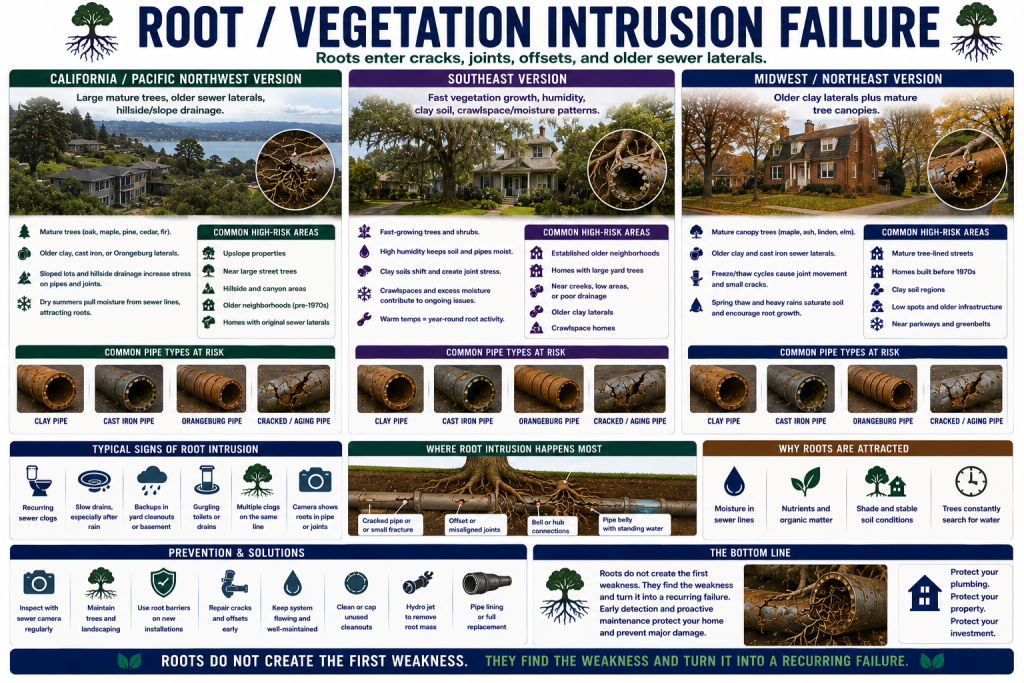
California / Pacific Northwest version:
Large mature trees, older sewer laterals, hillside/slope drainage.
Southeast version:
Fast vegetation growth, humidity, clay soil, crawlspace/moisture patterns.
Midwest / Northeast version:
Older clay laterals plus mature tree canopies.
Plain-English line:
Roots do not create the first weakness. They find the weakness and turn it into a recurring failure.
11. Boom-Build Installation Failure
Definition:
Rapid growth markets create predictable installation weaknesses.

Core mechanism:
When housing is built fast, repeated layouts, labor shortages, inspection pressure, and speed-driven decisions create hidden system defects.
Applies strongly to:
Texas, Florida, Arizona, Nevada, Georgia, North Carolina, Tennessee, Colorado, Utah, South Carolina, Idaho.
Applies partially to:
California growth corridors, Oregon growth corridors, Washington growth corridors, Alabama growth metros, South Dakota growth metros, Montana growth areas, Oklahoma, Arkansas.
Failure signature:
- poor pipe support
- bad slope
- undersized systems
- slab penetration stress
- improper expansion control
- inconsistent material transitions
- rushed trench bedding
- weak fixture/branch layout

Texas / Florida / Arizona version:
Fast subdivision growth plus slab-on-grade and high demand.
North Carolina / Georgia / Tennessee version:
Growth-market construction layered onto clay, humidity, crawlspaces, and mixed old/new systems.
Colorado / Utah / Idaho version:
Boom growth layered onto freeze, soil movement, elevation, and long runs.
Plain-English line:
Some homes inherit their plumbing problems the day they are built.
12. Complex-System / Luxury Load Failure
Definition:
Larger homes and higher-end water systems create more failure points.

Core mechanism:
The plumbing system becomes a network: long runs, recirculation, pressure zones, fixtures, irrigation, pools, outdoor kitchens, guest houses, ADUs, pumps, wells, and treatment systems.
Applies strongly to:
California, Florida, Texas, Colorado, Arizona, Utah, New York, Hawaii, Nevada, North Carolina, Georgia, Tennessee.
Applies partially to:
Washington, Oregon, Idaho, Montana, Wyoming, South Carolina, Virginia, New Jersey, Connecticut, Massachusetts, Maryland.
Failure signature:
- long hot-water waits
- recirculation failures
- booster pump issues
- pressure imbalance
- manifold confusion
- multi-bathroom demand overload
- irrigation/pool/backflow complexity
- remodel stacking
- hidden leaks across long runs

California version:
High-end remodels, ADUs, hillside systems, old-meets-new plumbing.
Florida version:
Luxury coastal homes, pools, irrigation, corrosion, slab moisture.
Texas version:
Large suburban homes, irrigation, hard water, slab stress, heat.
Colorado / Utah / Montana / Idaho version:
Large properties, long runs, elevation, freeze protection, private systems.
Plain-English line:
More plumbing convenience means more plumbing failure points.
13. Human-System Failure
Definition
Plumbing systems do not fail from environmental pressure alone.
Many systems fail because human decisions weakened the plumbing before the environment ever applied stress.
Improper installation.
Poor repair sequencing.
Incompatible materials.
Rushed construction.
DIY modifications.
Deferred maintenance.
Partial upgrades layered onto aging systems.
The environment creates pressure.
Human decisions often determine whether the system survives it.
Core Mechanism
Every plumbing system depends on consistency.
Consistent support.
Consistent slope.
Consistent pressure control.
Consistent material compatibility.
Consistent installation standards.
When shortcuts interrupt that consistency, the system develops weak points.
Those weak points eventually interact with:
- soil movement
- freeze cycles
- pressure variation
- heat expansion
- hard water
- saturation
- corrosion
- demand overload
The failure may appear environmental.
But the environment often exposes a human-created vulnerability that already existed inside the system.
Applies Strongly To
Texas
Florida
Arizona
Nevada
Georgia
North Carolina
Tennessee
Colorado
Utah
California growth corridors
Idaho growth markets
Applies Partially To
ALL states.
Human-system failures exist anywhere:
- systems are repaired repeatedly instead of replaced
- fast-growth construction outpaces quality control
- remodels layer new plumbing onto old infrastructure
- homeowners perform unqualified modifications
- contractors work under production pressure
- inspection quality varies
- maintenance is deferred for years
Failure Signature
- unsupported piping
- poor drain slope
- improper transitions
- incompatible materials
- over-tightened fittings
- torch/solder heat damage
- failed expansion control
- weak slab penetrations
- improperly bedded underground pipe
- recurring “repair-on-top-of-repair” conditions
- hidden non-code modifications
- undersized branch lines
- badly routed recirculation systems
- poorly supported PEX
- incorrect pressure regulation
- abandoned plumbing left active in walls or slabs
Pattern Stacking: The National Perspective

Texas — Full Stack Failure Environment
Stack:
- Expansive Soil / Slab Stress
- Heat / Thermal Expansion
- Hard Water / Scale
- Boom-Build Installation
- Complex-System / Luxury Load
- Coastal Corrosion in Gulf markets
- Karst in Hill Country
Result:
Texas is not one plumbing pattern. It is a collision of ground movement, mineral water, heat, slab design, growth construction, and oversized home systems.
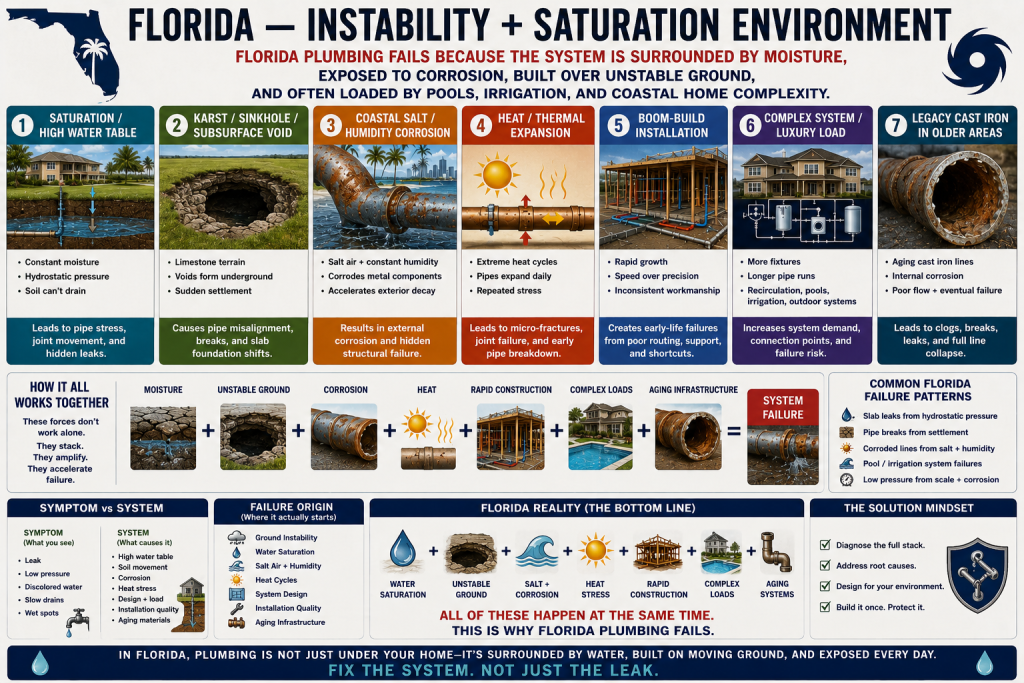
Florida — Instability + Saturation Environment
Stack:
- Saturation / High Water Table
- Karst / Sinkhole / Subsurface Void
- Coastal Salt / Humidity Corrosion
- Heat / Thermal Expansion
- Boom-Build Installation
- Complex-System / Luxury Load
- Legacy Cast Iron in older areas
Result:
Florida plumbing fails because the system is surrounded by moisture, exposed to corrosion, built over unstable ground, and often loaded by pools, irrigation, and coastal home complexity.
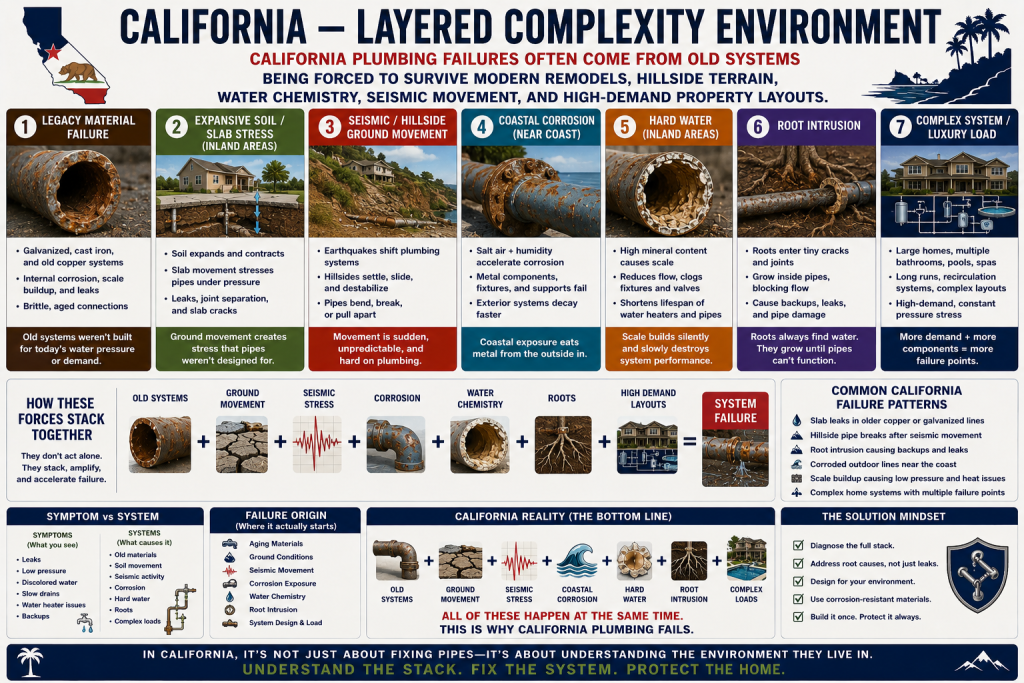
California — Layered Complexity Environment
Stack:
- Legacy Material Failure
- Expansive Soil / Slab Stress in areas
- Seismic / hillside ground movement
- Coastal Corrosion near coast
- Hard Water inland
- Root Intrusion
- Complex-System / Luxury Load
Result:
California plumbing failures often come from old systems being forced to survive modern remodels, hillside terrain, water chemistry, seismic movement, and high-demand property layouts.
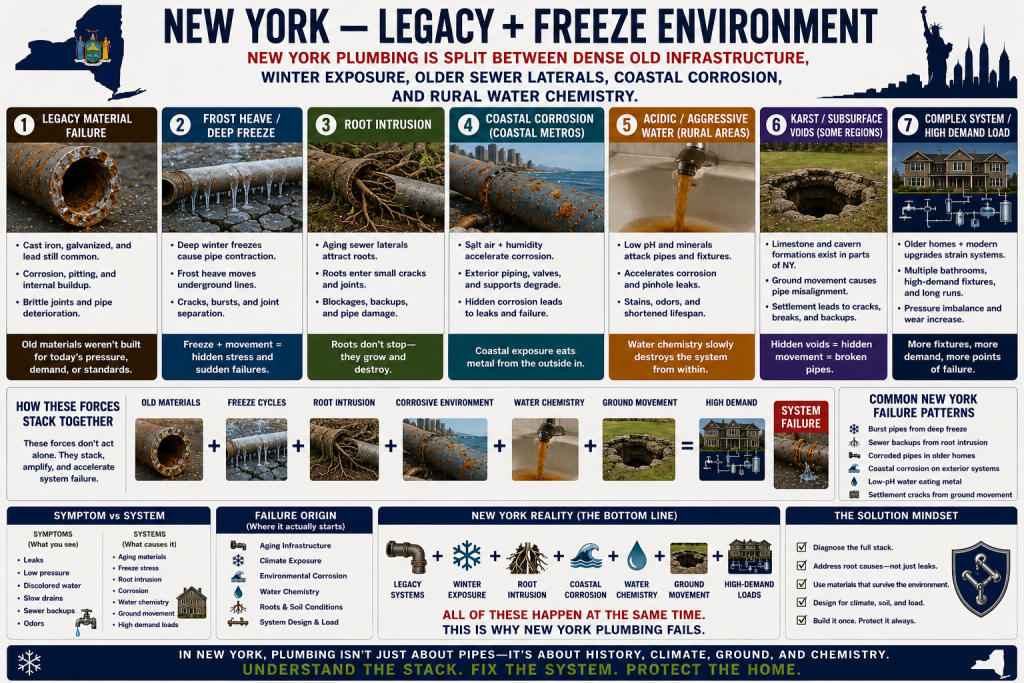
New York — Legacy + Freeze Environment
Stack:
- Legacy Material Failure
- Frost Heave / Deep Freeze
- Root Intrusion
- Coastal Corrosion in coastal metros
- Acidic / Aggressive Water in rural areas
- Karst in some regions
Result:
New York plumbing is split between dense old infrastructure, winter exposure, older sewer laterals, coastal corrosion, and rural water chemistry.

Colorado — Soil + Freeze + Elevation Environment
Stack:
- Expansive Soil / Slab Stress
- Frost Heave / Deep Freeze
- Hard Water / Scale
- Boom-Build Installation
- Complex-System / Luxury Load
- Mountain/rural pressure variation
Result:
Colorado plumbing fails where expansive soils, freeze-thaw cycles, elevation, long runs, and rapid growth construction overlap.
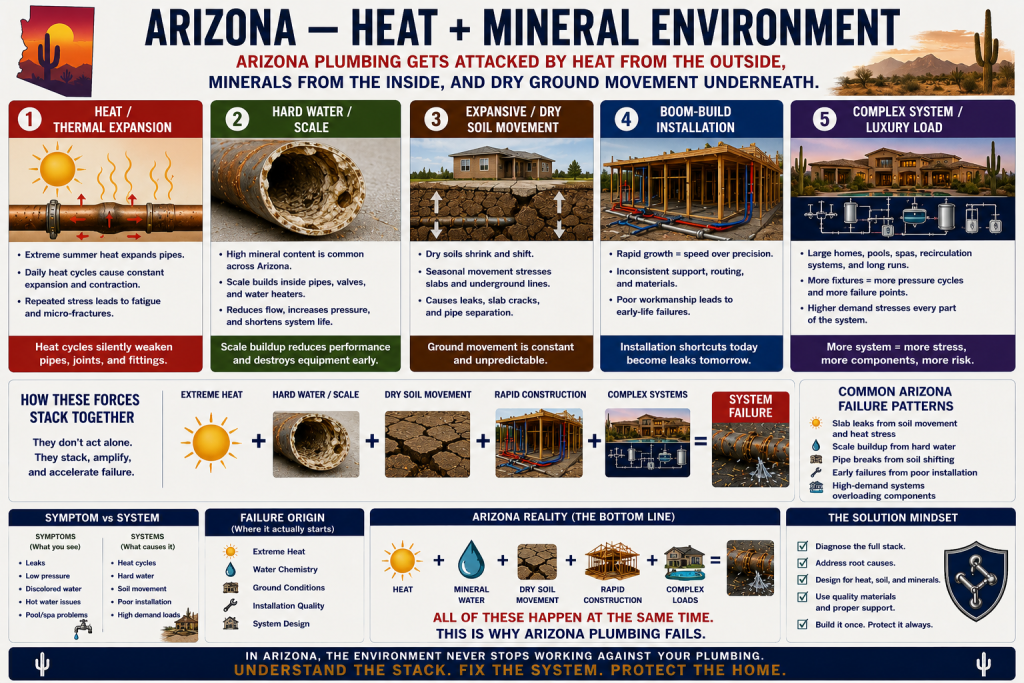
Arizona — Heat + Mineral Environment
Stack:
- Heat / Thermal Expansion
- Hard Water / Scale
- Expansive/Dry Soil Movement
- Boom-Build Installation
- Complex-System / Luxury Load
Result:
Arizona plumbing gets attacked by heat from the outside, minerals from the inside, and dry ground movement underneath.
Oregon / Washington — Hidden Wet Failure Environment
Stack:
- Saturation / High Water Table
- Root / Vegetation Intrusion
- Acidic / Aggressive Water
- Legacy Material Failure
- Coastal Corrosion on coast
- Hillside/slope movement
Result:
Pacific Northwest plumbing often fails quietly because moisture, roots, slope, crawlspaces, and older materials hide damage until it becomes expensive.
Midwest — Aging + Freeze + Scale Environment
States: Ohio, Illinois, Michigan, Wisconsin, Indiana, Iowa, Missouri, Minnesota.
Stack:
- Frost Heave / Deep Freeze
- Legacy Material Failure
- Hard Water / Scale
- Root Intrusion
- Saturation / Snowmelt in some areas
- Expansive clay in some areas
Result:
Midwest plumbing failures usually come from old systems being stressed by winter, minerals, mature trees, and wet basements or crawlspaces.
Southeast Growth Belt — Clay + Humidity + Boom-Build
States: Georgia, North Carolina, South Carolina, Tennessee, Alabama, Mississippi, Arkansas.
Stack:
- Expansive Soil / Slab Stress
- Saturation / Humidity
- Root / Vegetation Intrusion
- Boom-Build Installation
- Karst in Tennessee/Kentucky/Alabama/Georgia areas
- Legacy Material Failure in older towns
Result:
Southeast plumbing fails where clay soil, humidity, vegetation, crawlspaces, and rapid housing growth create multiple weak points.
Northern Freeze Belt — Cold + Old + Rural Exposure
States: Maine, Vermont, New Hampshire, North Dakota, South Dakota, Montana, Wyoming, Alaska.
Stack:
- Frost Heave / Deep Freeze
- Acidic or Hard Water depending on region
- Legacy Material Failure in older areas
- Rural/private-system exposure
- Demand Load from freeze-protection systems
Result:
Northern plumbing failure is often about exposure: exposed pipes, exposed service lines, exposed rural systems, and exposed old materials.
Hawaii — Exposure + Terrain Environment
Stack:
- Coastal Salt / Humidity Corrosion
- Saturation / Rain Exposure
- Karst / Lava Tube / Volcanic Terrain Movement
- Complex-System / Luxury Load
- Private/catchment system variability
Result:
Hawaii plumbing is shaped by salt, humidity, slope, rain, volcanic terrain, and the reality that many systems are exposed to the environment.
Final Positioning Statement
Plumbing failure is not a service issue. It is an environmental pattern. Every home sits inside a failure system — and once you understand the system, you can predict what will break before it happens.
And the America-only master sentence:
The same leak means something different in every state. In Texas, it may be clay movement. In Florida, it may be wet ground and limestone. In Arizona, it may be heat and minerals. In Minnesota, it may be freeze depth. In Maine, it may be old pipe and aggressive water. In Hawaii, it may be salt and terrain. Same symptom. Different enemy.