
Coastal Salt / Humidity Corrosion Failure
Definition
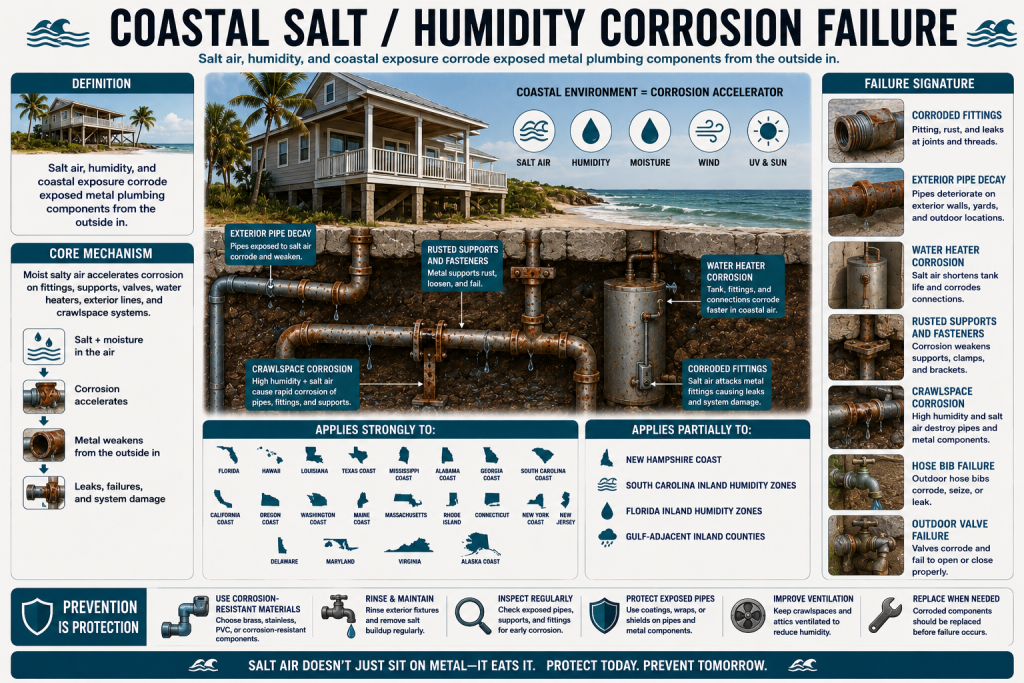
Coastal Salt / Humidity Corrosion Failure occurs when salty air, persistent humidity, moisture exposure, and coastal environmental conditions gradually corrode plumbing systems from the outside inward.
Most plumbing failure discussions focus on what happens inside the pipe.
Coastal corrosion environments often attack the outside of the system first.
Salt particles carried through humid coastal air accelerate oxidation on exposed plumbing materials and support systems.
Persistent moisture exposure prevents components from fully drying.
Over time, corrosion quietly spreads throughout the plumbing environment.
How Coastal Exposure Attacks Plumbing
Coastal corrosion develops through continuous environmental exposure.
The plumbing system may continue operating while surrounding components slowly weaken.
Coastal Salt / Humidity Corrosion conditions include:
- salt-air exposure
- coastal humidity
- storm moisture
- crawlspace condensation
- outdoor exposure
- wind-driven rain
- ocean-adjacent environments
- high moisture retention
- storm-surge exposure
- marine corrosion conditions
- wet coastal airflow
- condensation cycling
- humid attic environments
- saturated coastal foundations
Corrosion affects:
- valves
- fittings
- pipe supports
- hose bibs
- exposed copper
- galvanized components
- water heaters
- crawlspace systems
- outdoor plumbing
- irrigation systems
- fasteners
- hangers
- pressure regulators
- exposed drains
The plumbing system may continue functioning while environmental corrosion steadily increases around it.
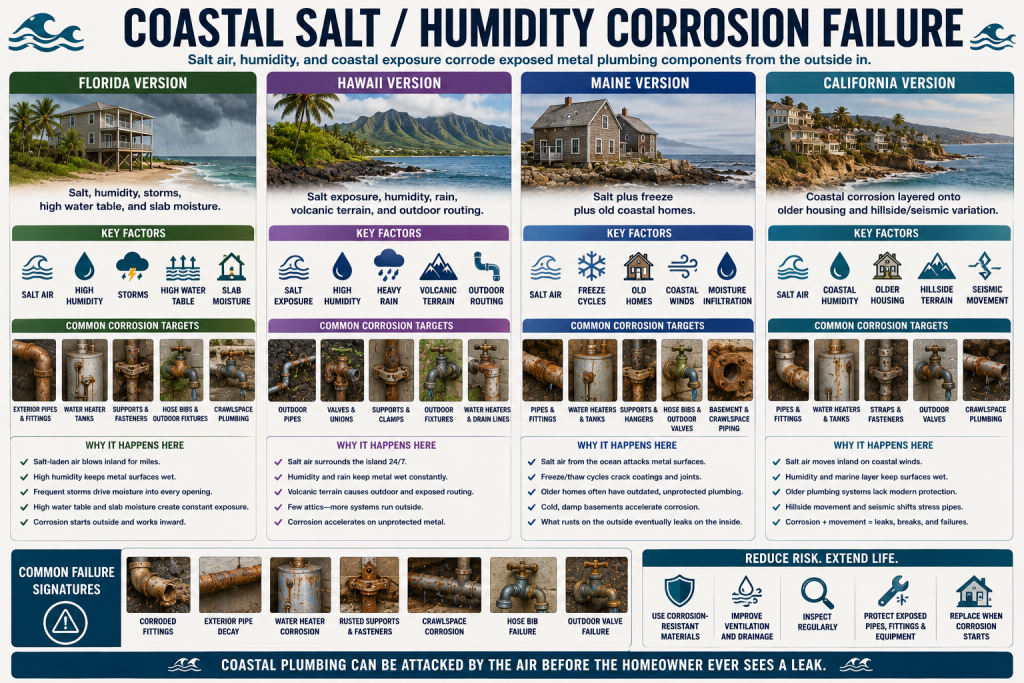
Why This Failure Family Matters
Most homeowners think plumbing corrosion begins inside the pipe.
Coastal environments frequently attack the plumbing system externally before internal failures become visible.
This is why coastal homes often experience:
- premature fitting failure
- rusted supports
- outdoor valve deterioration
- water heater corrosion
- crawlspace damage
- exposed copper degradation
- recurring exterior leaks
The environmental exposure remains active every day.
Humidity and salt do not need a major storm event to create long-term damage.
The environment itself continuously loads the plumbing system over time.
Strong Coastal Salt / Humidity States
Florida
Hawaii
Louisiana
Texas coast
Mississippi coast
Alabama coast
Georgia coast
South Carolina coast
North Carolina coast
California coast
Oregon coast
Washington coast
Maine coast
Massachusetts
Rhode Island
Connecticut
New York coast
New Jersey
Maryland
Virginia
Alaska coast
Florida Version
Florida combines salt exposure, humidity, storm saturation, slab moisture, coastal air, and high-demand plumbing systems.
The plumbing system often operates inside continuously wet environmental conditions.
Corrosion pressure remains active year-round.
Hawaii Version
Hawaii combines ocean exposure, volcanic terrain, humidity, heavy rainfall, outdoor routing, and coastal wind exposure.
Many plumbing systems operate in highly exposed environmental conditions with accelerated exterior corrosion risk.
Gulf Coast Version
Louisiana, Texas coast, Mississippi, Alabama, and surrounding Gulf regions frequently combine salt air, saturation, humidity, storm cycles, and crawlspace exposure.
Coastal corrosion often layers onto already wet environmental conditions.
California Coast Version
California coastal systems frequently combine salt exposure, older housing stock, hillside terrain, remodel layering, and marine moisture environments.
Corrosion pressure often develops slowly over decades.
New England Coastal Version
Maine, Massachusetts, Rhode Island, and surrounding Northeast coastal regions combine salt exposure with freeze cycles, older homes, basements, and aging infrastructure.
Many systems experience both corrosion stress and winter stress simultaneously.
Failure Signature
Common Coastal Salt / Humidity Corrosion symptoms include:
- corroded fittings
- rusted pipe supports
- hose bib deterioration
- outdoor valve failure
- crawlspace corrosion
- exposed pipe oxidation
- water heater corrosion
- recurring exterior leaks
- fastener deterioration
- humid mechanical-room damage
- irrigation component failure
- condensation-related deterioration
- rust staining
- support instability
Failure Timeline
Stage 1 — Environmental Exposure
The plumbing system begins experiencing coastal environmental loading.
Examples:
- salt air
- humidity
- condensation
- storm moisture
- ocean exposure
No visible plumbing failure exists yet.
Stage 2 — Corrosion Development
Environmental exposure begins weakening system components.
Examples:
- oxidation
- support corrosion
- fitting deterioration
- moisture accumulation
- exterior metal fatigue
Stage 3 — Symptom Phase
The homeowner notices recurring environmental plumbing changes.
Examples:
- rust staining
- exterior leaks
- valve stiffness
- crawlspace corrosion
- outdoor fixture deterioration
- visible oxidation
Stage 4 — Recurring Failure
Repairs occur.
The coastal exposure remains active.
Examples:
“Another exterior valve failed.”
“The corrosion keeps spreading.”
“The water heater rusted out again.”
Stage 5 — Damage Event
The environmental corrosion becomes visible plumbing failure.
Examples:
- major fitting failure
- water heater rupture
- crawlspace plumbing collapse
- outdoor plumbing separation
- hidden leak escalation
- support-system failure
- widespread corrosion replacement conditions
Foundation Interaction
Coastal corrosion affects different foundation systems differently.
Crawlspace Homes
Most vulnerable to:
- humidity corrosion
- condensation
- support deterioration
- exposed piping damage
Pier / Raised Coastal Homes
Most vulnerable to:
- salt exposure
- storm moisture
- wind-driven rain
- exposed support corrosion
Slab-on-Grade Homes
Most vulnerable to:
- slab moisture
- hidden corrosion
- exterior fitting exposure
Outdoor Plumbing Systems
Most vulnerable to:
- UV exposure
- salt-air attack
- moisture cycling
- corrosion acceleration
Pipe Material Interaction
Coastal exposure affects plumbing materials differently.
Copper
Most vulnerable to:
- exterior oxidation
- fitting corrosion
- condensation exposure
Galvanized Steel
Most vulnerable to:
- rust expansion
- severe corrosion
- support deterioration
Cast Iron
Most vulnerable to:
- exterior moisture deterioration
- corrosion scaling
Brass Components
Most vulnerable to:
- salt-related corrosion
- fitting deterioration
Detection Difficulty Score
Coastal corrosion failures are often difficult to detect because deterioration develops slowly through continuous environmental exposure.
Easy to Detect:
- visible rust
- exterior oxidation
- corroded hose bibs
Medium Detection:
- crawlspace deterioration
- support corrosion
- water heater rusting
Hard to Detect:
- hidden condensation damage
- concealed support weakening
- internal corrosion progression
- long-term moisture deterioration
Most Vulnerable Homes
- coastal homes
- crawlspace homes
- raised coastal properties
- outdoor-plumbing-heavy homes
- older coastal homes
- oceanfront properties
- humid-environment homes
- storm-exposed homes
- homes with exposed mechanical systems
- high-moisture environments
Failure Visibility
Coastal Salt / Humidity Corrosion failures often remain hidden because the environmental exposure develops slowly over many years.
Many plumbing systems continue operating while corrosion quietly spreads across fittings, supports, valves, and exposed components.
The visible plumbing problem is often the final stage of long-term environmental corrosion.
Homeowner Translation
The plumbing system may not be failing because of one isolated leak.
The environment surrounding the home may be slowly corroding the plumbing system every day.
Contractor Translation
Coastal Salt / Humidity Corrosion failures occur when salt exposure, humidity, condensation, and marine environmental conditions gradually weaken plumbing materials, supports, fittings, and exposed system components over long periods of time.
The visible plumbing failure is often the final stage of long-term environmental corrosion exposure.
Final Positioning Line
Coastal plumbing failures usually begin long before visible corrosion appears. Salt, humidity, and moisture quietly attack the plumbing system every day until years of environmental exposure finally become visible damage.