



Decision System

Understanding How Homeowners Interpret Risk, Trust, Damage, and Long-Term Infrastructure Stability
Most residential plumbing decisions are made under incomplete information.
The homeowner sees:
- a leak
- a stain
- a crack
- a pressure problem
- a drain backup
- a repair estimate
But the visible symptom is often only a small portion of the actual system condition.

Hidden stress may already exist inside:
- walls
- slabs
- underground lines
- crawlspaces
- pressure systems
- aging materials
- structural support environments
This creates a dangerous gap between:
what the homeowner sees
and what the infrastructure system is actually experiencing.

The Decision System exists to help homeowners better understand:
- how plumbing failures progress
- how hidden damage develops
- how infrastructure stress accumulates
- how environmental conditions influence risk
- how repair decisions affect long-term stability
- how to evaluate contractor recommendations
- how repeated small failures can indicate larger system imbalance
Because homes do not fail randomly.
And major infrastructure decisions rarely begin with a catastrophic event.
Why The Decision System Matters
Most Residential Failures Escalate Long Before The Emergency Appears
Visible plumbing emergencies often represent the final stage of a much longer progression.
Pressure accumulates.
Materials fatigue.
Moisture spreads.
Corrosion advances.
Underground movement destabilizes surrounding systems.
The visible event arrives only after hidden conditions have been developing for months or years.
This is why many homeowners misinterpret:
- recurring leaks
- intermittent drain problems
- isolated pipe failures
- foundation movement
- fluctuating water pressure
- repeated repair zones
as separate problems.
In many homes, these symptoms are connected.
The Decision System studies how:
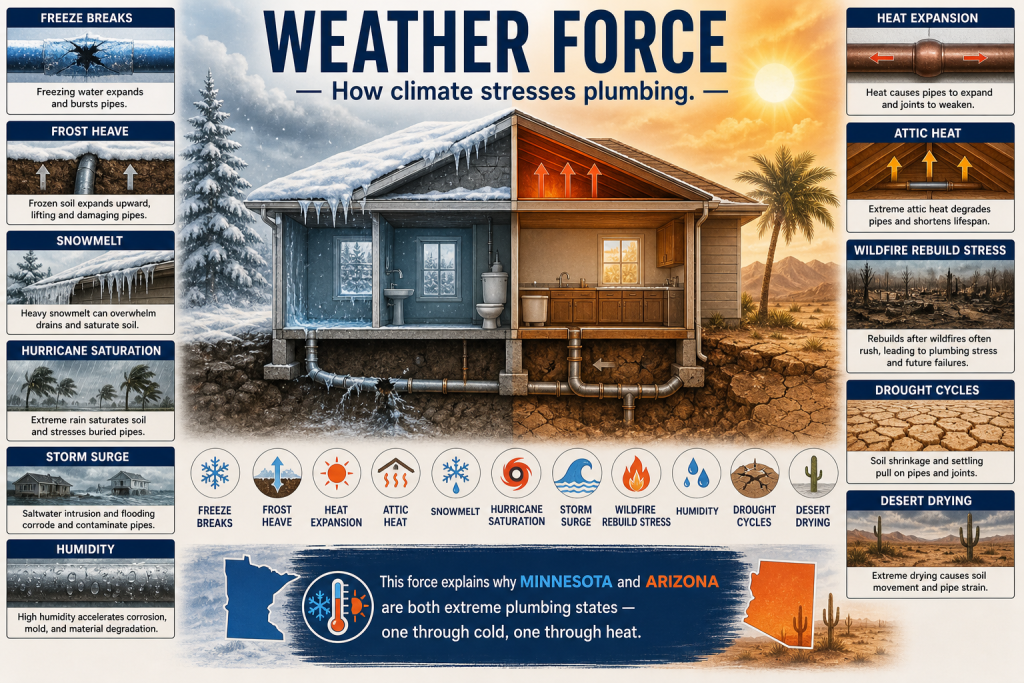
- environmental stress
- material aging
- hidden moisture movement
- structural instability
- pressure behavior
- human decision patterns
combine to create escalating infrastructure risk over time.
The Visibility Problem
The Most Serious Damage Often Exists Outside The Homeowner’s Immediate View
Residential plumbing systems are largely concealed.
Homeowners cannot easily see:
- underground pipe conditions
- slab moisture
- corrosion progression
- subsurface erosion
- hidden structural stress
- internal pipe scaling
- pressure instability
- concealed material fatigue
This creates an environment where infrastructure damage may expand silently while the visible symptom appears relatively minor.
A small ceiling stain may reflect:
a widespread moisture environment.
An isolated leak may indicate:
system-wide material aging.
A recurring sewer backup may reveal:
subsurface instability already affecting underground infrastructure.
The visible symptom is not always the actual failure.
Sometimes it is only the location where hidden stress finally becomes detectable.

Infrastructure Decisions Are Often Emotional Decisions
Fear, Uncertainty, and Incomplete Information Influence Residential Repair Choices
Most homeowners are not trained to evaluate:
- infrastructure systems
- pressure environments
- moisture migration
- environmental stress
- structural interaction
- long-term material behavior
Instead, decisions are often influenced by:
- urgency
- fear of cost
- visible damage
- conflicting contractor opinions
- temporary symptom relief
- uncertainty about escalation risk
This frequently leads to:
- delayed repairs
- repeated patchwork fixes
- incomplete evaluations
- symptom-only treatment
- underestimating hidden damage
- ignoring recurring warning signs
The Decision System studies how these decision environments contribute to long-term infrastructure escalation.
Because unresolved stress conditions often continue progressing after the visible symptom temporarily disappears.
Patchwork Repair Environments
Repeated Isolated Repairs Can Conceal Larger System Instability
Not every leak requires a whole home repipe.
Not every system requires replacement.
But repeated isolated failures can sometimes indicate broader infrastructure instability already affecting the home.
Patchwork repair environments commonly involve:
- recurring leak locations
- multiple repair zones
- repeated drain clearing
- fixture-by-fixture replacement
- temporary pressure corrections
- isolated slab leak repairs
- recurring corrosion exposure
- expanding moisture conditions
In some homes, these repairs stabilize the system successfully.
In others, they unintentionally extend the lifespan of an increasingly unstable plumbing environment.
The Decision System helps homeowners better understand:
when repair remains practical,
and when broader system evaluation becomes necessary.
Repipe Versus Repeated Repair
Long-Term Stability Sometimes Requires System-Level Thinking
The Decision System does not assume every home requires a repipe.
Instead, it focuses on evaluating:
- escalation frequency
- material condition
- infrastructure age
- environmental stress exposure
- regional failure patterns
- recurring instability
- hidden damage progression
As systems age, homeowners may eventually reach a point where:
- repairs become more frequent
- pressure instability spreads
- corrosion accelerates
- hidden moisture expands
- underground conditions worsen
- secondary damage costs increase
At this stage, the decision is no longer:
“How do we fix this leak?”
The decision becomes:
“How stable is the overall infrastructure system moving forward?”
This distinction matters.
Because system-level instability often produces recurring emergency environments over time.
Contractor Evaluation Logic
Claims Get Compared. Standards Get Trusted.
During major plumbing decisions, homeowners often receive:
- multiple opinions
- conflicting recommendations
- different repair scopes
- different urgency assessments
- different pricing structures
This creates confusion.
One contractor may recommend:
localized repair.
Another may recommend:
partial replacement.
A third may identify:
system-wide instability.
The homeowner is then forced to evaluate:
- credibility
- long-term reasoning
- infrastructure understanding
- environmental awareness
- escalation-stage interpretation
- risk recognition
- trust
The Decision System encourages homeowners to look beyond:
the immediate visible symptom.
Strong infrastructure evaluations often include:
- whole-system reasoning
- environmental context
- failure progression understanding
- material condition analysis
- pressure behavior assessment
- regional risk awareness
- hidden damage evaluation
Because infrastructure decisions become more accurate when the broader system environment is properly understood.
Regional Conditions Influence Decision Accuracy
Homes Fail Differently Across Different Environmental Environments
Regional conditions dramatically affect plumbing system behavior.
Homes in:
- Florida experience saturation and corrosion pressure
- Texas experiences expansive soil movement
- Arizona experiences heat and hard water stress
- Colorado experiences freeze-thaw cycling
- California experiences hillside movement and aging infrastructure
- Midwest regions experience freeze expansion and legacy material fatigue
The same symptom may represent completely different risks depending on:
- geography
- climate
- soil behavior
- water chemistry
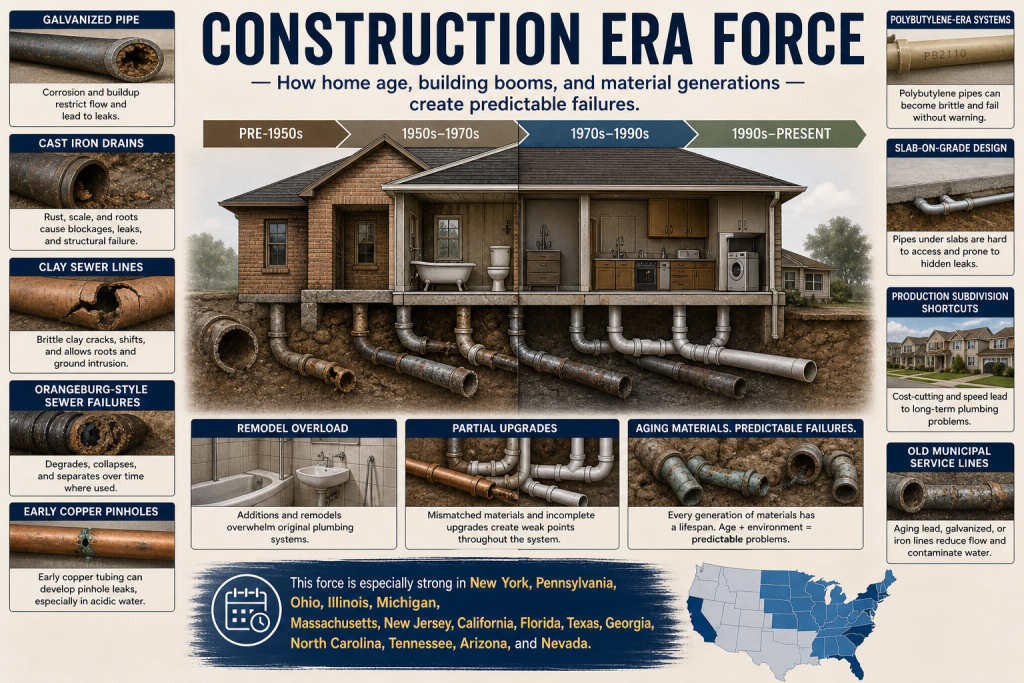
- construction era
- municipal infrastructure conditions
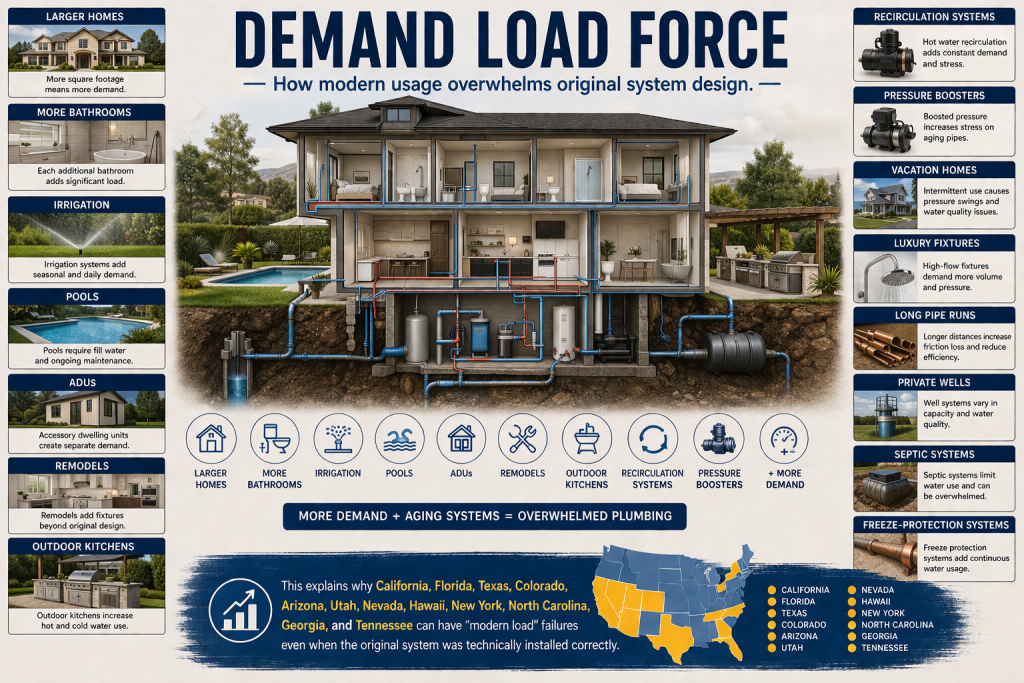
- demand load exposure
This is why regional risk intelligence is part of the Decision System itself.
Because infrastructure decisions should be evaluated within the environmental conditions surrounding the home.
Failure Progression And Decision Timing
Most Major Escalations Begin Before The Emergency Event
The Decision System also studies how:
- invisible stress accumulation
- early system imbalance
- concealed damage expansion
- structural destabilization
- visible failure events
- secondary damage escalation
develop over time.
This matters because many homeowners evaluate infrastructure decisions only after visible failure occurs.
But hidden system conditions frequently begin much earlier.
Understanding progression stages helps homeowners better recognize:
- recurring warning signs
- escalation behavior
- instability patterns
- hidden environmental stress
- long-term system risk
before catastrophic failure develops.
The Goal Of The Decision System
The Decision System combines:
- infrastructure condition analysis
- environmental stress mapping
- hidden damage evaluation
- contractor evaluation logic
- escalation-stage analysis
- regional failure behavior
- system stability assessment
- failure progression modeling
- infrastructure risk recognition
to help homeowners better understand:
- what failed
- why it failed
- how the system reached instability
- and how future escalation risk should be evaluated
Because the most expensive residential failures often begin long before the visible emergency itself appears.