
Saturation / High Water Table Failure
Definition
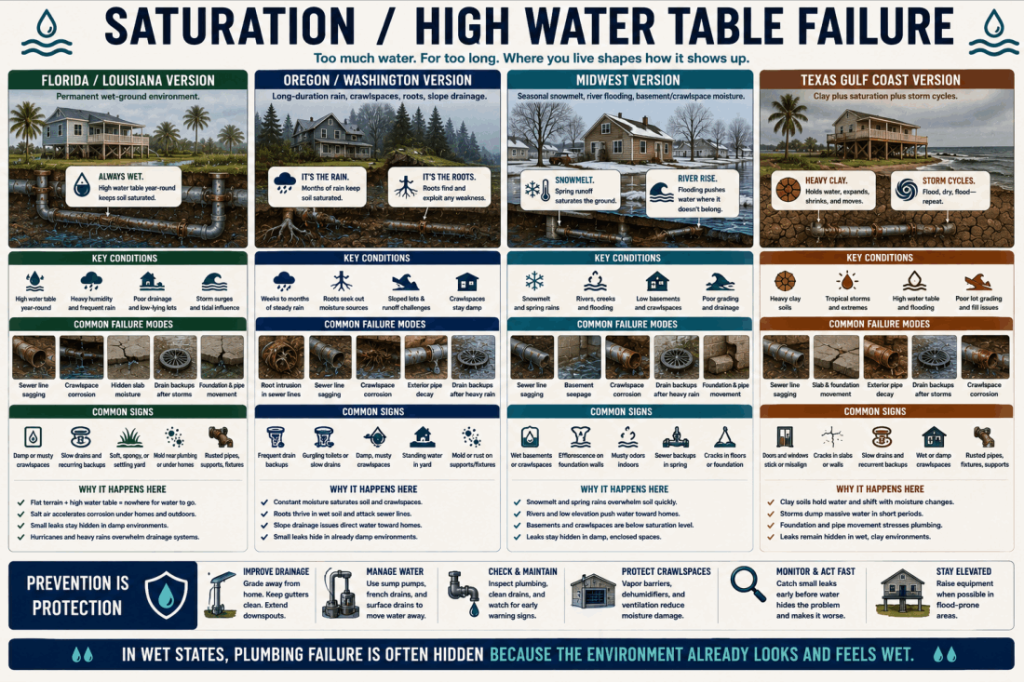
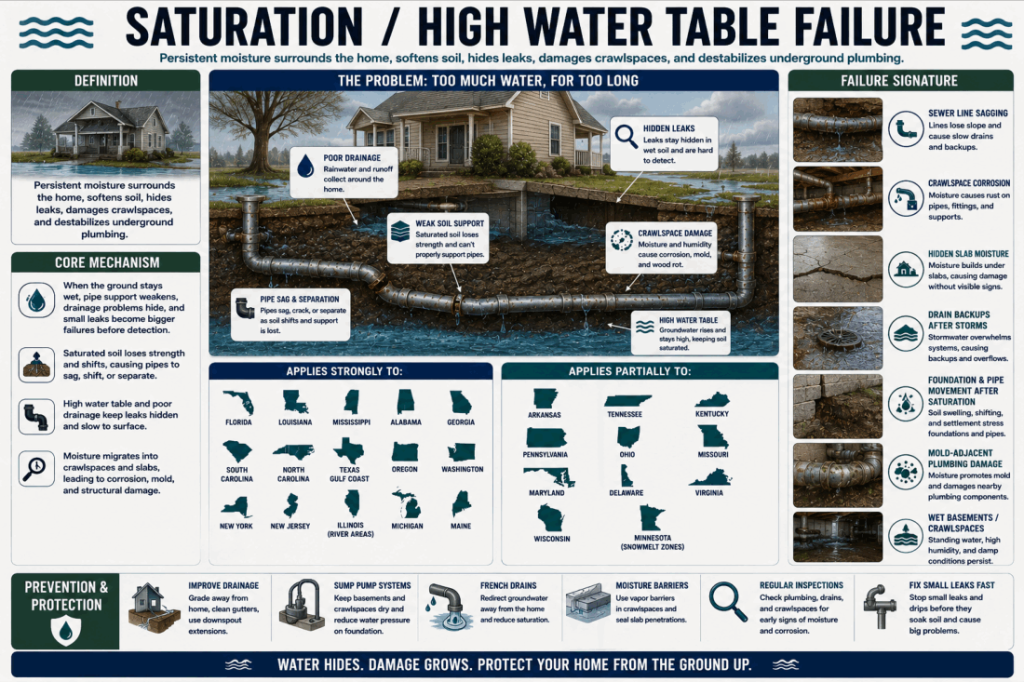
Saturation / High Water Table Failure occurs when persistent groundwater, storm saturation, wet soil conditions, or long-term moisture exposure destabilize plumbing systems and surrounding support environments.
The plumbing system depends on stable underground conditions.
When the environment stays wet for extended periods of time, underground support conditions begin changing.
Wet soil weakens.
Drainage shifts.
Pipe support deteriorates.
Moisture hides developing plumbing problems.
The plumbing system may continue operating while hidden environmental saturation quietly increases.
How Saturation Attacks Plumbing
Saturation-related plumbing stress develops through long-duration moisture exposure.
Unlike sudden flooding events, saturation failures often develop slowly underneath the home and surrounding property.
Saturation / High Water Table conditions include:
- high groundwater
- saturated soil
- stormwater accumulation
- long-duration rain exposure
- crawlspace moisture
- slab moisture
- wet basements
- drainage instability
- snowmelt saturation
- river-adjacent groundwater loading
- coastal saturation
- underground washout
- storm-cycle loading
- moisture-retaining soil conditions
Persistent moisture affects:
- sewer support stability
- underground pipe alignment
- crawlspace systems
- slab conditions
- foundation drainage
- buried pipe supports
- drain slope behavior
- corrosion environments
- mold-adjacent plumbing areas
- underground settlement behavior
The environment may already appear wet before plumbing symptoms become visible.
That often delays detection.
Why This Failure Family Matters
Most homeowners think plumbing leaks create wet environments.
In saturation environments, the wet environment often exists before the plumbing failure becomes visible.
This is why moisture-heavy regions frequently experience:
- hidden plumbing deterioration
- recurring drain instability
- sewer sagging
- crawlspace corrosion
- slab moisture confusion
- recurring storm-related backups
- foundation-adjacent plumbing damage
The environmental saturation remains active continuously.
The plumbing system operates inside moisture-loaded conditions every season.
This is also why plumbing failures in wet environments are often detected later and become more expensive before repair begins.
Strong Saturation / High Water Table States
Florida
Louisiana
Mississippi
Alabama
Georgia
South Carolina
North Carolina
Texas Gulf Coast
Oregon
Washington
New York
New Jersey
Michigan
Maine
Illinois river regions
Florida Version
Florida combines high groundwater, storm saturation, slab systems, humidity, limestone instability, and coastal exposure.
Many plumbing systems operate inside permanently moisture-heavy environments.
Small underground plumbing issues often remain hidden much longer than in dry states.
Louisiana / Gulf Coast Version
Louisiana and Gulf Coast regions combine saturation, stormwater loading, wet soil conditions, crawlspace exposure, and coastal moisture environments.
Drainage systems often experience continuous environmental pressure.
Oregon / Washington Version
Pacific Northwest environments frequently combine long-duration rainfall, wet crawlspaces, mature vegetation, slope drainage, and older plumbing infrastructure.
Moisture-related plumbing stress often develops quietly over long periods of time.
Midwest / Snowmelt Version
Michigan, Illinois river regions, Wisconsin, and surrounding wet Midwest environments frequently combine snowmelt saturation, basement exposure, aging infrastructure, and groundwater fluctuation.
The plumbing system often experiences seasonal moisture loading underneath the structure.
Southeast Version
Georgia, Alabama, South Carolina, and North Carolina frequently combine humidity, storm saturation, clay soil, crawlspaces, and rapid growth construction.
Wet environmental conditions often accelerate hidden plumbing deterioration.
Failure Signature
Common Saturation / High Water Table symptoms include:
- sewer sagging
- recurring drain backups
- crawlspace moisture
- wet basements
- slab moisture
- foundation-adjacent plumbing damage
- recurring storm-related plumbing problems
- mold-adjacent plumbing deterioration
- drain slope instability
- underground support weakening
- recurring sewer odor
- hidden leak escalation
- corrosion acceleration
- moisture-heavy utility areas
Failure Timeline
Stage 1 — Environmental Saturation
The environment surrounding the plumbing system becomes persistently wet.
Examples:
- groundwater rise
- storm saturation
- snowmelt loading
- long-duration rainfall
- drainage accumulation
No visible plumbing failure exists yet.
Stage 2 — Support Weakening
Moisture exposure begins altering underground support conditions.
Examples:
- soil softening
- drain sagging
- crawlspace deterioration
- slab moisture loading
- support instability
Stage 3 — Symptom Phase
The homeowner notices recurring moisture-related plumbing behavior.
Examples:
- musty odor
- slow drains after storms
- wet crawlspace areas
- sewer odor
- isolated moisture spots
- recurring backups
Stage 4 — Recurring Failure
Repairs occur.
The saturation environment remains active.
Examples:
“The backup returned after heavy rain.”
“The crawlspace keeps staying wet.”
“The sewer issue comes back during storms.”
Stage 5 — Damage Event
The saturation-related stress becomes visible plumbing failure.
Examples:
- sewer collapse
- crawlspace flooding
- foundation-adjacent plumbing damage
- slab moisture escalation
- major drain instability
- mold-related structural damage
- full underground replacement conditions
Foundation Interaction
Saturation affects different foundation systems differently.
Crawlspace Homes
Most vulnerable to:
- persistent moisture
- corrosion
- support deterioration
- mold-adjacent plumbing damage
Basement Homes
Most vulnerable to:
- seepage interaction
- groundwater pressure
- sewer backups
- moisture loading
Slab-on-Grade Homes
Most vulnerable to:
- slab moisture
- hidden underground instability
- under-slab leaks
- saturation-related movement
Coastal / Low-Elevation Homes
Most vulnerable to:
- groundwater rise
- storm saturation
- long-duration wet exposure
- drainage instability
Pipe Material Interaction
Persistent moisture affects plumbing materials differently.
Cast Iron
Most vulnerable to:
- corrosion
- scaling
- moisture-related deterioration
Clay Sewer
Most vulnerable to:
- settlement
- root intrusion
- sagging
- washout exposure
Galvanized Steel
Most vulnerable to:
- rust buildup
- corrosion acceleration
Copper
Most vulnerable to:
- long-term moisture exposure
- external corrosion
- support instability
Detection Difficulty Score
Saturation-related plumbing failures are often difficult to detect because the surrounding environment already appears wet.
Easy to Detect:
- standing water
- wet crawlspaces
- severe backups
Medium Detection:
- recurring storm-related drain issues
- slab moisture
- isolated saturation areas
Hard to Detect:
- hidden underground support weakening
- early-stage sewer sagging
- concealed moisture deterioration
- long-term groundwater instability
Most Vulnerable Homes
- crawlspace homes
- low-elevation homes
- coastal homes
- slab-on-grade homes
- homes near rivers or wetlands
- older sewer systems
- storm-prone properties
- poorly drained properties
- homes with long underground runs
- older moisture-exposed homes
Failure Visibility
Saturation / High Water Table failures often remain hidden because the environment already contains visible moisture.
The plumbing system may continue operating while underground support conditions slowly deteriorate.
The visible plumbing problem is often the final stage of long-term environmental saturation.
Homeowner Translation
The plumbing system may not be failing because of one isolated leak.
The environment surrounding the home may already be weakening the plumbing system through long-term moisture exposure.
Contractor Translation
Saturation / High Water Table failures occur when persistent groundwater, storm saturation, moisture retention, and unstable drainage conditions alter underground support stability, drain geometry, and environmental exposure across the plumbing system.
The visible plumbing problem is often the final stage of long-term moisture loading.
Final Positioning Line
Saturation-related plumbing failures usually begin long before visible flooding appears. Persistent moisture quietly weakens underground support conditions and hides plumbing deterioration until recurring water problems finally become impossible to ignore.