



Infrastructure Visualization Methodology
Understanding the Invisible Systems Behind Home Failure

Modern infrastructure failure is often difficult to document in real time.
Plumbing failures occur:
- underground
- inside walls
- beneath foundations
- behind finished surfaces
- during emergencies where documentation is impossible
- or in historical events that were never fully photographed
At Plumbing Whole Home Repipe, we believe homeowners deserve more than generic explanations and stock photography.
Our visual systems are designed to help homeowners, property owners, and contractors understand:
- how infrastructure fails
- why specific regions experience recurring damage patterns
- how environmental conditions accelerate deterioration
- and what failure progression actually looks like over time
This page explains how we use historical research, environmental analysis, technical modeling, and AI-assisted reconstruction to create educational infrastructure visualizations.
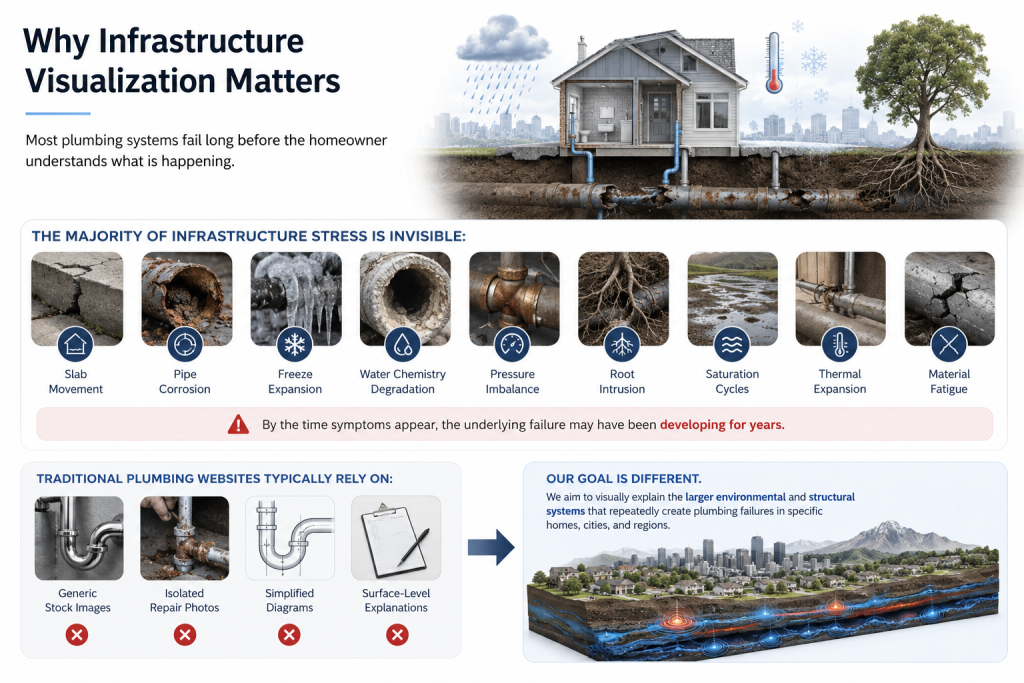
Why Infrastructure Visualization Matters
Most plumbing systems fail long before the homeowner understands what is happening.
The majority of infrastructure stress is invisible:
- slab movement
- pipe corrosion
- freeze expansion
- water chemistry degradation
- pressure imbalance
- root intrusion
- saturation cycles
- thermal expansion
- material fatigue
By the time symptoms appear, the underlying failure may have been developing for years.
Traditional plumbing websites typically rely on:
- generic stock images
- isolated repair photos
- simplified diagrams
- surface-level explanations
Our goal is different.
We aim to visually explain the larger environmental and structural systems that repeatedly create plumbing failures in specific homes, cities, and regions.
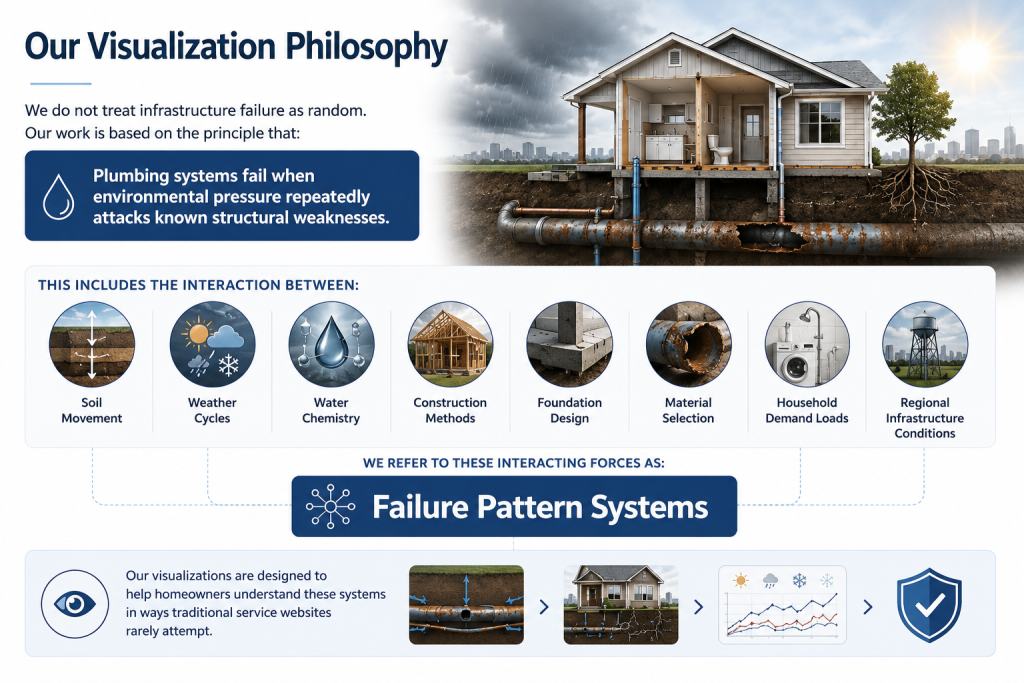
Our Visualization Philosophy
We do not treat infrastructure failure as random.
Our work is based on the principle that:
Plumbing systems fail when environmental pressure repeatedly attacks known structural weaknesses.
This includes the interaction between:
- soil movement
- weather cycles
- water chemistry
- construction methods
- foundation design
- material selection
- household demand loads
- regional infrastructure conditions
We refer to these interacting forces as:
Failure Pattern Systems
Our visualizations are designed to help homeowners understand these systems in ways traditional service websites rarely attempt.
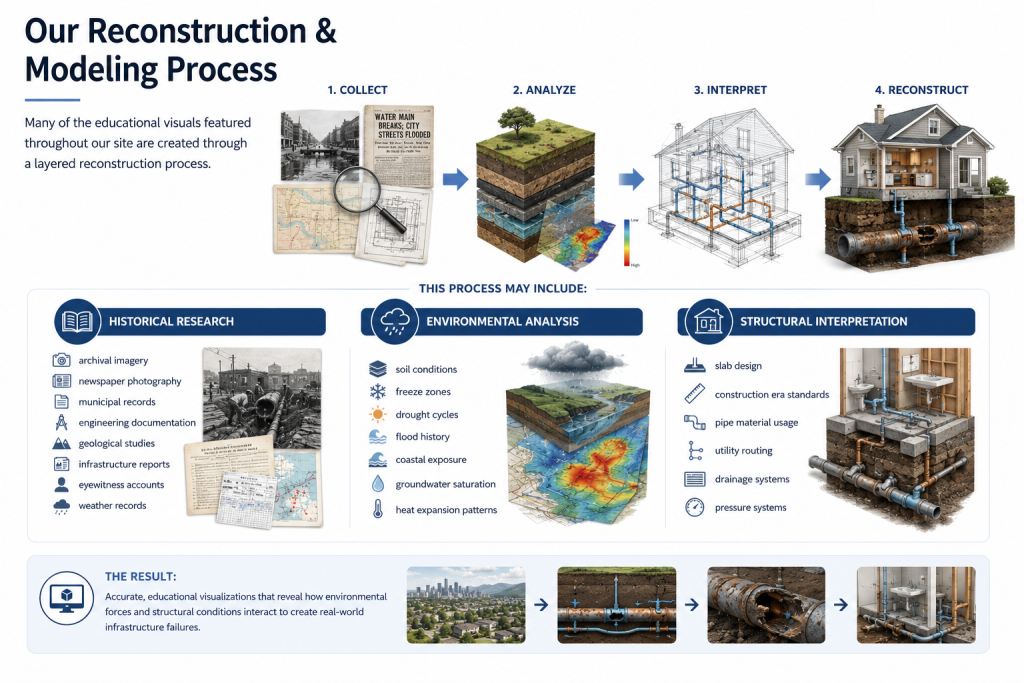
Our Reconstruction & Modeling Process
Many of the educational visuals featured throughout our site are created through a layered reconstruction process.
This process may include:
Historical Research
- archival imagery
- newspaper photography
- municipal records
- engineering documentation
- geological studies
- infrastructure reports
- eyewitness accounts
- weather records
Environmental Analysis
- soil conditions
- freeze zones
- drought cycles
- flood history
- coastal exposure
- groundwater saturation
- heat expansion patterns
Structural Interpretation
- slab design
- construction era standards
- pipe material usage
- utility routing
- drainage systems
- pressure systems
Technical Failure Modeling
We use visual reconstruction techniques to model:
- underground pipe stress
- slab leak progression
- corrosion behavior
- structural collapse conditions
- freeze expansion
- saturation failure
- infrastructure chain reactions
AI-Assisted Visualization
Advanced generative AI systems may be used to create:
- historical reconstructions
- educational diagrams
- environmental simulations
- infrastructure visualizations
- invisible system modeling
- conceptual failure sequences
These visuals are designed to improve educational clarity and infrastructure understanding.

Visual Evidence Classification System
To maintain transparency, our visual assets may fall into different evidence categories.
Level 1 — Historical Documentation
Original archival photographs, municipal records, engineering documents, or verified historical imagery.
Level 2 — Site-Based Reconstruction
High-fidelity reconstructions based on:
- verified geography
- known structural layouts
- historical weather conditions
- documented timelines
- regional infrastructure conditions
Level 3 — Technical Failure Modeling
AI-assisted or digitally modeled scenes designed to explain:
- underground failures
- hidden plumbing conditions
- environmental pressure systems
- infrastructure collapse mechanics
Level 4 — Educational Visualization
Illustrative scenes created to help explain concepts, risks, and failure progression for educational purposes.
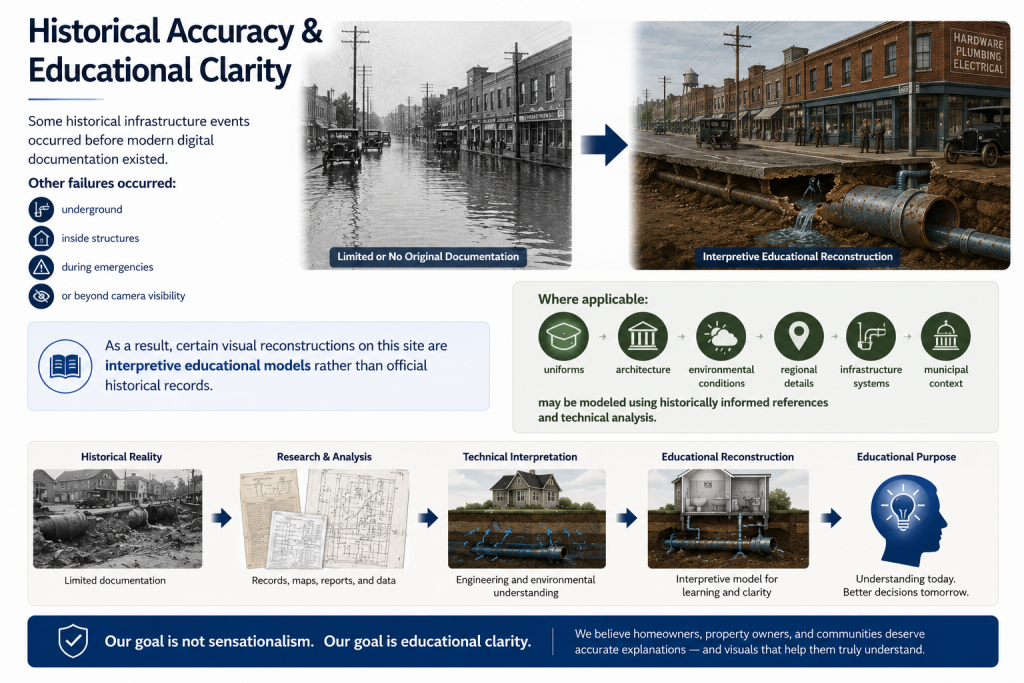
Historical Accuracy & Educational Clarity
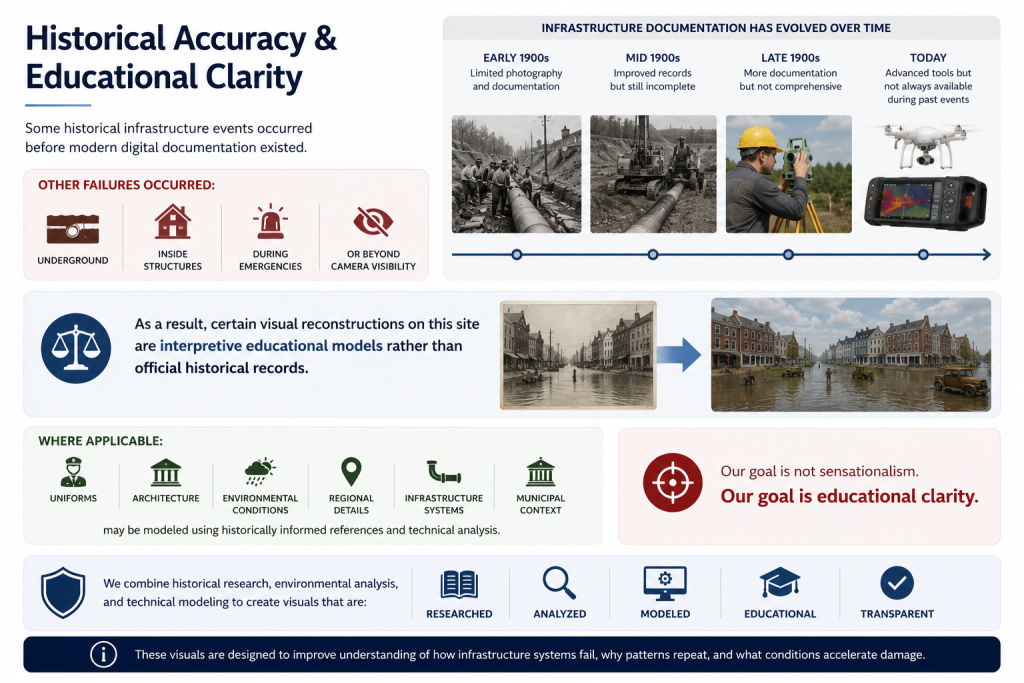
Some historical infrastructure events occurred before modern digital documentation existed.
Other failures occurred:
- underground
- inside structures
- during emergencies
- or beyond camera visibility
As a result, certain visual reconstructions on this site are interpretive educational models rather than official historical records.
Where applicable:
- uniforms
- architecture
- environmental conditions
- regional details
- infrastructure systems
- municipal context
may be modeled using historically informed references and technical analysis.
Our goal is not sensationalism.
Our goal is educational clarity.
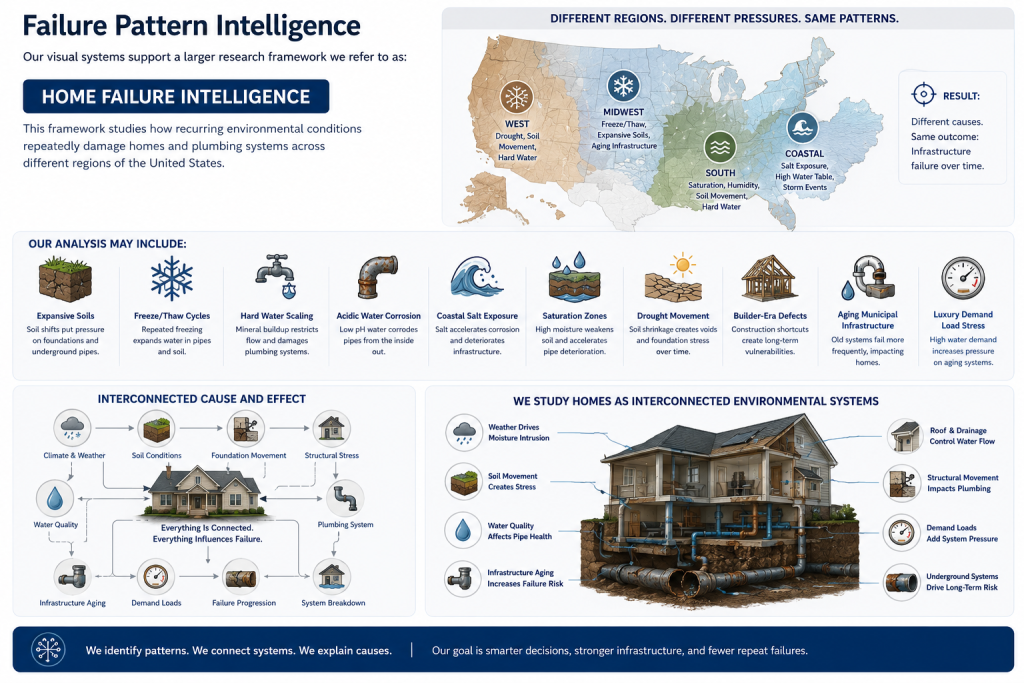
Failure Pattern Intelligence
Our visual systems support a larger research framework we refer to as:
Home Failure Intelligence
This framework studies how recurring environmental conditions repeatedly damage homes and plumbing systems across different regions of the United States.
Our analysis may include:
- expansive soils
- freeze/thaw cycles
- hard water scaling
- acidic water corrosion
- coastal salt exposure
- saturation zones
- drought movement
- builder-era defects
- aging municipal infrastructure
- luxury demand load stress
Rather than viewing plumbing as isolated components, we study homes as interconnected environmental systems.

Educational Purpose
The visualizations and reconstructions throughout this website are intended for:
- homeowner education
- infrastructure awareness
- failure pattern analysis
- technical communication
- historical interpretation
- environmental understanding
These visualizations should not be interpreted as official municipal records, engineering certifications, or government-issued documentation unless explicitly identified as such.
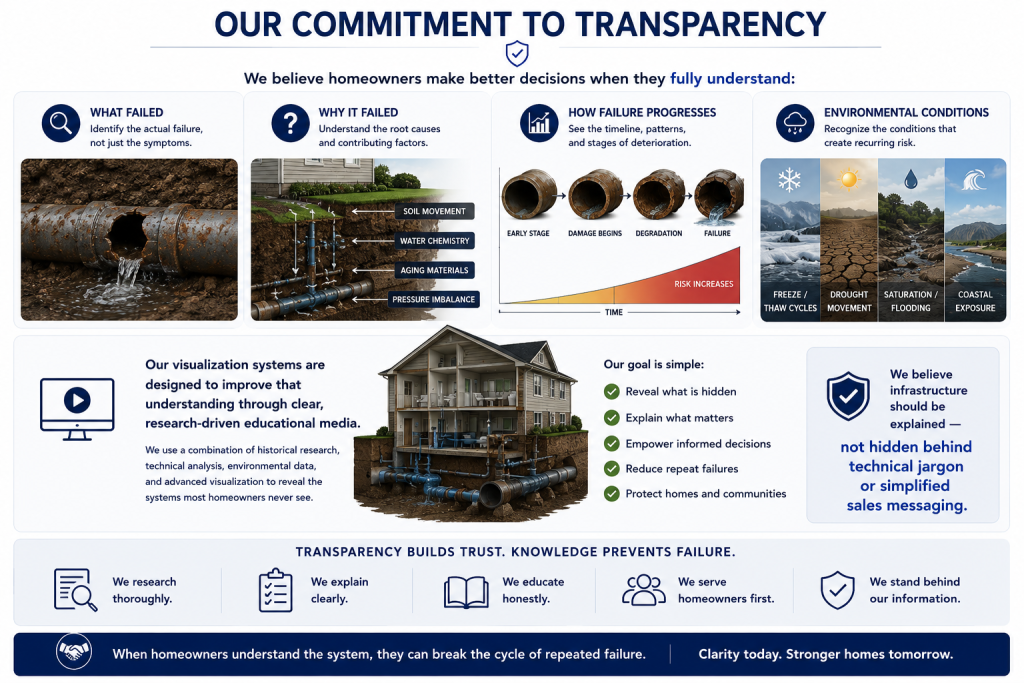
Our Commitment to Transparency
We believe homeowners make better decisions when they fully understand:
- what failed
- why it failed
- how failure progresses
- and what environmental conditions create recurring risk
Our visualization systems are designed to improve that understanding through clear, research-driven educational media.
We believe infrastructure should be explained — not hidden behind technical jargon or simplified sales messaging.
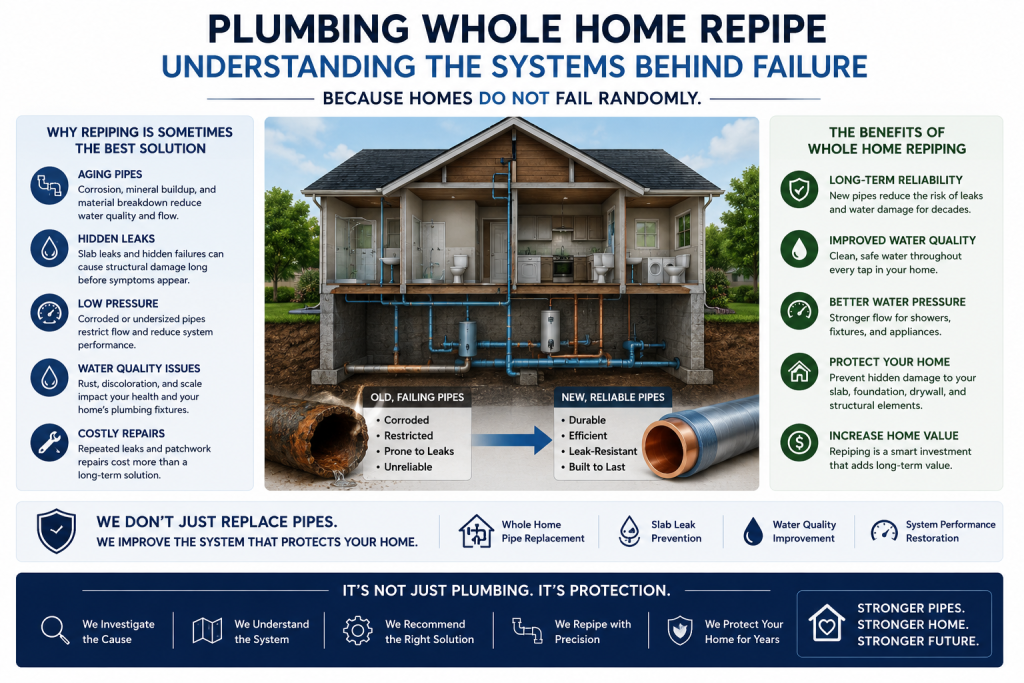
Plumbing Whole Home Repipe
Understanding the Systems Behind Failure
Because homes do not fail randomly.
Failure Classification Structure
Our research framework organizes residential infrastructure failures into multiple layers of environmental force, material stress, and system escalation behavior.
National Forces
- Ground Force
- Water Chemistry Force
- Weather Force
- Construction Era Force
- Demand Load Force
Failure Families
- Slab Stress Failure
- Saturation Failure
- Hard Water Scale Failure
- Freeze Expansion Failure
- Human-System Failure
- Coastal Corrosion Failure
- Pressure Escalation Failure
- Root Intrusion Failure
- Thermal Expansion Failure
Escalation Categories
- Hidden Damage
- Structural Movement
- Pressure Accumulation
- Material Fatigue
- System Instability
- Moisture Migration
- Progressive Corrosion
- Subsurface Erosion
Visualization Inputs
Our visualization and failure analysis systems may incorporate multiple environmental, structural, historical, and observational inputs to better understand recurring residential infrastructure conditions.
Visualization inputs may include:
- historical infrastructure events
- regional soil conditions
- municipal water characteristics
- construction-era plumbing materials
- environmental stress patterns
- thermal expansion exposure
- freeze/thaw cycling
- saturation conditions
- corrosion environments
- pressure instability patterns
- homeowner symptom reports
- contractor field observations
- structural movement indicators
- underground moisture migration
- drainage and venting behavior
- material aging signatures
- regional climate behavior
- slab movement conditions
- erosion indicators
- subsurface instability patterns