

Ground Force

Definition
Ground Force is the environmental pressure created by the earth underneath and around the plumbing system.
The plumbing system depends on stable support.
When the ground moves, expands, contracts, freezes, erodes, settles, shifts, saturates, or loses support, the plumbing absorbs that stress.
Ground movement rarely looks dramatic at first.
Most systems fail slowly.
Small shifts become pipe stress.
Pipe stress becomes recurring symptoms.
Recurring symptoms become visible plumbing damage.
How Ground Attacks Plumbing
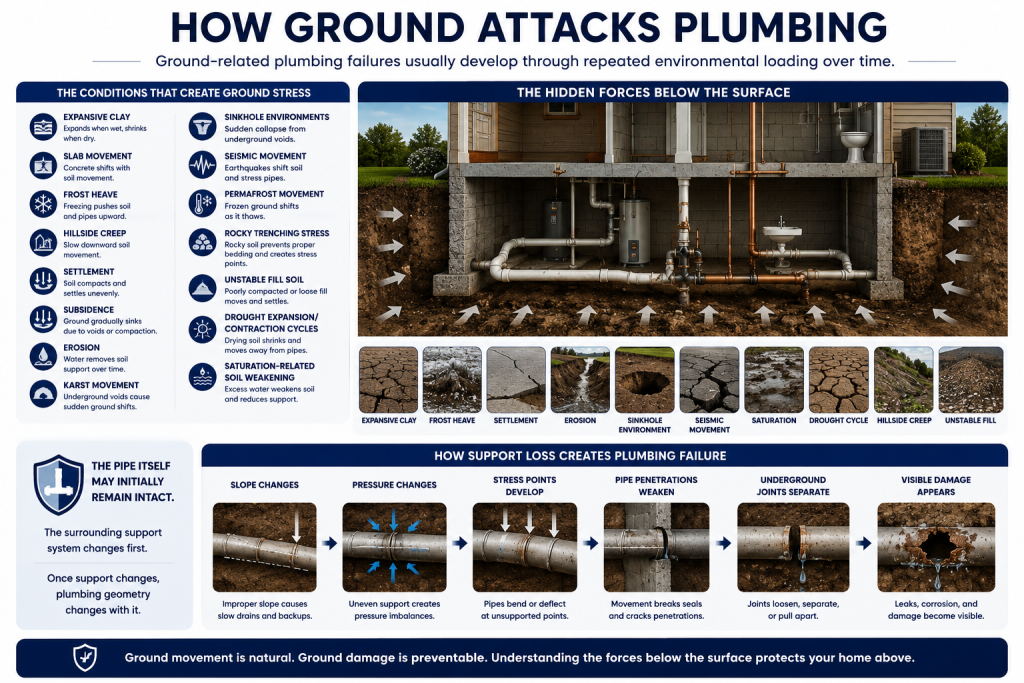
Ground-related plumbing failures usually develop through repeated environmental loading over time.
These conditions include:
- expansive clay
- slab movement
- frost heave
- hillside creep
- settlement
- subsidence
- erosion
- karst movement
- sinkhole environments
- seismic movement
- permafrost movement
- rocky trenching stress
- unstable fill soil
- drought expansion/contraction cycles
- saturation-related soil weakening
The pipe itself may initially remain intact.
The surrounding support system changes first.
Once support changes, plumbing geometry changes with it.
Slope changes.
Pressure changes.
Stress points develop.
Pipe penetrations weaken.
Underground joints separate.

Why Ground Force Matters
Most homeowners think plumbing failure begins inside the pipe.
Many failures actually begin outside the pipe.
The environment underneath the home continuously interacts with:
- foundations
- buried drains
- water service lines
- slab penetrations
- sewer slope
- underground supports
- trench bedding
- crawlspace supports
This is why two homes with the same pipe material can fail completely differently depending on geography.
The plumbing system is not isolated from the environment.
It is physically connected to the ground around it.

Strong Ground Force States
Ground Force strongly affects:
Texas
Colorado
California
Florida
Tennessee
Kentucky
Missouri
Pennsylvania
Utah
Arizona
Nevada
Georgia
North Carolina
South Carolina
Oklahoma
Kansas
Illinois
Alaska
Hawaii
Texas Version
Texas plumbing systems are heavily influenced by expansive clay.
During wet periods, the soil expands.
During drought conditions, the soil contracts.
That repeated movement places stress on slab foundations and under-slab plumbing.
Small shifts become recurring slab leaks, sewer bellies, and foundation-adjacent plumbing damage.
Colorado Version
Colorado combines expansive soils, freeze-thaw cycles, elevation variation, and mountain terrain.
The plumbing system experiences both vertical and horizontal stress.
Long pipe runs, freeze exposure, and soil movement create layered pressure conditions.
California Version
California Ground Force is shaped by seismic movement, hillside terrain, drought cycles, settlement variation, and older infrastructure.
Many plumbing systems operate inside environments where the ground itself is constantly changing.
Slope movement and older remodel layering often increase hidden stress.
Florida Version
Florida Ground Force is different from Texas.
The issue is less about expansive clay and more about unstable support conditions.
High water tables, limestone environments, saturation, erosion, and subsurface void conditions create shifting support underneath slabs and sewer systems.
Tennessee / Kentucky Version
Large portions of Tennessee and Kentucky operate inside karst terrain.
Limestone dissolution, caves, underground drainage paths, and irregular subsurface support create unpredictable underground movement conditions.
Drain slope instability and recurring sewer issues are common symptoms.
Hawaii Version
Hawaii Ground Force combines volcanic terrain, slope movement, lava tube environments, erosion, and saturation exposure.
Many systems operate on steep terrain where long runs, exposed routing, and unstable support conditions increase plumbing stress.
Ground Force Failure Signature
Common Ground Force symptoms include:
- slab leaks
- recurring underground leaks
- sewer bellies
- pipe separation
- drain slope loss
- recurring foundation-adjacent leaks
- cracked underground lines
- recurring sewer backups
- warm floors
- unexplained water bills
- pipe stress near slab penetrations
- recurring repairs in the same area
- shifting drain performance after weather changes
Ground Force Timeline
Stage 1 — Environmental Loading
The ground underneath the home begins changing.
Examples:
- drought shrinkage
- heavy saturation
- freeze expansion
- hillside movement
- settlement
- erosion
No visible plumbing failure exists yet.
Stage 2 — Structural Stress
The plumbing system begins absorbing movement.
Examples:
- pipe bending
- support stress
- drain slope change
- slab penetration stress
- underground joint loading
Stage 3 — Symptom Phase
The homeowner notices inconsistent symptoms.
Examples:
- intermittent drain problems
- warm flooring
- recurring leaks
- shifting water pressure
- sewer odor
- isolated foundation moisture
Stage 4 — Recurring Failure
Repairs occur.
The environmental pressure remains active.
Examples:
“We already repaired this leak.”
“The sewer backed up again.”
“Another pipe failed nearby.”
Stage 5 — Damage Event
The environmental pattern becomes visible system damage.
Examples:
- major slab leak
- sewer collapse
- underground separation
- foundation-adjacent plumbing failure
- recurring under-slab repair
- full repipe or reroute conditions
Foundation Interaction
Ground Force affects every foundation type differently.
Slab-on-Grade Homes
Most vulnerable to:
- slab leaks
- pipe stress
- soil movement
- hidden underground damage
- sewer bellies
Crawlspace Homes
Most vulnerable to:
- pier shifting
- support movement
- sagging drains
- exposed pipe stress
Basement Homes
Most vulnerable to:
- settlement cracks
- sewer movement
- foundation seepage interaction
- freeze-related stress
Hillside Homes
Most vulnerable to:
- slope movement
- long-run stress
- sewer slope instability
- retaining/drainage interaction
Detection Difficulty Score
Ground Force failures are often difficult to diagnose because the plumbing symptom appears far away from the environmental cause.
Easy to Detect:
- visible settlement
- foundation cracking
- major slab leak
Medium Detection:
- sewer bellies
- recurring slope issues
- isolated underground stress
Hard to Detect:
- slow subsurface movement
- hidden slab stress
- long-term support instability
- early-stage underground separation
Most Vulnerable Homes
- slab-on-grade homes
- hillside properties
- older sewer systems
- homes with long underground runs
- production subdivision construction
- homes built on expansive clay
- homes near drainage corridors
- older remodel-layered systems
- homes with previous foundation movement
Homeowner Translation
The plumbing system may not be failing because the pipe was defective.
The ground underneath the home may be slowly changing shape around it.
Contractor Translation
Ground Force failures occur when environmental movement alters support conditions, slab geometry, underground slope, or stress distribution across buried plumbing systems.
The plumbing failure is often the visible result of long-term environmental loading.
Final Positioning Line
Ground-related plumbing failures usually begin underneath the home long before visible water damage appears. The pipe often breaks last. The environmental stress usually starts first.