



Hard Water / Scale Failure
How This Helps Homeowners
Hard water failure rarely begins with a visible plumbing emergency.
Most systems deteriorate slowly.
Minerals build inside piping year after year while homeowners continue using the system normally. Pressure gradually changes. Water heaters become less efficient. Fixture flow decreases. Internal pipe diameter shrinks. Heat transfer becomes restricted. Eventually the plumbing system begins operating under conditions it was never designed to handle.
Many homeowners notice symptoms separately:
- weaker showers
- noisy water heaters
- white mineral buildup
- changing water pressure
- recurring fixture repairs
- rising utility costs
The underlying connection often goes unnoticed.
Hard water and mineral scale quietly change how residential plumbing systems behave across entire regions of the United States. Roughly 80–85% of U.S. water supplies contain hard water conditions caused by dissolved calcium and magnesium moving through mineral-rich geology.
Understanding scale failure helps homeowners recognize why plumbing systems in Arizona, Nevada, Texas, Utah, parts of California, and other mineral-heavy regions experience accelerated infrastructure stress.
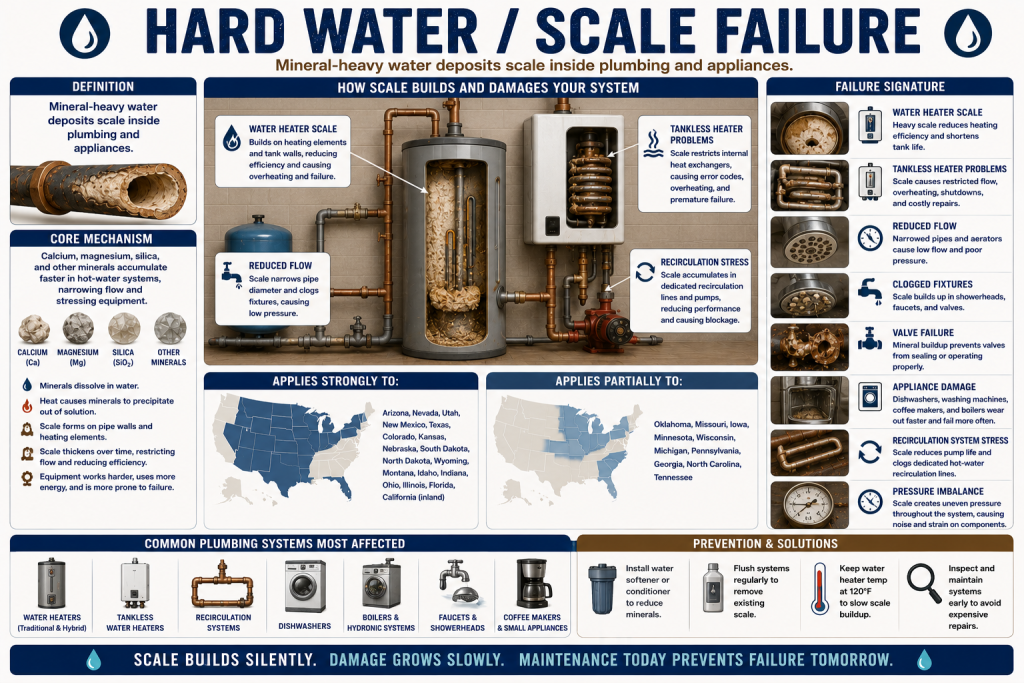
What Is Hard Water / Scale Failure?
Hard water failure develops when dissolved minerals repeatedly move through residential plumbing systems and begin attaching to pipe walls, fixtures, valves, appliances, and heating components.
Over time those minerals harden into scale.
Scale buildup changes plumbing behavior from the inside outward.
Water flow becomes restricted. Heat transfer slows. Pressure behavior changes throughout the system. Internal turbulence increases near fittings and bends. Older materials begin degrading faster beneath mineral accumulation.
The damage often develops invisibly for years before major failure appears.
Unlike sudden plumbing emergencies, scale failure behaves more like long-term infrastructure compression.
Why Hard Water Creates Hidden System Stress
Mineral accumulation rarely spreads evenly.
Scale typically develops faster:
- near water heaters
- inside hot-water lines
- around valves
- near elbows and fittings
- at fixture restrictions
- inside older galvanized piping
- in areas with inconsistent flow
Heating accelerates mineral separation.
That is why water heaters often become the first major warning sign in hard water regions. Sediment accumulates inside tanks while heat exchangers slowly lose efficiency. Rumbling noises, popping sounds, fluctuating temperatures, and longer recovery times frequently appear before homeowners realize scale is already affecting the broader plumbing system.
Pressure behavior also changes as pipe diameter narrows internally.
A system that originally operated under balanced flow conditions may begin developing:
- localized pressure spikes
- inconsistent fixture delivery
- accelerated valve wear
- turbulence near restrictions
- weakened joints and fittings
The plumbing system slowly transitions from stable operation into active infrastructure stress.
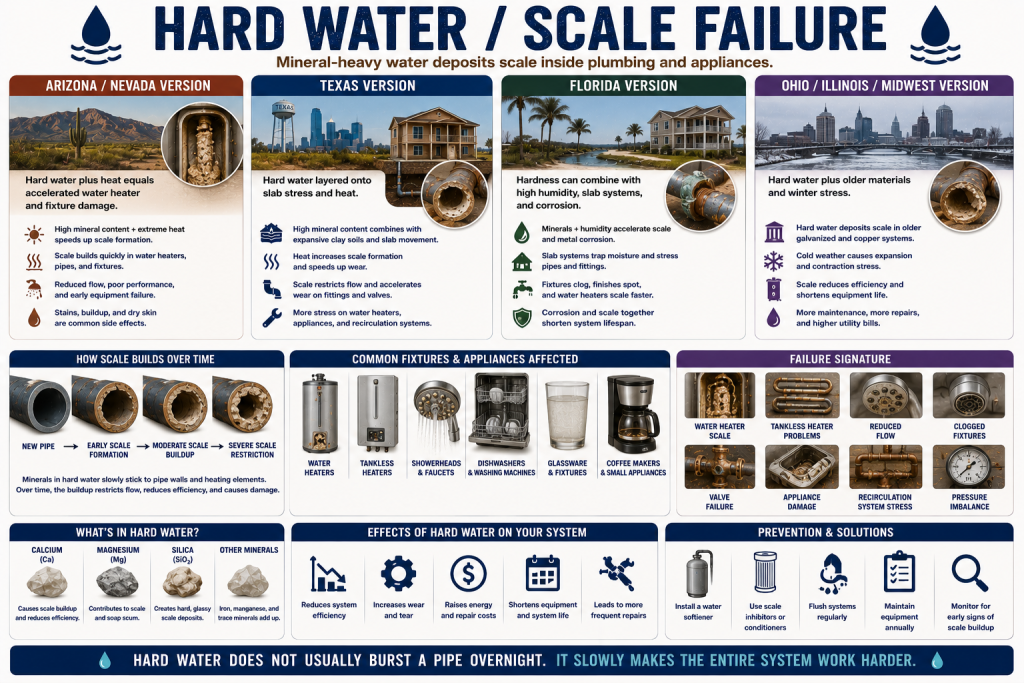
Regions Most Associated With Hard Water / Scale Failure
Hard water conditions develop differently across the country depending on geology, municipal supply conditions, groundwater exposure, and construction growth.
High-risk mineral and scale regions include:
Arizona
Extreme mineral content combines with high heat exposure and rapid construction growth.
Nevada
Hard water and pressure variability frequently accelerate fixture degradation and heater stress.
Utah
Elevated mineral levels commonly affect water heaters, valves, and hot-water systems.
Inland California
Many regions experience aggressive scale buildup combined with aging copper infrastructure.
Texas
Large residential systems and hard water conditions create long-term flow restriction issues.
Colorado
Mineral-heavy mountain water and temperature fluctuation increase scale accumulation inside heating systems.
Different environments produce different failure behavior.
Some systems experience pressure restriction first.
Others develop corrosion beneath scale accumulation.
Certain homes begin showing fixture damage years before hidden piping problems become visible.
How Scale Changes Plumbing Behavior
Scale does not simply “clog pipes.”
It changes the entire operating condition of the plumbing system.
As buildup thickens:
- flow velocity changes
- turbulence increases
- heat transfer decreases
- pressure balance shifts
- material fatigue accelerates
Galvanized systems become especially vulnerable because rough interior walls trap mineral deposits easily. Copper systems resist buildup longer but often develop pitting near bends, fittings, and hot-water loops. Even newer systems can experience valve restriction and fixture degradation over time.
Water heaters frequently absorb the largest operational stress.
Mineral sediment settles continuously inside tanks while heating elements work harder to maintain output. Efficiency drops. Internal temperatures rise. Tank lifespan shortens.
Many homeowners mistake these conditions for isolated appliance problems when the broader plumbing system is already under mineral stress.
Common Signs Of Hard Water / Scale Failure
Hard water failure usually announces itself through small environmental clues before major plumbing damage develops.
Common warning patterns include:
- white mineral buildup around fixtures
- cloudy glassware
- changing shower pressure
- noisy water heaters
- recurring faucet cartridge replacement
- slow hot-water recovery
- stuck valves
- mineral staining
- pinhole leaks
- pressure imbalance between fixtures
In older systems, corrosion may begin forming beneath hardened scale deposits. Hidden pipe deterioration can continue for years before rupture or leakage becomes visible.
Many homeowners treat each symptom separately while the underlying system condition continues escalating.
Why Scale Failure Is Increasing Across America
Several national trends are intensifying hard water stress across residential infrastructure systems.
Older plumbing materials remain active far beyond original design expectations.
Modern homes place larger simultaneous demand loads on plumbing systems through:
- multiple bathrooms
- oversized tubs
- irrigation systems
- recirculation loops
- high-demand appliances
- larger water heaters
Population growth in high-mineral regions is also accelerating construction across areas already known for difficult water chemistry.
At the same time, many homeowners remain unaware that mineral accumulation is altering system behavior internally long before visible damage appears.
The result is a slow-moving national infrastructure problem hidden behind otherwise normal daily plumbing use.
The Infrastructure Pattern Behind Hard Water Failure
Hard water failure is ultimately a pressure, heat, and time problem operating simultaneously inside residential systems.
Minerals slowly narrow flow paths.
Heat accelerates separation.
Pressure behavior changes.
Materials weaken beneath buildup.
The plumbing system gradually loses its original operating balance.
Most homeowners only recognize the problem after:
- fixture failure
- water heater breakdown
- slab leak conditions
- pressure instability
- pipe restriction
- hidden corrosion
- major repipe recommendations
The visible plumbing event usually appears long after the infrastructure stress already existed.