
Legacy Material Failure
Definition
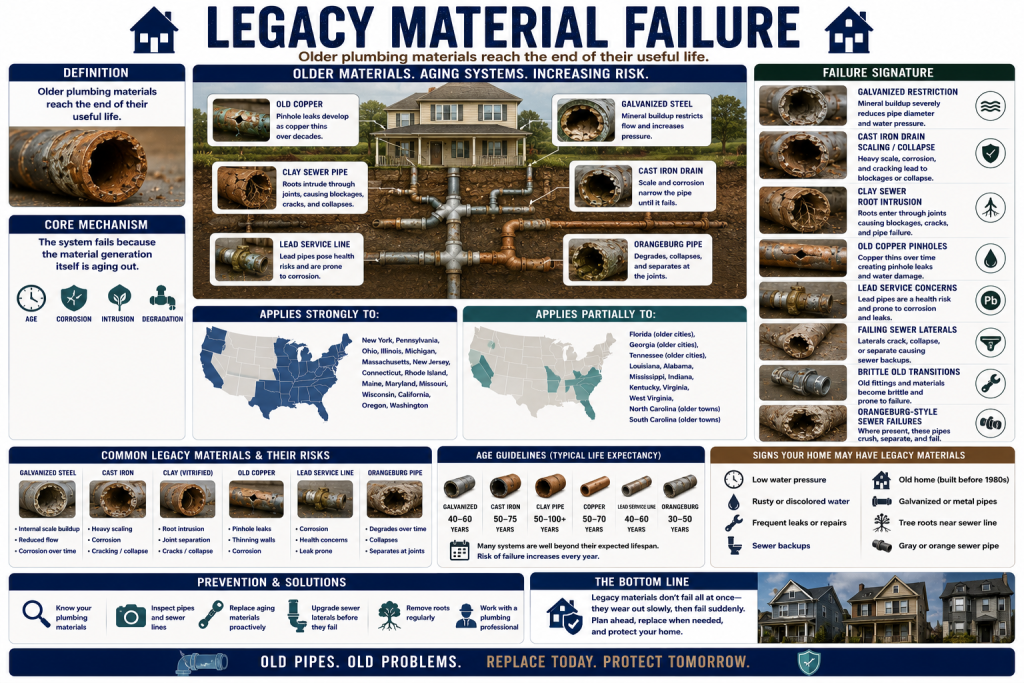
Legacy Material Failure occurs when older plumbing materials gradually lose structural reliability as they age, corrode, restrict, weaken, separate, or deteriorate over decades of environmental exposure.
Every plumbing generation was built using the materials, standards, and construction assumptions of its era.
Many of those materials were never designed to handle:
- modern water demand
- current pressure conditions
- decades of corrosion
- repeated remodel layering
- aggressive water chemistry
- environmental stress loading
- long-term system aging
The visible plumbing problem is often the final stage of long-term material deterioration.
How Legacy Materials Fail
Older plumbing systems often deteriorate slowly over decades before visible symptoms appear.
Different material generations fail differently.
Legacy Material Failure conditions include:
- galvanized steel restriction
- cast iron corrosion
- clay sewer deterioration
- Orangeburg sewer collapse
- early copper pinhole conditions
- brittle aging transitions
- lead-era plumbing concerns
- aging brass deterioration
- sewer joint separation
- corrosion scaling
- long-term internal restriction
- mixed-generation plumbing stress
- aging municipal service lines
Legacy systems may continue functioning while hidden deterioration quietly increases throughout the plumbing network.
Why This Failure Family Matters
Most homeowners think plumbing systems fail because of one isolated leak.
Legacy systems often fail because the material generation itself is reaching the end of its functional lifespan.
This is why older homes frequently experience:
- recurring leaks
- pressure loss
- drain instability
- sewer backups
- recurring pipe repairs
- fixture inconsistency
- hidden corrosion
- multiple failures across different areas of the home
Many older systems continue functioning long after deterioration has already started.
The plumbing may still “work.”
The material stability underneath the system may already be failing.
Older unlined cast iron systems are especially vulnerable to corrosion, scaling, and internal restriction over time.
Galvanized steel systems are also known to develop severe internal rust buildup and restriction as the protective zinc layer deteriorates with age.
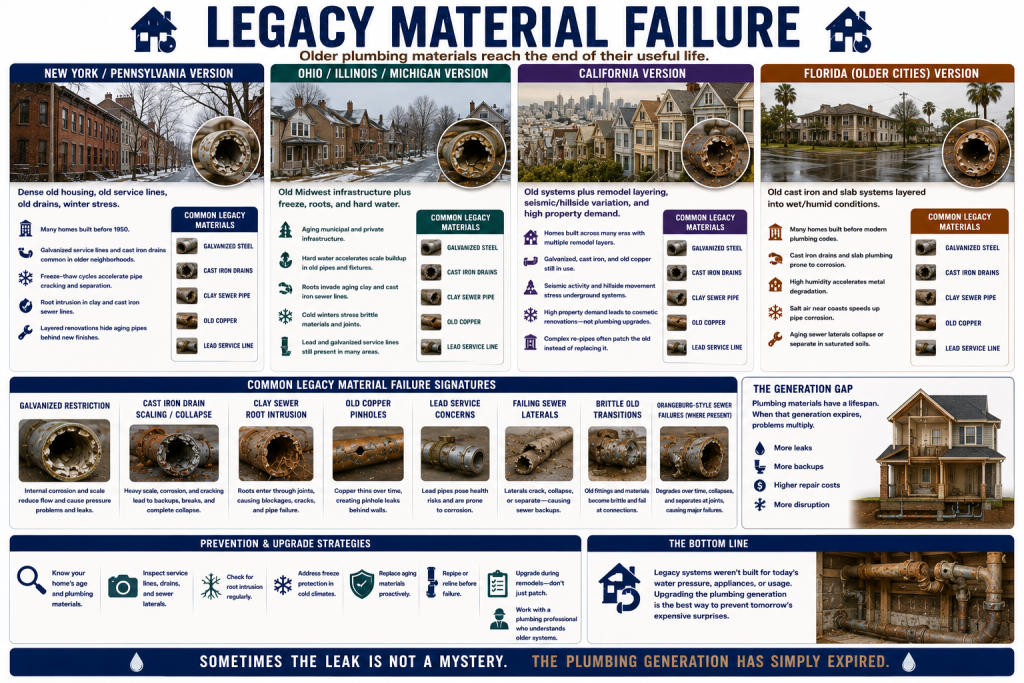
Common Legacy Plumbing Materials
Galvanized Steel
Widely used in older homes before copper and plastic systems became common.
Most vulnerable to:
- internal rust buildup
- severe flow restriction
- pressure loss
- corrosion scaling
- brittle aging
Galvanized systems often experience major internal restriction after decades of use.
Cast Iron Drain Systems
Common in homes built before the 1970s and early 1980s.
Most vulnerable to:
- corrosion
- scaling
- cracking
- sewer collapse
- joint separation
- root intrusion after deterioration
Cast iron sewer systems commonly deteriorate over time depending on soil conditions, water chemistry, installation quality, and environmental exposure.
Clay Sewer Laterals
Common in older urban neighborhoods and legacy infrastructure environments.
Most vulnerable to:
- joint separation
- root intrusion
- settlement
- cracking
- offset connections
The pipe itself may survive for decades while the joints gradually destabilize.
Orangeburg Sewer Pipe
Used heavily from the 1940s through portions of the 1970s.
Most vulnerable to:
- collapse
- deformation
- saturation damage
- crushing
- sagging
Many systems now operate beyond their expected lifespan.
Early Copper Systems
Many older copper systems now experience:
- pinhole leaks
- wall thinning
- aggressive-water corrosion
- fitting deterioration
- recirculation wear
Water chemistry heavily affects long-term copper stability.
Why Different Materials Fail Differently
Every plumbing material reacts differently to:
- water chemistry
- freeze cycles
- heat exposure
- soil movement
- saturation
- demand overload
- installation quality
- age
This is why two homes built in different decades often develop completely different plumbing problems even inside the same city.
The failure pattern usually follows the material generation underneath the home.
Strong Legacy Material States
New York
Pennsylvania
Ohio
Illinois
Michigan
Massachusetts
New Jersey
California
Florida
Texas
Georgia
North Carolina
Tennessee
Wisconsin
Missouri
Northeast Legacy Infrastructure Version
Older Northeast homes frequently combine:
- galvanized systems
- cast iron drains
- clay laterals
- aging municipal infrastructure
- basement plumbing
- multiple remodel generations
Many plumbing systems now operate decades beyond their original intended lifespan.
Midwest Version
Illinois, Ohio, Michigan, Wisconsin, and surrounding Midwest states frequently combine aging sewer systems, hard water, freeze exposure, mature trees, and older service lines.
Environmental loading often accelerates long-term material deterioration.
California Version
California legacy plumbing systems often combine older materials with repeated remodel layering.
Homes frequently contain multiple plumbing generations operating together inside the same structure.
The system may no longer behave like one unified installation.
Florida Version
Florida legacy systems frequently combine aging cast iron drains, slab foundations, saturation, humidity, and coastal corrosion.
Many older drain systems now operate inside continuously moisture-heavy environments.
Texas / Southwest Version
Texas, Arizona, Nevada, and surrounding growth states often contain subdivision-era plumbing systems now experiencing slab stress, hard water, heat expansion, and long-term demand overload simultaneously.
Failure Signature
Common Legacy Material symptoms include:
- low water pressure
- recurring leaks
- rust-colored water
- sewer backups
- drain instability
- recurring clogs
- fixture inconsistency
- metallic taste
- cast iron scaling
- galvanized restriction
- sewer lateral deterioration
- recurring hidden leaks
- pipe cracking
- root intrusion
- aging transition failure
Failure Timeline
Stage 1 — Material Aging
The plumbing materials begin deteriorating internally.
Examples:
- corrosion
- restriction
- wall thinning
- scaling
- brittle aging
No visible plumbing failure exists yet.
Stage 2 — System Weakening
The plumbing system begins losing long-term reliability.
Examples:
- pressure loss
- drain instability
- hidden corrosion
- fitting deterioration
- sewer weakening
Stage 3 — Symptom Phase
The homeowner notices recurring plumbing problems.
Examples:
- low pressure
- slow drains
- recurring clogs
- discolored water
- isolated leaks
- sewer odor
Stage 4 — Recurring Failure
Repairs occur.
The aging material system remains active.
Examples:
“Another section failed.”
“The same drain keeps backing up.”
“We already repaired plumbing in this area.”
Stage 5 — Damage Event
The material deterioration becomes visible plumbing failure.
Examples:
- cast iron collapse
- sewer replacement
- major repipe
- slab leak escalation
- widespread hidden leaks
- recurring system-wide plumbing instability
Foundation Interaction
Legacy systems behave differently depending on foundation type.
Slab-on-Grade Homes
Most vulnerable to:
- hidden deterioration
- under-slab corrosion
- slab leak escalation
- difficult access conditions
Crawlspace Homes
Most vulnerable to:
- exposed corrosion
- support deterioration
- sagging drains
- transition instability
Basement Homes
Most vulnerable to:
- stack deterioration
- aging sewer laterals
- freeze interaction
- moisture loading
Detection Difficulty Score
Legacy Material Failures are often difficult to detect because systems may continue functioning while deterioration quietly spreads internally.
Easy to Detect:
- low pressure
- visible corrosion
- rust-colored water
Medium Detection:
- aging drain instability
- hidden scaling
- recurring sewer issues
Hard to Detect:
- under-slab deterioration
- internal wall thinning
- concealed corrosion
- underground lateral aging
Most Vulnerable Homes
- homes built before 1980
- homes with original plumbing
- older urban homes
- heavily remodeled homes
- homes with mixed plumbing generations
- slab-on-grade homes
- older sewer systems
- homes with aging municipal infrastructure
Failure Visibility
Legacy Material Failures often remain hidden because the plumbing system slowly adapts while deterioration spreads internally over decades.
The homeowner usually notices the system after multiple plumbing problems begin appearing simultaneously.
The visible plumbing problem is often the final stage of long-term material aging.
Homeowner Translation
The plumbing system may not be failing because of one isolated plumbing issue.
The material generation underneath the home may simply be reaching the end of its functional lifespan.
Contractor Translation
Legacy Material Failures occur when aging plumbing materials gradually lose structural reliability through corrosion, restriction, scaling, environmental exposure, and long-term material fatigue.
The visible plumbing failure is often the final stage of decades of accumulated deterioration.
Final Positioning Line
Legacy plumbing systems usually fail slowly long before major damage becomes visible. The materials underneath the home quietly deteriorate for decades until recurring plumbing problems finally reveal that the entire system is aging out.