


Unregulated System Pressure Spike Multi-Point Fixture Failure

Throughout areas like Danville and Menlo Park, older homes often operate for years under artificially reduced pressure due to internal pipe restriction.
As those restrictions are removed during repipe work, underlying system conditions become fully exposed.
Because of this, pressure becomes a hidden variable that only reveals itself after installation.
In cities such as Chicago and Newark, similar patterns appear where aging galvanized steel corrosion masks true municipal supply levels.
Once full flow is restored, systems experience conditions they were never configured to handle.
No contractor was involved in this installation.
All work was performed by the homeowner.
Initial Conditions
Inside a 2,400 sq ft two-story home built in the late 1980s, original galvanized piping had significantly restricted flow.
Water pressure at fixtures appeared weak for years.
Observed symptoms included low water pressure, slow hot water delivery, and sediment in faucet aerators.
Additionally, fluctuating water temperature and occasional banging sounds were present.
Rising water bills and minor pinhole leaks in older sections indicated system degradation.
No pressure testing had been performed at the meter.
Actual municipal pressure conditions were unknown.
What the Homeowner Thought
From the homeowner’s perspective, low pressure was caused by the city supply.
The assumption was that increasing flow would improve system performance.
A full PEX repipe appeared to solve the issue.
The focus remained on restoring proper water delivery.
Pressure control was not considered necessary.
The system was expected to stabilize automatically.

What Was Actually Happening
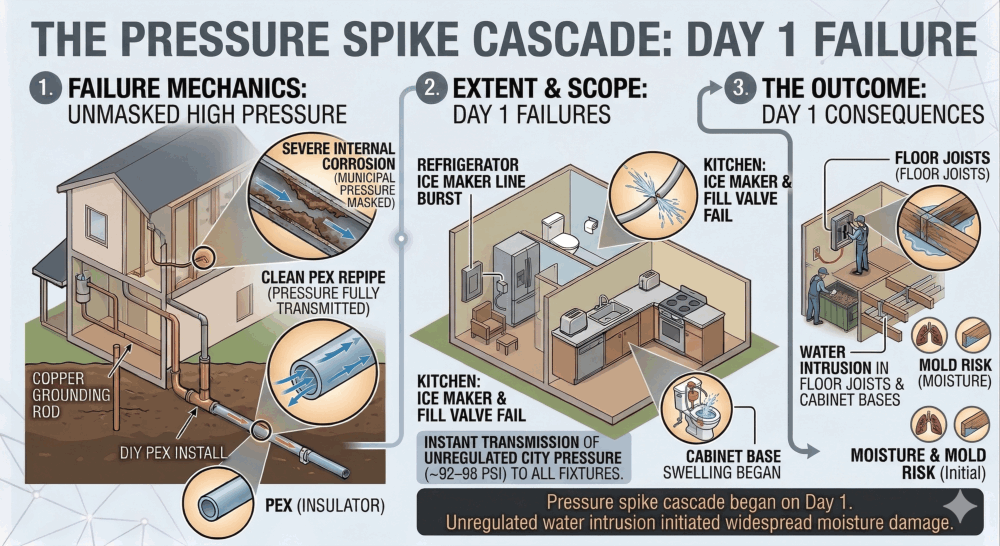
Municipal supply pressure measured between 92 and 98 PSI.
Internal pipe restriction had been limiting that pressure at fixtures.
By removing galvanized piping, full system diameter was restored.
This allowed unrestricted pressure to move through the system.
Fixtures and appliances were not rated for sustained high pressure.
Internal components became vulnerable immediately.
The system transitioned from restricted flow to over-pressurized conditions.
11. Unregulated System Pressure Spike Multi-Point Fixture Failure
12. Dead-Leg Water Stagnation Bacterial Growth Risk Condition
13. Unsupported Piping Expansion and Water Hammer Stress Failure
14. Mixed PEX System Compatibility and Connection Degradation Failure
15. Undersized Distribution Line Flow Restriction System Collapse
16. Sub-Slab Buried Fitting Access and Structural Failure Event
17. Closed-System Thermal Expansion Pressure Accumulation Failure
18. Drain Venting Disruption and Sewer Gas Backflow Condition
19. Plumbing Distribution Mapping and Hot-Cold Cross-Connection Failure
20. Vertical Load-Induced Pipe Support and Base Connection Failure
Homeowner Action (DIY – No Contractor Involved)
No licensed plumber participated in this repipe.
The homeowner independently installed a full PEX system.
PEX-A vs PEX-B selection was not evaluated relative to pressure regulation.
No pressure regulator valve was installed or adjusted.
Main shut-off valves were replaced.
However, pressure conditions were not tested post-installation.

Failure Trigger
Within three days of system activation, high pressure began affecting fixtures.
Weak points in appliance connections experienced stress.
The refrigerator ice maker line failed first.
Shortly after, a washing machine hose ruptured at the crimp.
Two toilet fill valves cracked under sustained pressure.
Multiple failures occurred across the system.
Water discharge continued for approximately six hours during homeowner absence.
Why It Was Not Visible at Install
Immediately after installation, water flow improved significantly.
Increased pressure appeared beneficial at first.
Short-term operation did not exceed visible limits.
System components initially functioned under elevated conditions.
In homes like those in Menlo Park, pressure-related failures often appear after repeated cycles.
Homeowners are not expected to identify pressure thresholds without testing.
Execution & Escalation
Following fixture failures, water spread across the first floor.
Flow continued uninterrupted due to sustained pressure.
Hardwood flooring absorbed moisture rapidly.
Cabinet bases became saturated and began swelling.
Water migrated across approximately 1,200 square feet.
Damage escalated during the absence period.

Extent of Damage
Hardwood floors experienced widespread cupping.
Cabinet structures showed delamination at the base.
Moisture exposure affected multiple rooms.
Drywall and subfloor materials required remediation.
Total restoration costs exceeded $68,000.
Insurance flagged unregulated pressure as a contributing factor.
What Professionals Verify
Professionals measure system pressure at the meter before repipe work.
They identify whether pressure exceeds safe operating thresholds.
Pressure regulator valves are installed or adjusted as required.
System components are evaluated for compatibility with pressure levels.
PEX systems are designed with pressure control in mind.
Fixture connections such as braided supply lines and angle stops are verified under load.
Verification ensures system stability under real operating conditions.
Decision Distortion
The homeowner believed the decision involved improving water flow.
The actual decision involved managing system pressure.
Visible low pressure suggested deficiency.
Hidden high pressure created risk.
This mismatch led to a system-wide failure after installation.
Broader Pattern
In cities like San Ramon and across national markets such as Newark, similar failures occur when pressure is not regulated.
Older systems often conceal true municipal conditions.
Contractor standards data shows failures typically emerge within days to weeks.
Common timelines include 48 hours to early-week system stress events.
The system appears improved initially.
Failure develops under sustained pressure exposure.
Process Context
A whole-house repipe is executed as a controlled system recalibration.
Pressure conditions are evaluated before and after installation.
PEX-A or copper repipe systems are integrated with pressure regulation.
Manifold systems or trunk and branch plumbing layouts are designed for balanced distribution.
Drywall access is strategic and minimal.
Water bypass systems maintain service during installation.
Same-day water restoration is balanced with full system verification.

Permitting & Compliance
City plumbing permits often require pressure compliance with code standards.
Building code inspections verify safe operating conditions.
Unregulated pressure may affect homeowners insurance coverage.
Resale value ROI can be impacted by documented system failures.
Licensed, bonded, and insured professionals ensure proper pressure management.
Outcome Shift
The failure did not result from the PEX installation itself.
It resulted from restoring full pressure without regulation.
If a pressure regulator had been installed, the system would have remained stable.
Fixtures and appliances would have operated within safe limits.
Instead, pressure exposure caused multi-point failure across the system.
Cost & Decision Considerations
Costs extended into flooring replacement and cabinet repair.
Drywall patching and texture matching added additional scope.
Project timelines increased due to drying and reconstruction.
Insurance complications affected claim processing.
Financial exposure exceeded expectations.
Pressure management determined total impact.
Key Takeaway
No contractor was involved in this installation.
All work was performed by the homeowner.
The decision was not about restoring water flow.
The decision was about controlling system pressure.
Pressure determines system stability.
Regulation prevents failure.
Assumption creates cascading damage.