


Undersized Distribution Line Flow Restriction System Collapse
Across neighborhoods like Campbell and San Bruno, repipes often focus on replacing materials while overlooking system sizing requirements.
As fixture demand increases in multi-bath homes, flow capacity becomes a primary design variable.
Because of this, pipe diameter directly influences system performance under load.
In cities such as Chicago and Richmond, similar failures appear when simplified installations ignore demand calculations.
While systems may appear functional initially, performance degradation emerges during real usage conditions.
No contractor was involved in this installation.
All work was performed by the homeowner.
Initial Conditions
Inside a 2,200 sq ft home with three bathrooms, the original system used 3/4-inch trunk lines with 1/2-inch branches.
This configuration supported simultaneous fixture demand.
Pre-existing symptoms included low water pressure during peak usage, fluctuating water temperature, and slow hot water delivery.
Additionally, sediment in faucet aerators and occasional banging sounds were present.
Tankless water heater performance had been inconsistent under load.
The system required balanced distribution across multiple fixtures.
However, sizing requirements were not recalculated during repipe.

What the Homeowner Thought
From the homeowner’s perspective, using 1/2-inch PEX throughout simplified installation.
Smaller pipe size appeared easier to route and connect.
The assumption was that consistent sizing would maintain performance.
Flow demand across fixtures was not considered a limiting factor.
Focus remained on completing the repipe efficiently.
System capacity was not evaluated.
What Was Actually Happening
Reducing the entire system to 1/2-inch piping restricted flow capacity.
Under single-fixture use, the system appeared functional.
However, simultaneous demand created significant pressure drop.
Water flow could not meet the requirements of multiple fixtures.
Tankless water heaters depend on minimum flow thresholds to operate.
Reduced flow caused repeated shutdown cycles.
Appliances requiring stable pressure experienced inconsistent performance.
The system entered a functional failure state rather than a structural one.
11. Unregulated System Pressure Spike Multi-Point Fixture Failure
12. Dead-Leg Water Stagnation Bacterial Growth Risk Condition
13. Unsupported Piping Expansion and Water Hammer Stress Failure
14. Mixed PEX System Compatibility and Connection Degradation Failure
15. Undersized Distribution Line Flow Restriction System Collapse
16. Sub-Slab Buried Fitting Access and Structural Failure Event
17. Closed-System Thermal Expansion Pressure Accumulation Failure
18. Drain Venting Disruption and Sewer Gas Backflow Condition
19. Plumbing Distribution Mapping and Hot-Cold Cross-Connection Failure
20. Vertical Load-Induced Pipe Support and Base Connection Failure
Homeowner Action (DIY – No Contractor Involved)
No licensed plumber participated in this repipe.
The homeowner independently replaced all piping with 1/2-inch PEX.
PEX-A vs PEX-B selection was not evaluated in relation to flow capacity.
No manifold system or trunk and branch plumbing layout was maintained.
Pipe sizing decisions were based on convenience rather than calculation.
The installation proceeded without demand analysis.

Failure Trigger
Once the system was placed under normal household use, multiple fixtures operated simultaneously.
This created cumulative demand across the network.
Flow restriction caused pressure to drop below operational thresholds.
Tankless water heater shutdowns became frequent.
Appliance cycles failed due to insufficient water delivery.
The system could not sustain required performance levels.
Why It Was Not Visible at Install
Immediately after installation, single-fixture performance appeared normal.
Water flowed adequately when demand was low.
Sizing deficiencies only appear under combined usage.
Short-term testing does not replicate full system demand.
In homes like those in Campbell, concealed piping hides distribution limitations.
Homeowners are not expected to calculate flow requirements without system knowledge.
Execution & Escalation
As usage patterns continued, performance issues became consistent.
Showers experienced temperature instability during simultaneous use.
Dishwashers and washing machines failed to complete cycles properly.
Tankless water heater shutdowns increased in frequency.
System reliability declined across all fixtures.
The issue escalated from inconvenience to full system inadequacy.
Extent of Damage
No catastrophic leak occurred.
Structural components remained intact.
However, system functionality was severely compromised.
Daily operations were disrupted across multiple appliances.
Water delivery could not meet household demand.
The failure affected the entire system uniformly.
What Professionals Verify
Professionals calculate flow demand based on fixture count and usage patterns.
They design systems using appropriate trunk and branch plumbing layouts.
Pipe sizing is matched to expected simultaneous demand.
Manifold systems may be used to balance distribution.
PEX-A or copper repipe systems are selected with full capacity planning.
Verification ensures consistent performance under real operating conditions.

Decision Distortion
The homeowner believed the decision involved simplifying installation.
The actual decision involved maintaining system capacity.
Uniform pipe size suggested efficiency.
Hidden flow limitations determined outcome.
This mismatch created performance failure across the system.
Broader Pattern
In areas like Los Altos and across national markets such as Chicago, undersized repipes produce similar outcomes.
Multi-fixture homes are especially vulnerable to capacity loss.
Contractor standards data shows performance failures emerge immediately under load.
Unlike delayed leaks, these issues appear during normal use.
The system appears functional in isolation.
Failure appears under combined demand.
Process Context
A whole-house repipe is executed as a capacity-driven system design.
Flow demand calculations guide pipe sizing decisions.
PEX-A or copper systems are configured to maintain proper distribution.
Horizontal vs vertical repiping layouts are optimized for flow balance.
Drywall access is controlled and minimal.
Water bypass systems maintain service during installation.
Same-day water restoration is balanced with full system verification.
Permitting & Compliance
City plumbing permits require adherence to sizing and flow standards.
Building code inspections verify proper distribution design.
Improper sizing may affect homeowners insurance coverage.
Resale value ROI can be impacted by system performance issues.
Licensed, bonded, and insured professionals ensure compliance with capacity requirements.
Outcome Shift
The failure did not result from material choice alone.
It resulted from reducing system capacity below demand requirements.
If proper sizing had been maintained, the system would have functioned correctly.
All fixtures and appliances would have operated reliably.
Instead, undersizing created a full-system performance collapse.
Cost & Decision Considerations
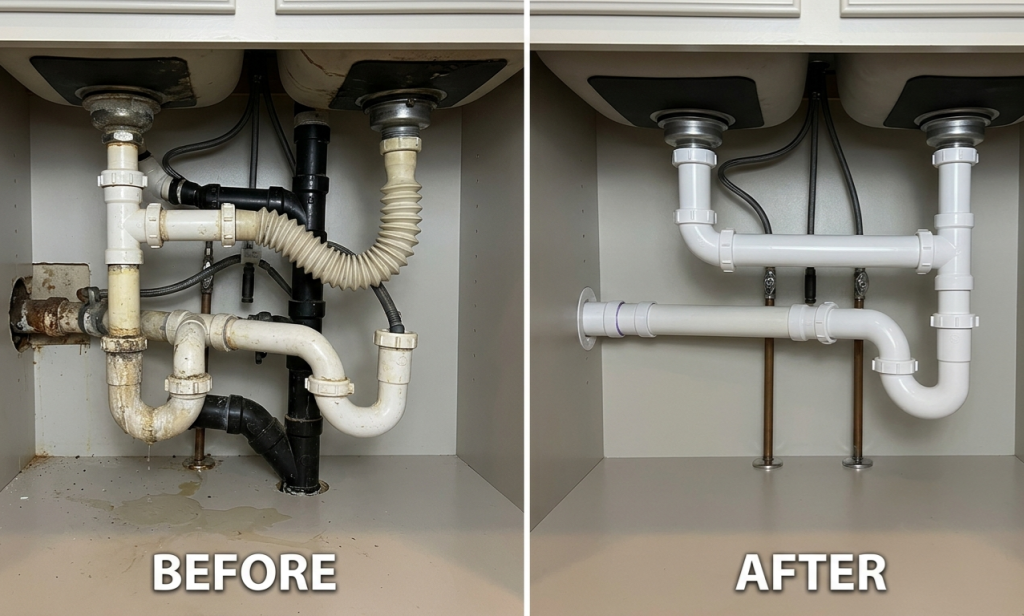
Costs extended into a full re-repipe to correct sizing.
Additional labor and material increased total project expense.
Appliance troubleshooting added time and complexity.
Project timelines expanded due to corrective work.
Financial exposure exceeded initial expectations.
Sizing decisions determined total impact.
Key Takeaway
No contractor was involved in this installation.
All work was performed by the homeowner.
The decision was not about simplifying pipe installation.
The decision was about maintaining system capacity under real demand.
Flow determines performance.
Proper sizing ensures reliability.
Assumption creates system-wide failure.