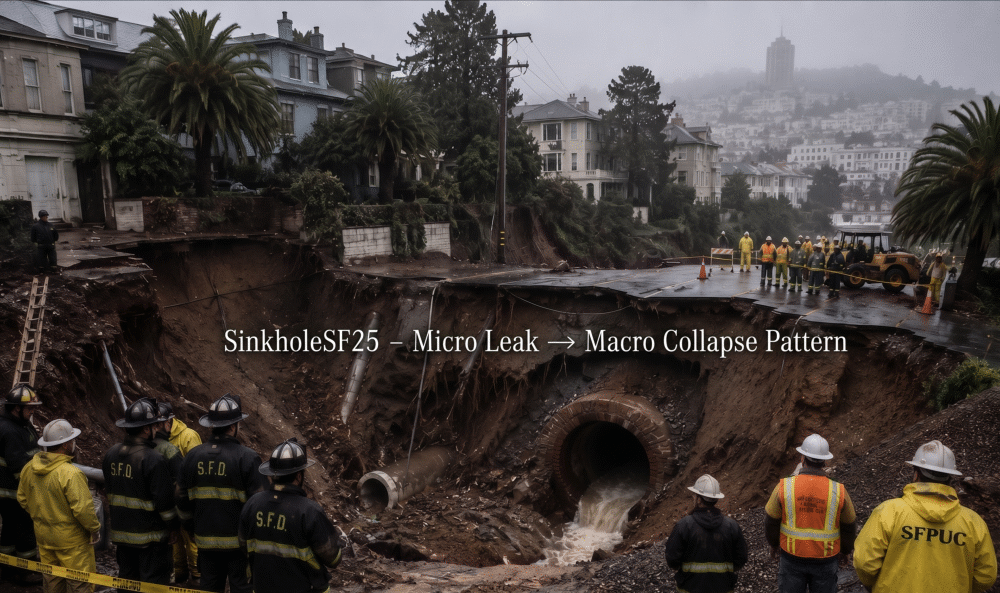
sinkholeSF25 — Micro Leak → Macro Collapse Pattern
Big failures don’t start big.
They start small.
Then they repeat.
Then they connect.
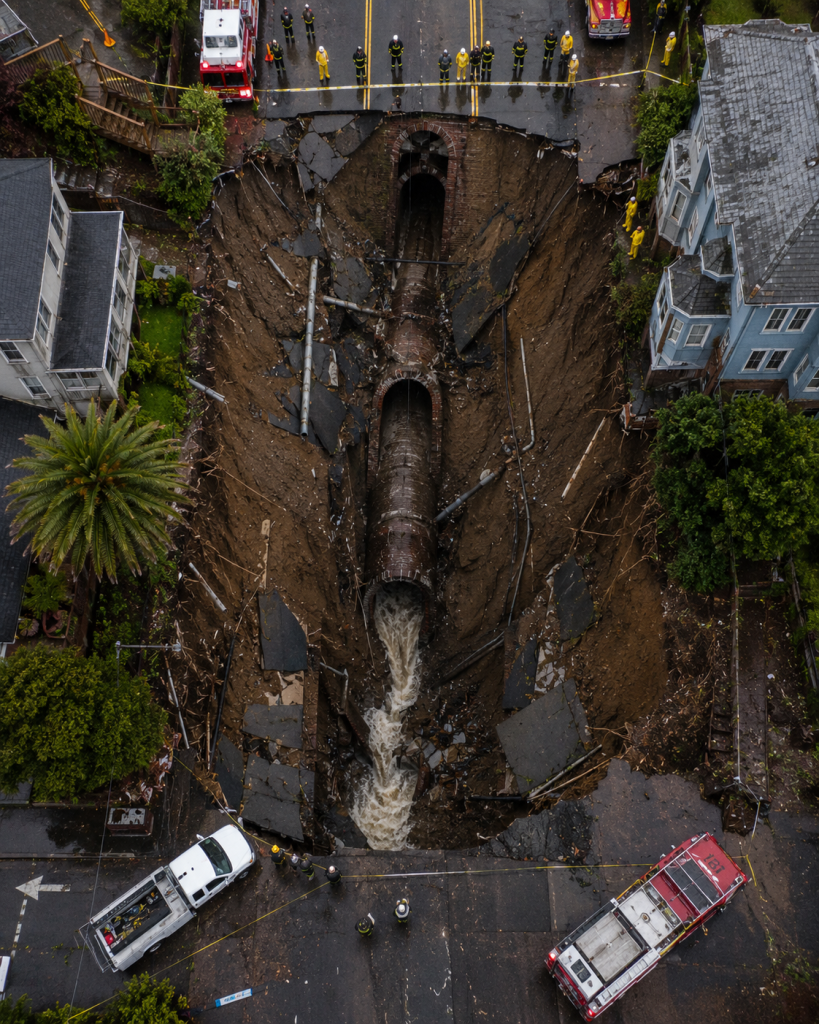
In 1995, the collapse in San Francisco wasn’t a sudden event.
A ~100-year-old sewer line didn’t just break.
It degraded.
Small leaks formed inside the system.
Water escaped into surrounding soil.
Soil began to shift.
No one sees a micro leak underground.
But the system does.
Over time, those small failures combined into one outcome:
Loss of support.
Then collapse.
SYSTEM VS SYMPTOM BREAKDOWN
The visible failure is the final stage.
It’s not where the problem starts.
What people react to:
- Sinkholes
- Structural cracking
- Flooding
- Sudden pipe bursts
What actually builds underneath:
- Low-volume, continuous leakage
- Gradual soil displacement
- Pressure changes across weakened pipe sections
- Expansion of voids around infrastructure
The macro event is just the system reaching its limit.
FAILURE ORIGIN (NOT VISIBLE DAMAGE)
Micro leaks are the starting point.
Not breaks. Not bursts.
Leaks.
In the San Francisco Bay Area:
- Soil responds to moisture immediately
- Water changes load conditions underground
- Aging pipes lose resistance to internal pressure
That creates a sequence:
- Pipe integrity weakens with age
- Small leaks begin under pressure
- Water exits the system into surrounding soil
- Soil loses compaction and begins to move
- Voids form beneath structures
Each step is minor on its own.
Together, they create instability.
WHY REPAIRS DON’T SOLVE UNDERLYING CONDITIONS
Repairs address the visible leak.
They don’t stop the pattern.
Fixing one leak:
- Doesn’t restore full pipe integrity
- Doesn’t eliminate stress in adjacent sections
- Doesn’t remove water already affecting soil
The system continues to operate under the same conditions:
- Same pressure
- Same environmental movement
- Same aging materials
So new micro leaks form.
In different locations.
This is why leaks seem to “move” through a home.
They’re not random.
They’re sequential.

SYSTEM ALIGNMENT VS PATCHWORK
A system either distributes stress evenly or concentrates it.
Aligned system:
- Continuous material integrity
- Even pressure distribution
- Stable flow conditions
- Predictable interaction with soil
Patched system:
- Mixed pipe conditions
- Pressure spikes at repaired sections
- Flow disruption at transitions
- Increased stress at joints and connections
Each patch creates imbalance.
Each imbalance increases the likelihood of the next micro leak.
That’s how small issues scale into structural problems.
INFRASTRUCTURE → HOME (PATTERN TRANSLATION)
The Sea Cliff event follows the same pattern as residential failures.
Infrastructure scale → Residential scale
- Sewer line micro leaks → Hidden plumbing leaks
- Soil saturation → Crawlspace or slab moisture
- Void expansion → Foundation instability
- Collapse → Structural damage inside the home
The difference is scale.
Not mechanism.

THE MICRO → MACRO PROGRESSION IN HOMES
Most homes experiencing repeated plumbing issues are already in this pattern.
Early indicators:
- Isolated leaks over time
- Slight pressure inconsistencies
- Minor moisture detection in soil or subfloor
Mid-stage indicators:
- Multiple leaks in different areas
- Noticeable pressure fluctuation
- Soft or shifting ground conditions
Late-stage indicators:
- Structural movement
- Major pipe failure
- Water damage events
By the time it’s obvious, the system has been failing for years.
THE DECISION POINT
You can chase leaks.
Or you can stop the pattern that creates them.
One is reactive.
The other is structural.

BREAK THE PATTERN AT THE SYSTEM LEVEL
A full home repipe eliminates the micro leak cycle.
It resets the system:
- Removes aging pipe material across all lines
- Restores consistent pressure and flow
- Eliminates hidden weak points
- Prevents water from escaping into surrounding soil
This isn’t about fixing a leak.
It’s about stopping the sequence that leads to collapse.
Because every major failure—
starts as something small.