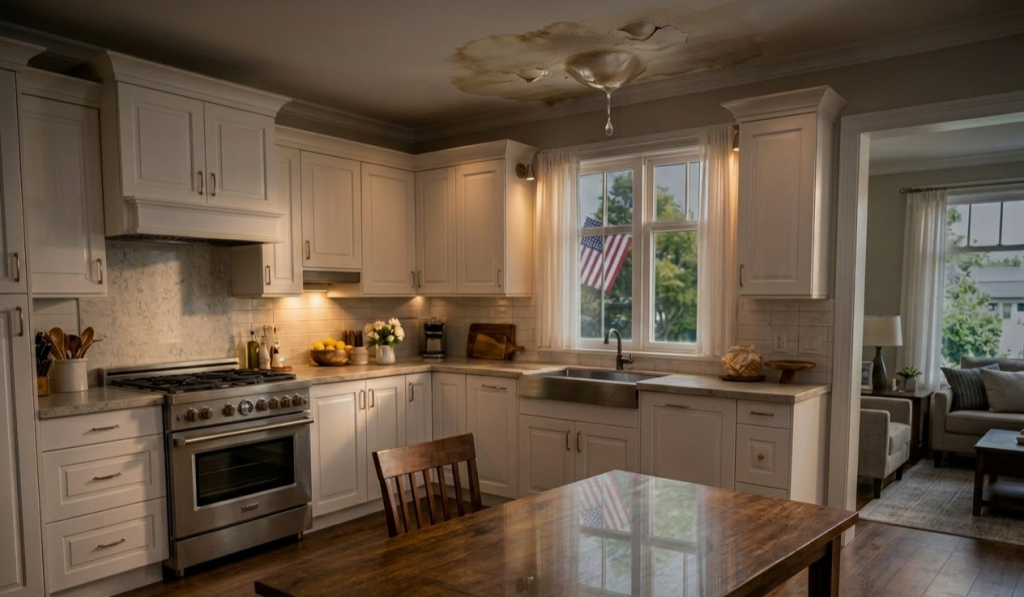
sinkholeSF33 — Crawlspace Saturation = Early Collapse Stage
No collapse.
There is no break.
No emergency call.
Just damp ground under the house.
That’s where structural failure starts.
In the 1995 Sea Cliff sinkhole event in San Francisco, the visible collapse came last.
What came first was saturation.
A failed sewer line didn’t just leak.
It introduced continuous water into soil that was never meant to carry it.
The ground didn’t fail instantly.
It weakened gradually—until it couldn’t hold load.
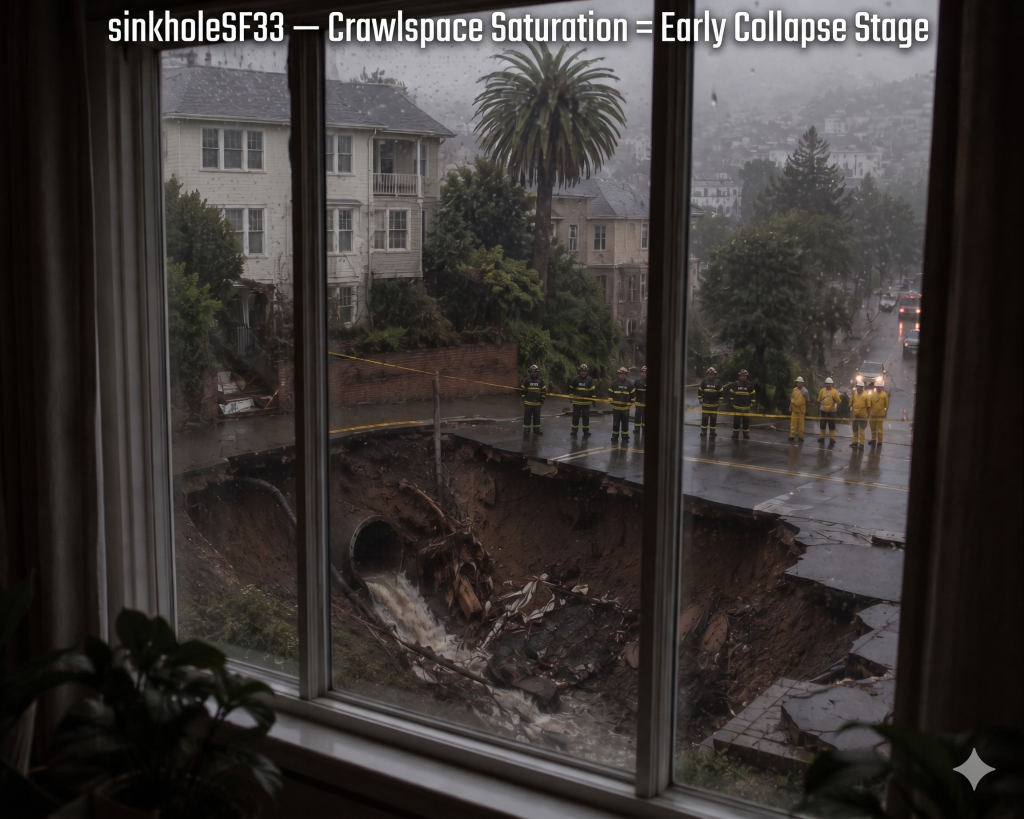
System vs Symptom Breakdown
What homeowners notice:
- musty crawlspace smell
- damp soil or standing moisture
- minor wood warping
- occasional humidity issues
What’s actually happening:
- continuous water intrusion from a compromised plumbing system
- soil losing bearing capacity under the structure
- increased load stress on framing and foundation points
- long-term instability forming below the home
Contractor Insight:
Crawlspace moisture is rarely just “moisture.” It’s usually evidence of system failure interacting with soil. Once the ground changes, the structure becomes unstable—even if it looks fine above.
Failure Origin (Not Visible Damage)
Failure doesn’t begin with structural movement.
It begins with environmental change.
Inside the plumbing system:
- small leaks develop under pressure cycles
- joints allow slow escape over time
- pipe materials degrade past tolerance
Below the structure:
- soil absorbs water unevenly
- compaction decreases
- voids begin forming in localized areas
Advanced Thinking:
Soil is part of the structural system. When water changes soil density, you’re not dealing with a plumbing issue anymore—you’re altering the foundation’s support conditions.
Why Repairs Don’t Solve Underlying Conditions
Most crawlspace-related repairs focus on symptoms:
- drying the space
- sealing visible leaks
- installing vapor barriers
These actions do not address:
- the full condition of the plumbing system
- the total volume of water already introduced into the soil
- the pressure inconsistencies causing repeated leakage
Contractor Insight:
Drying a crawlspace without correcting the system is temporary. The environment will reset to failure conditions as soon as the next weak point releases water.
Advanced Pattern:
- leak occurs → crawlspace saturates
- repair isolates one point → pressure shifts
- new leak forms → saturation continues
Cycle repeats.
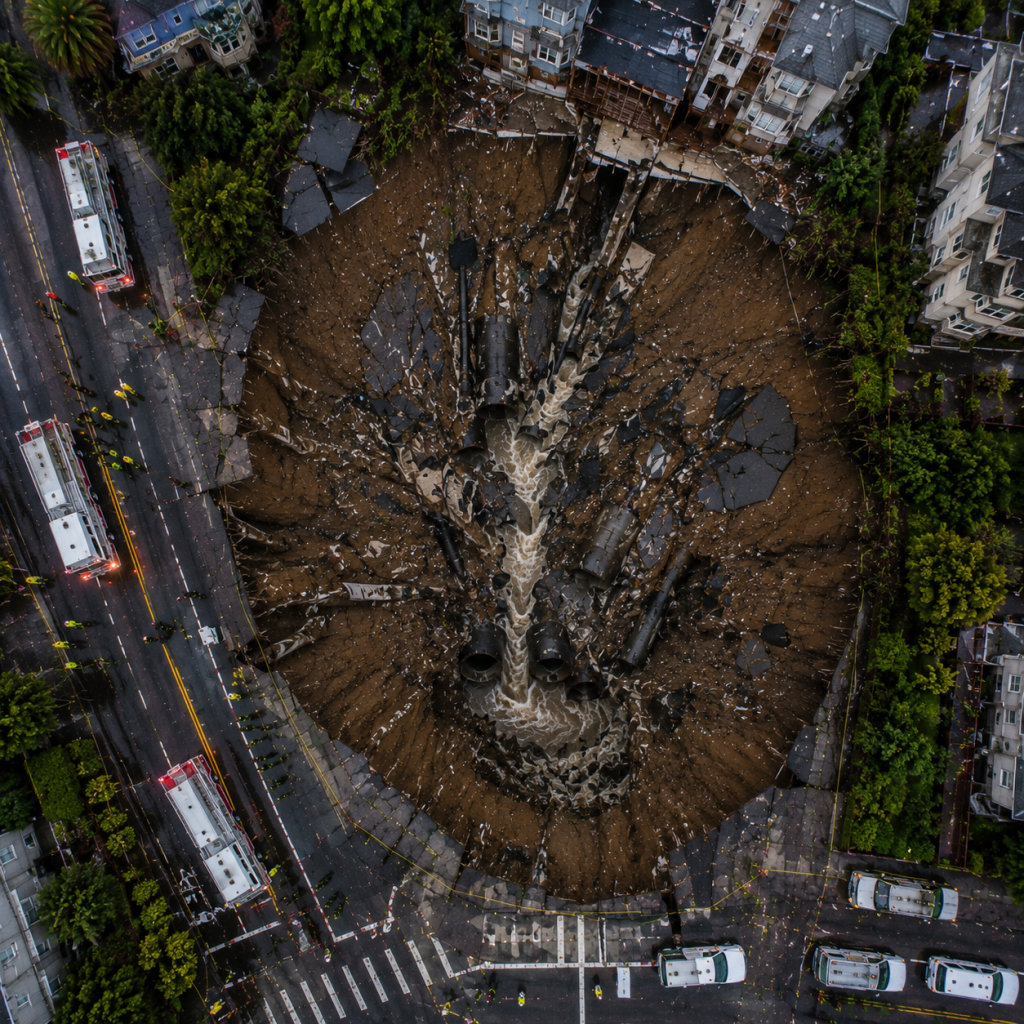
System Alignment vs Patchwork
A plumbing system must maintain containment under pressure.
Aligned system:
- zero water escape into surrounding soil
- consistent pressure behavior
- uniform material integrity
- stable environmental conditions below the structure
Patched system:
- intermittent leaks across different zones
- ongoing moisture introduction into crawlspace
- mixed material stress responses
- cumulative soil degradation
Contractor Insight:
Crawlspaces expose system problems faster because there’s no slab barrier. You’re seeing the environmental impact in real time. In slab homes, the same process happens—just hidden longer.
Advanced Thinking:
Moisture is not the problem.
Uncontrolled water movement is.
The Translation: Infrastructure → Home
The Sea Cliff failure is the large-scale version of crawlspace saturation.
Infrastructure:
- sewer leak → soil saturation → void formation → collapse
Residential:
- plumbing leak → crawlspace saturation → soil weakening → structural movement
Same drivers:
- Pressure
- Water Movement
- Time
- Movement
Contractor Insight:
Crawlspace saturation is not an early warning sign. It’s already a mid-stage failure. The system has been compromised long enough to affect the environment.
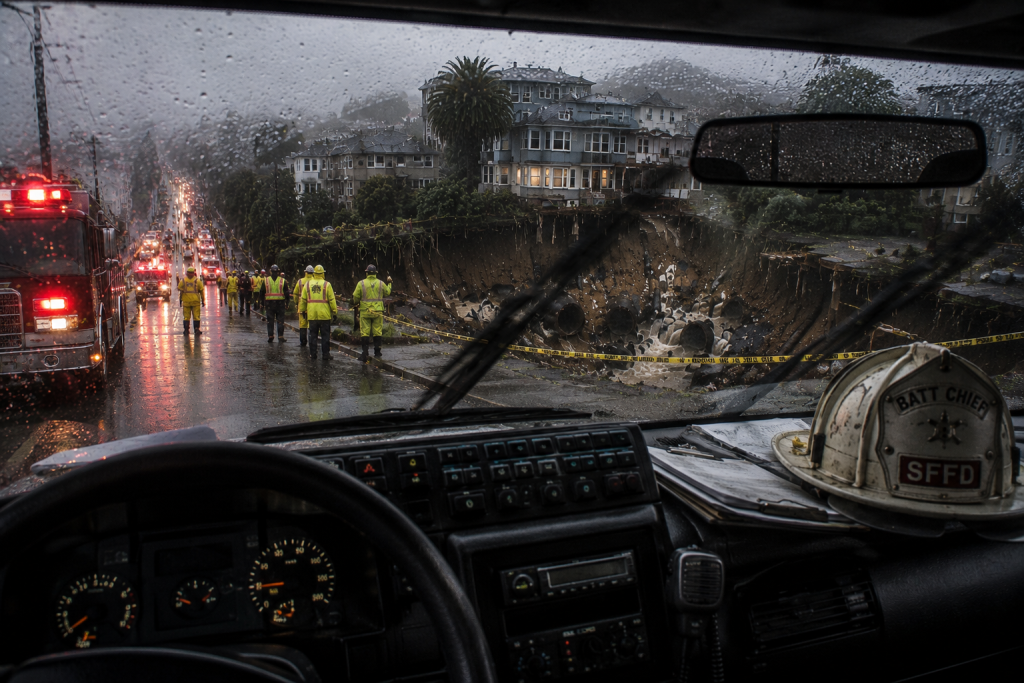
Why This Accelerates in Bay Area Conditions
In San Francisco and surrounding areas:
- soil reacts quickly to moisture changes
- homes often sit on aging infrastructure
- seasonal shifts amplify expansion and contraction
Advanced Thinking:
Moisture + movement + aging systems creates compounding failure. Each factor alone is manageable. Combined, they accelerate structural risk.
System Progression: Saturation → Instability → Damage
The pattern is consistent:
- Hidden leak develops
- Crawlspace begins absorbing moisture
- Soil loses density and strength
- Load shifts across foundation points
- Structural stress builds silently
- Visible damage appears (cracks, movement, uneven floors)
At step 6, the system has already failed across multiple layers.
Structural Prevention, Not Repair
If crawlspace saturation is present, the system has already crossed into failure conditions.
The solution is not:
- drying
- sealing
- repeated spot repairs
The solution is system correction.
A repipe:
- eliminates ongoing water release into the environment
- restores full containment under pressure
- stabilizes conditions beneath the structure
Contractor Insight:
You don’t stabilize a structure by managing moisture alone. You stabilize it by removing the source of uncontrolled water.
Advanced Positioning:
Crawlspace saturation isn’t maintenance.
It’s a structural warning.
Repipe is not a repair decision.
It’s a prevention strategy against collapse-stage conditions.