



Copper-to-Galvanized Direct Connection Electrolysis Failure
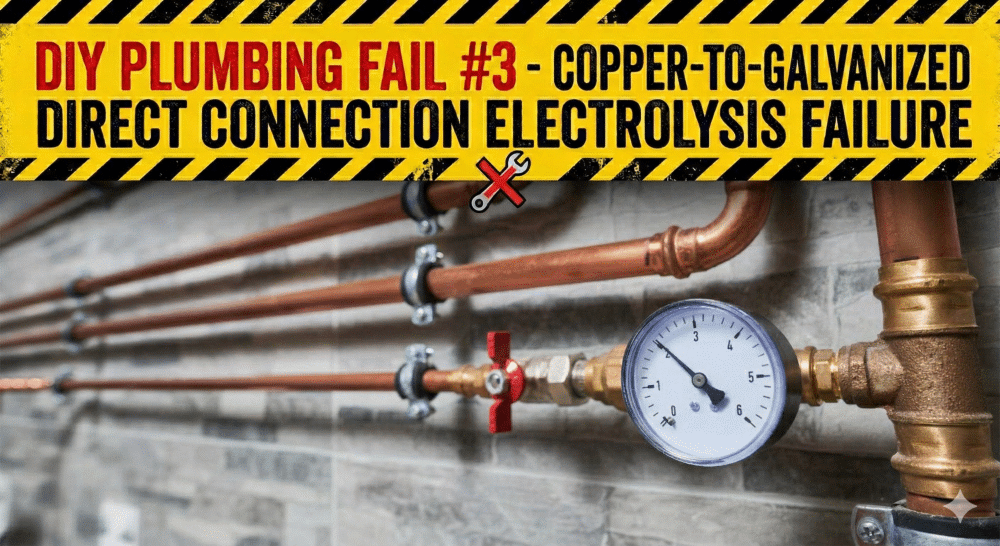
In regions like Oakland and San Jose, aging plumbing systems are frequently combined with partial upgrades that introduce mixed materials.
At the same time, enforcement around transition standards has not consistently kept pace with field conditions.
Because of this, homeowners often inherit systems in which material interactions become the hidden risk.
Across cities such as Detroit and Cleveland, older galvanized infrastructure remains common.
When newer copper repipe segments are introduced without proper separation, long-term system instability can develop.
Notably, no contractor was involved in this case.
All work was completed by the homeowner.
Initial Conditions
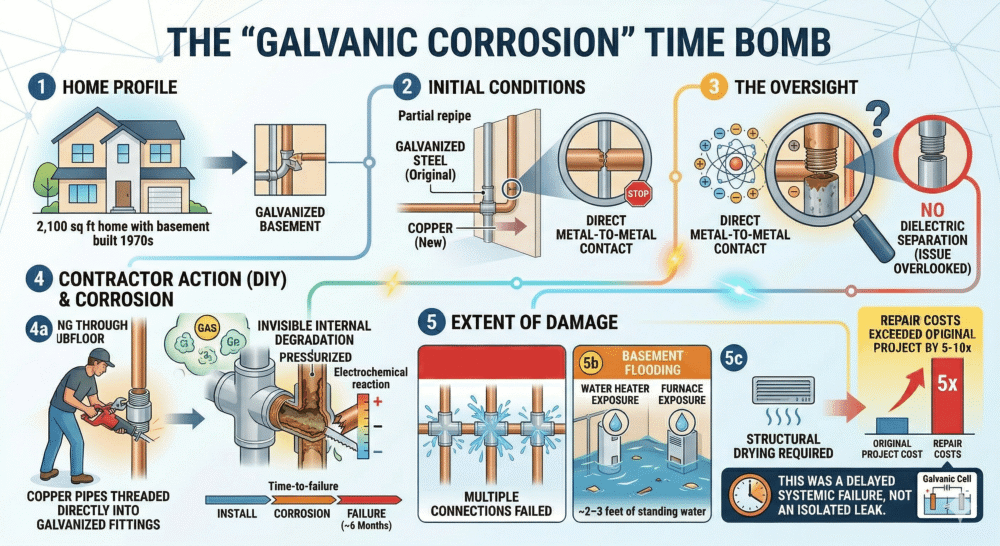
Inside a 2,100 sq ft basement home built in the 1970s, a partial repipe had been performed.
Sections of galvanized steel piping remained active within the system.
Prior symptoms included low water pressure, brown or rust-colored water, and metallic-tasting water.
Additionally, sediment in faucet aerators and intermittent banging sounds had been observed.
Fluctuating water temperature and early pinhole leaks in copper sections began appearing after initial work.
The system combined older galvanized steel corrosion zones with newer copper supply lines.
No dielectric separation had been installed at transition points.
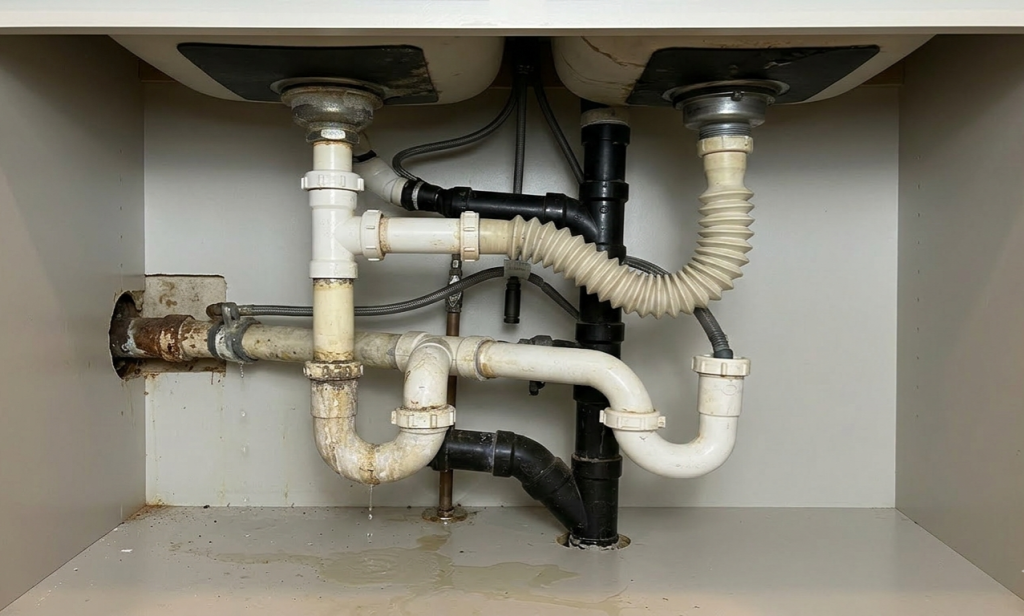
What the Homeowner Thought
From the homeowner’s perspective, connecting copper to existing galvanized piping appeared straightforward.
Thread compatibility suggested the materials could function together.
The decision was framed as a simple connection task.
Material interaction was not considered a risk factor.
Attention remained on completing the repipe rather than evaluating long-term system behavior.
1. Finger-in-the-Dike Emergency Water Line Breach Control Failure
2. Refrigerant Line Misidentification During Plumbing Routing Failure
3. Copper-to-Galvanized Direct Connection Electrolysis Failure
4. Open-Flame Soldering Ignition Inside Concealed Wall Cavity
5. Improvised Hose-Based Main Supply Line Structural Failure
6. Water-to-Gas System Cross-Connection Infrastructure Contamination Event
7. Thermal Exposure-Induced PEX Deformation and Rupture Failure
8. Improper Push-Fitting Installation Seal Integrity Failure
9. Back-Pitched Drain Line Waste Accumulation and Pressure Failure
10. Plumbing System Grounding Interruption Electrical Shock Event
What Was Actually Happening
At each connection point, copper and galvanized steel created an electrochemical imbalance.
Direct metal-to-metal contact initiated galvanic corrosion.
Over time, electrons transferred between dissimilar metals.
This process accelerated internal degradation at the joint interface.
Unlike visible leaks, this reaction occurred inside the connection.
No external indicators appeared during installation or early use.
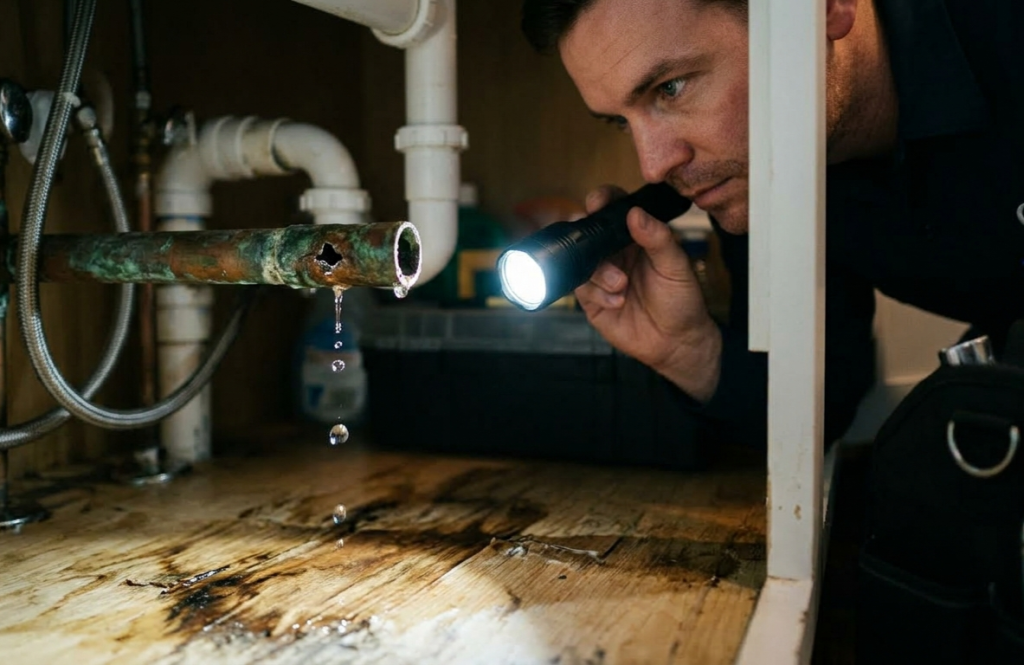
Homeowner Action (DIY – No Contractor Involved)
No licensed contractor participated in this installation.
The homeowner directly threaded copper pipes into galvanized fittings.
No dielectric unions or isolation fittings were used.
Material compatibility was not evaluated prior to connection.
No system-wide assessment of trunk and branch plumbing interactions occurred.
The installation proceeded based on physical fit rather than material behavior.
Failure Trigger
Corrosion progressed internally over approximately six months.
Connection points weakened simultaneously across multiple locations.
As pressure cycles continued, structural integrity declined.
Eventually, multiple joints failed under normal operating conditions.
The failure was not isolated.
It was systemic.
Why It Was Not Visible at Install
Galvanic corrosion develops internally at the molecular level.
Surface inspection does not reveal early-stage degradation.
Connections may appear stable during pressure testing.
Short-term performance does not reflect long-term interaction.
In cities like Buffalo, where mineral content and temperature shifts influence water chemistry, these reactions can accelerate.
Homeowners are not expected to detect electrochemical processes without specialized knowledge.
Execution & Escalation
Multiple joint failures occurred nearly simultaneously.
Pressurized water discharged into the basement environment.
Flooding rapidly accumulated to approximately two to three feet of standing water.
Water heater and furnace systems were exposed to moisture.
Structural materials absorbed water.
Drywall and framing required extensive drying.
The event escalated from hidden corrosion to full-system failure.
Extent of Damage
Water damage extended across the basement footprint.
Mechanical systems required inspection and potential replacement.
Mold behind drywall became a risk due to prolonged moisture exposure.
Warped baseboards and subfloor saturation developed.
Remediation included structural drying and system reconstruction.
The scale of damage exceeded expectations for a localized plumbing issue.
What Professionals Verify
Professionals evaluate material compatibility before connection.
They install dielectric unions between dissimilar metals.
System design considers copper repipe vs PEX transitions where appropriate.
PEX-A vs PEX-B decisions may reduce galvanic interaction risks.
Water chemistry, pressure conditions, and system layout are assessed.
Main shut-off valves and isolation points are verified prior to modifications.
Verification focuses on long-term system behavior, not immediate function.
Decision Distortion
The homeowner believed the decision involved connecting two pipes.
In reality, the decision involved managing electrochemical interaction over time.
Visible compatibility suggested simplicity.
Hidden material behavior determined outcome.
This gap created delayed risk that was not apparent during installation.

Broader Pattern
Across markets like Philadelphia and Indianapolis, partial repipes frequently introduce mixed-material systems.
In these environments, improper transitions create delayed failure patterns.
Contractor standards data shows that many failures emerge at 6 months or later.
Some escalate further at 2-year intervals depending on water chemistry and usage patterns.
The initial install often appears successful.
Failure develops under real operating conditions.
Process Context
A whole-house repipe is designed as a controlled system replacement.
Transitions between materials are minimized or properly isolated.
PEX-A systems using an Uponor expansion system or full Type L copper installations are planned holistically.
Manifold systems or trunk and branch plumbing layouts are selected based on structure and usage.
Drywall access is controlled and strategic.
Water bypass systems enable continuous service during work.
Same-day water restoration is coordinated within a managed process.
Permitting & Compliance
City plumbing permits often require inspection of material transitions.
Building code inspections verify proper use of dielectric fittings.
Improper installations may affect homeowners insurance coverage.
Resale value ROI can be impacted by undocumented or non-compliant work.
Licensed, bonded, and insured professionals provide documented compliance pathways.

Outcome Shift
The failure did not originate from a single weak connection.
It resulted from systemic electrolysis across multiple joints.
If dielectric separation had been installed, corrosion would have been prevented.
The system would have maintained long-term stability.
Instead, direct contact created a time-delayed failure across the entire network.
Cost & Decision Considerations
Costs extended beyond plumbing repair into structural remediation.
Drywall patching and texture matching increased scope.
Mechanical system exposure added further expense.
Project timelines expanded due to drying and reconstruction requirements.
Financial impact exceeded the original repipe cost per square foot.
Initial decisions influenced long-term cost more than installation effort.
Key Takeaway
No contractor was involved in this installation.
All work was performed by the homeowner.
The decision was not about connecting copper to galvanized pipe.
The decision was about managing material interaction over time.
System behavior determines outcome.
Proper isolation prevents failure.
Assumption creates delayed risk.