



Thermal Exposure-Induced PEX Deformation and Rupture Failure

Across cities like San Mateo and Redwood City, compact utility room layouts often bring plumbing materials into close proximity with heat sources.
At the same time, modern repipe materials such as PEX are widely adopted without full understanding of thermal limits.
Because of this, heat exposure becomes a hidden variable in otherwise standard installations.
In regions like Las Vegas and Dallas, elevated ambient temperatures further compound heat-related stress on piping systems.
Even in moderate climates, localized heat zones around water heaters create concentrated exposure risks.
No contractor was involved in this installation.
All work was performed by the homeowner.
Initial Conditions
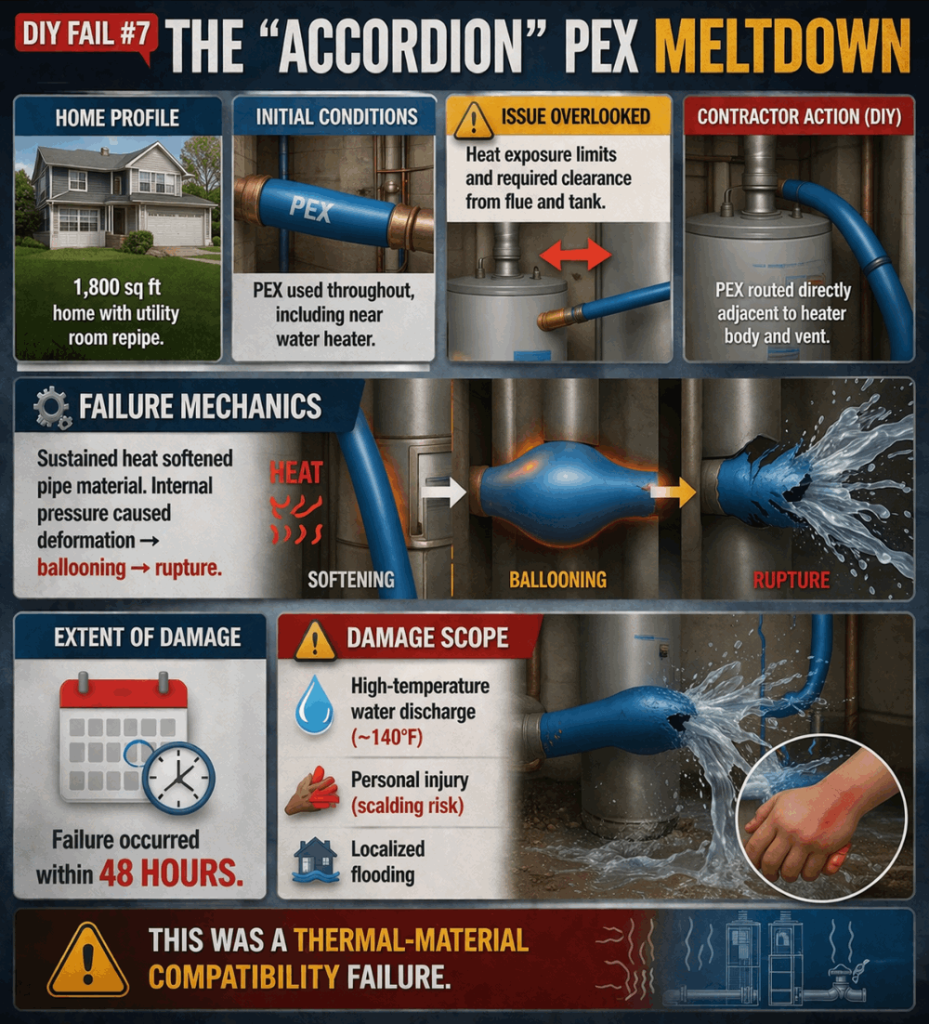
Within a 1,800 sq ft home, a utility room repipe had recently been completed.
PEX piping was installed throughout the potable water system.
Existing symptoms included fluctuating water temperature, occasional water hammer, and slow hot water delivery.
Additionally, sediment in faucet aerators and intermittent low water pressure had been observed.
No immediate failure indicators were present following installation.
PEX lines were routed near the water heater and venting system.
Clearance requirements were not evaluated.
What the Homeowner Thought
From the homeowner’s perspective, PEX piping offered flexibility and ease of installation.
Routing lines close to the water heater appeared efficient and practical.
The assumption was that all plumbing materials could tolerate proximity to the heater.
Heat exposure was not considered a limiting factor.
Focus remained on completing connections rather than evaluating environmental conditions.
What Was Actually Happening
PEX material has defined temperature tolerance limits.
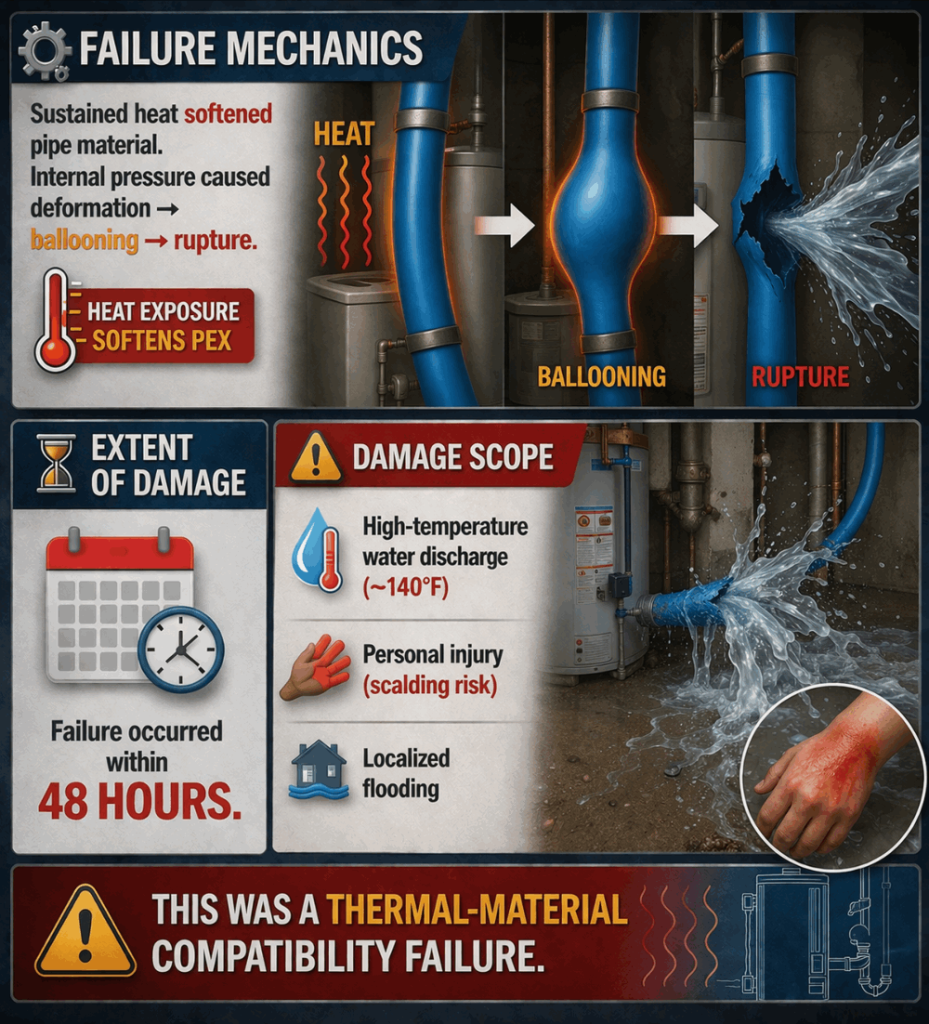
Prolonged exposure to elevated heat softens the pipe structure.
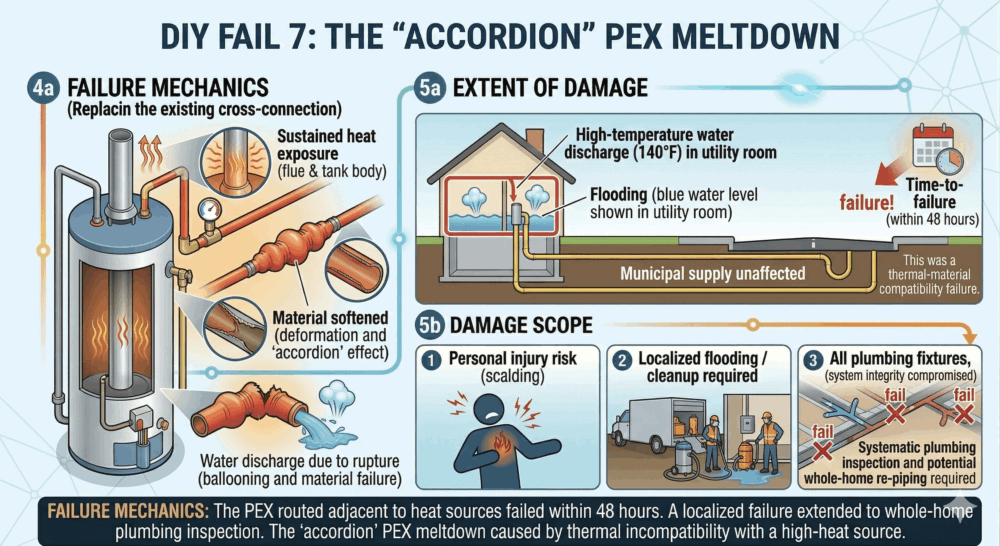
Positioning near the heater body and flue exposed the piping to sustained radiant heat.
Internal water pressure remained constant within the system.
As material softened, structural rigidity declined.
Pressure caused the pipe to deform outward.
This deformation progressed into ballooning.
Failure became inevitable under continued stress.
Homeowner Action (DIY – No Contractor Involved)
No licensed plumber or contractor participated in this work.
The homeowner independently routed PEX piping near the heater.
No clearance standards were followed.
No heat shielding or rerouting strategy was implemented.
Material selection such as PEX-A vs PEX-B was not evaluated relative to heat exposure.
Installation proceeded based on convenience rather than system design.
1. Finger-in-the-Dike Emergency Water Line Breach Control Failure
2. Refrigerant Line Misidentification During Plumbing Routing Failure
3. Copper-to-Galvanized Direct Connection Electrolysis Failure
4. Open-Flame Soldering Ignition Inside Concealed Wall Cavity
5. Improvised Hose-Based Main Supply Line Structural Failure
6. Water-to-Gas System Cross-Connection Infrastructure Contamination Event
7. Thermal Exposure-Induced PEX Deformation and Rupture Failure
8. Improper Push-Fitting Installation Seal Integrity Failure
9. Back-Pitched Drain Line Waste Accumulation and Pressure Failure
10. Plumbing System Grounding Interruption Electrical Shock Event
Failure Trigger
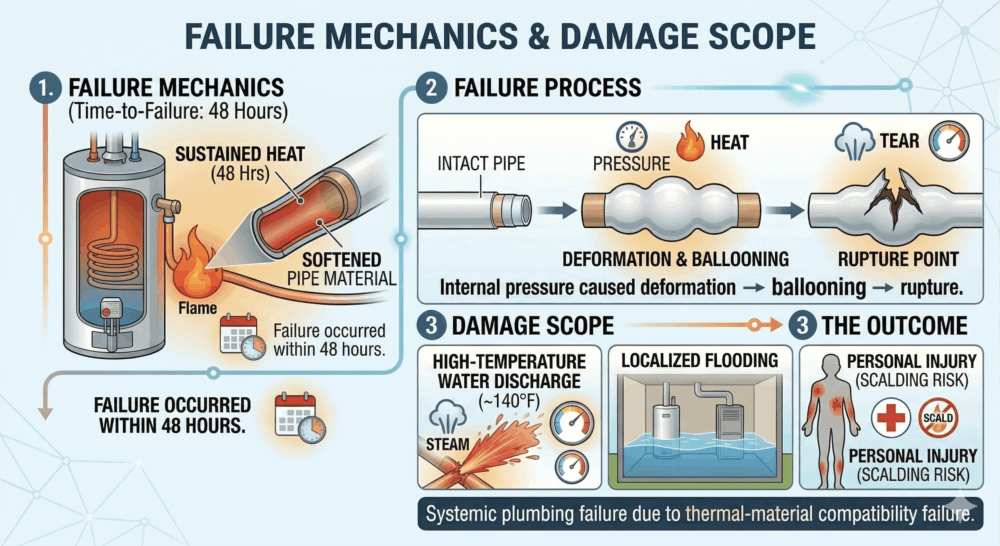
Within approximately 48 hours, the PEX pipe reached a critical deformation state.
Sustained heat softened the material beyond its structural threshold.
Internal pressure caused rapid expansion at the weakened section.
The pipe ballooned before rupturing.
Failure occurred suddenly.
No gradual leak preceded the rupture.
Why It Was Not Visible at Install
Immediately after installation, the piping appeared stable.
Short-term operation did not exceed visible limits.
Thermal degradation develops over time under sustained exposure.
Material softening is not externally visible in early stages.
In high-heat environments like Las Vegas, this process accelerates.
Homeowners are not expected to evaluate thermal compatibility without system knowledge.

Execution & Escalation
Upon rupture, high-temperature water discharged into the utility space.
Water temperature approached approximately 140°F.
The release created immediate scalding risk.
Localized flooding developed rapidly.
Water spread across flooring and adjacent areas.
Damage escalated within minutes due to pressure and temperature.
Extent of Damage
Hot water exposure damaged surrounding materials.
Flooring and lower wall sections absorbed heat and moisture.
Mold risk increased in enclosed areas following saturation.
Warped baseboards and damp surfaces developed quickly.
Personal injury risk was present due to scalding conditions.
Repair required both plumbing correction and environmental remediation.
What Professionals Verify
Professionals evaluate heat zones before routing piping.
Clearance distances from water heaters and flues are defined and enforced.
PEX routing avoids direct exposure to radiant heat.
Alternative materials such as Type L copper may be used near high-temperature sources.
PEX-A systems are installed with consideration of environmental conditions.
Heat shielding and rerouting strategies are applied where necessary.
Verification includes both material selection and placement.
Decision Distortion
The homeowner believed the decision involved routing flexible piping efficiently.
The actual decision involved managing thermal exposure within the system.
Visible installation simplicity suggested reliability.
Hidden heat conditions determined failure.
This gap created rapid risk that was not apparent at completion.
Broader Pattern
In areas like San Bruno and Concord, compact utility spaces frequently create heat proximity issues.
Across national markets such as Dallas, elevated ambient temperatures amplify these risks.
Contractor standards data shows that thermal failures often occur within short timeframes.
Common intervals include 24 to 72 hours after installation.
The system appears functional initially.
Failure develops under sustained operating conditions.
Process Context
A whole-house repipe is executed as a controlled system design.
Material placement considers environmental exposure, not just routing convenience.
PEX-A or copper repipe systems are selected based on heat conditions.
Transitions near heaters are planned to prevent thermal stress.
Drywall access and routing paths are strategically determined.
Water bypass systems maintain service during installation.
Same-day water restoration is balanced with full system verification.
Permitting & Compliance
City plumbing permits require adherence to material clearance standards.
Building code inspections verify safe installation near heat sources.
Improper placement may affect homeowners insurance coverage.
Resale value ROI can be impacted by non-compliant installations.
Licensed, bonded, and insured professionals ensure compliance with safety requirements.
Outcome Shift
The failure did not result from PEX material alone.
It resulted from placing the material within a high-heat environment.
If proper clearance had been maintained, the system would have remained stable.
No rupture would have occurred.
Instead, thermal exposure converted a standard installation into a rapid failure event.

Cost & Decision Considerations
Costs extended into water damage repair and system correction.
Drywall patching and texture matching increased scope.
Utility room restoration added additional expense.
Project timelines expanded due to remediation requirements.
Financial exposure exceeded the simplicity of the original task.
Initial placement decisions determined total impact.
Key Takeaway
No contractor was involved in this installation.
All work was performed by the homeowner.
The decision was not about routing flexible piping.
The decision was about managing thermal exposure within the system.
Heat determines material behavior.
Proper placement prevents failure.
Assumption creates immediate risk.