



Refrigerant Line Misidentification During Plumbing Routing Failure
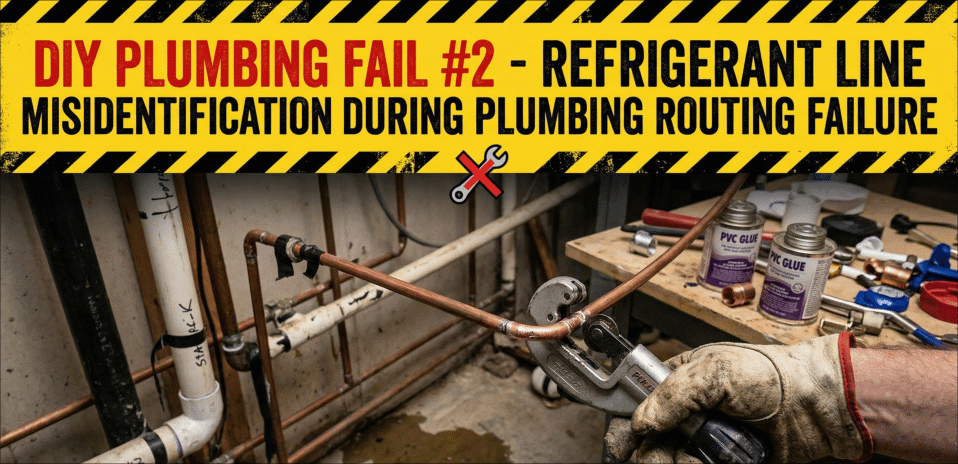
Across markets like Fremont and San Francisco, residential systems have become more tightly integrated while verification practices remain inconsistent.
As density increases, plumbing and HVAC pathways often overlap within confined structural zones.
Consequently, homeowners face decisions involving systems they cannot fully see or distinguish.
In cities such as Boston and Chicago, older construction combined with retrofits creates similar layered conditions.
Within these environments, system misidentification becomes a primary risk factor.
Importantly, no contractor participated in this event.
All actions were performed by the homeowner.
Initial Conditions
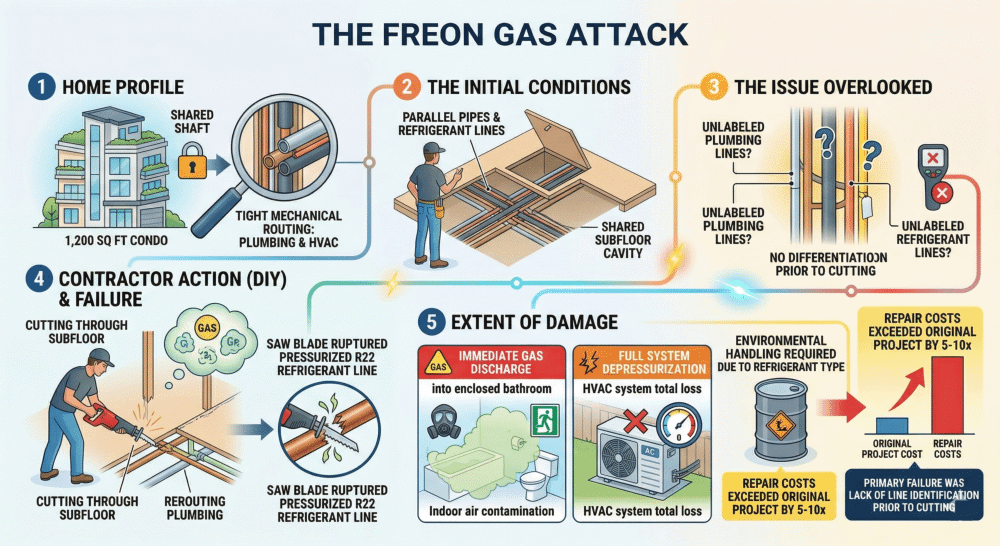
Inside a 1,200 sq ft condo, mechanical systems shared a restricted subfloor cavity.
Potable water lines and HVAC refrigerant lines ran parallel within the same channel.
Early indicators included fluctuating water temperature, occasional water hammer, and slow hot water delivery.
Sediment in faucet aerators and intermittent low water pressure were also present.
Meanwhile, no signs indicated any vulnerability in the HVAC system.
No mapping of horizontal vs vertical repiping had been completed.
No identification of line types had occurred prior to the intrusion.
1. Finger-in-the-Dike Emergency Water Line Breach Control Failure
2. Refrigerant Line Misidentification During Plumbing Routing Failure
3. Copper-to-Galvanized Direct Connection Electrolysis Failure
4. Open-Flame Soldering Ignition Inside Concealed Wall Cavity
5. Improvised Hose-Based Main Supply Line Structural Failure
6. Water-to-Gas System Cross-Connection Infrastructure Contamination Event
7. Thermal Exposure-Induced PEX Deformation and Rupture Failure
8. Improper Push-Fitting Installation Seal Integrity Failure
9. Back-Pitched Drain Line Waste Accumulation and Pressure Failure
10. Plumbing System Grounding Interruption Electrical Shock Event
What the Homeowner Thought
From the homeowner’s perspective, the task involved rerouting only the plumbing.
The decision appeared contained within the potable water system.
Cutting into the subfloor was assumed to affect only water supply lines.
HVAC components were not considered part of the working zone.
Focus remained on access and routing rather than system identification.

What Was Actually Happening
Within the cavity, refrigerant lines carrying pressurized R22 ran adjacent to plumbing lines.
Visual similarity between insulated lines reduced differentiation.
Unlike potable water lines, refrigerant systems operate under distinct pressure and chemical conditions.
A breach would not release water.
Instead, pressurized gas would discharge into the surrounding space.
System control required HVAC shutdown, not plumbing isolation.
This distinction was not recognized.
Homeowner Action (DIY – No Contractor Involved)
At no point was a contractor involved.
The homeowner independently initiated subfloor cutting.
A saw was used to access the cavity.
No inspection tools were used to verify line identity.
Neither main shut-off valves nor system-specific isolation procedures were considered.
No coordination between plumbing and HVAC systems occurred before cutting.
Failure Trigger
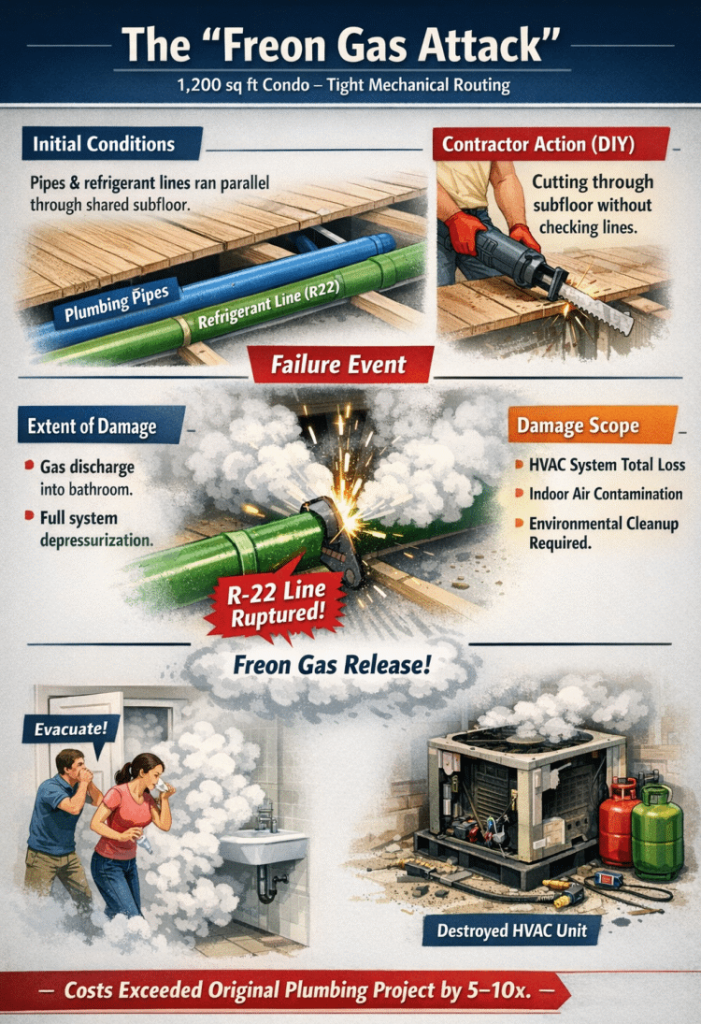
Contact between the saw blade and a refrigerant line caused immediate rupture.
Pressurized R22 gas discharged into the enclosed bathroom.
Rapid depressurization rendered the HVAC system inoperable.
Gas spread within the confined area without ventilation control.
The event escalated instantly upon penetration.
Why It Was Not Visible at Install
Mechanical systems are often routed together in space-constrained builds.
Insulation and proximity obscure material differences between lines.
In retrofit-heavy areas like Philadelphia, overlapping systems further complicate identification.
Visual inspection alone cannot reliably distinguish between plumbing and refrigerant lines.
Homeowners are not expected to interpret these distinctions without verification tools.
Execution & Escalation
Gas accumulation degraded indoor air quality immediately.
The enclosed bathroom environment intensified exposure conditions.
Occupants were forced to evacuate the area.
System depressurization halted HVAC operation entirely.
Environmental handling requirements were triggered due to refrigerant type.
What began as a plumbing adjustment became a multi-system failure event.
Extent of Damage
The HVAC system required full replacement.
Refrigerant contamination required regulated handling procedures.
Indoor air conditions necessitated remediation.
Structural areas surrounding the breach required inspection.
Total repair costs exceeded the original plumbing scope by five to ten times.

What Professionals Verify
Before any intrusion, professionals verify all system types within the work zone.
They differentiate potable water lines from refrigerant lines using non-invasive methods.
System shutdown procedures are established prior to cutting.
Coordination between trades ensures no system is unintentionally compromised.
Material identification extends beyond surface appearance.
Isolation is confirmed, not assumed.
Decision Distortion
The homeowner believed the decision centered on plumbing rerouting.
In reality, the decision required identifying every system within the cavity.
Visible piping suggested simplicity.
Hidden system overlap introduced complexity.
This mismatch created risk that was not apparent during the decision moment.
Broader Pattern
Across San Jose and Los Angeles, increased system density amplifies this pattern.
In colder regions like Minneapolis, additional insulation further obscures line identification.
Contractor margin research consistently shows that misidentification drives failure events.
The act of cutting is rarely the root cause.
Incorrect system assumptions are.
Process Context
A controlled repipe or reroute begins with full system mapping.
All mechanical systems within the access zone are identified prior to intrusion.
Routing decisions consider both plumbing and HVAC pathways.
PEX-A vs PEX-B selection, or copper repipe vs PEX transitions, are planned with system awareness.
Drywall or subfloor access is precise and limited.
Water bypass systems and system shutdown protocols are implemented before work begins.
Permitting & Compliance
City plumbing permits often require coordination with building systems.
Building code inspections may extend to multi-system interactions.
Improper refrigerant release introduces environmental compliance issues.
Homeowners insurance coverage may be affected by unlicensed work.
Licensed, bonded, and insured professionals provide documented compliance pathways.
Outcome Shift
The failure did not originate from cutting alone.
It resulted from misidentifying the system within the cut path.
If verification had occurred, the refrigerant line would not have been breached.
The plumbing adjustment would have remained controlled.
Instead, a single incorrect assumption caused total HVAC system loss.

Cost & Decision Considerations
Costs expanded beyond plumbing into HVAC replacement and environmental handling.
Project timelines increased due to remediation requirements.
Occupancy disruption added indirect financial impact.
Resale value considerations may be affected by undocumented system damage.
Initial decisions influenced total exposure more than execution difficulty.
Key Takeaway
No contractor was involved in this event.
All actions were performed by the homeowner.
The decision was not about cutting access for plumbing.
The decision was about identifying every system within the work area.
System overlap defines risk.
Verification reduces consequences.
Assumption increases cost.