

Improper Push-Fitting Installation Seal Integrity Failure

Across communities like Pleasanton and Los Gatos, large-scale interior remodels increasingly rely on fast-install plumbing methods without full process verification.
At the same time, push-to-connect fittings have become common due to ease of use.
However, installation precision requirements often remain misunderstood.
In regions such as Charlotte and Milwaukee, similar remodeling patterns show increased use of concealed fittings behind finished walls.
When preparation steps are skipped, failures do not occur immediately.
Instead, they develop gradually under normal operating conditions.
No contractor was involved in this installation.
All work was performed by the homeowner.
Initial Conditions
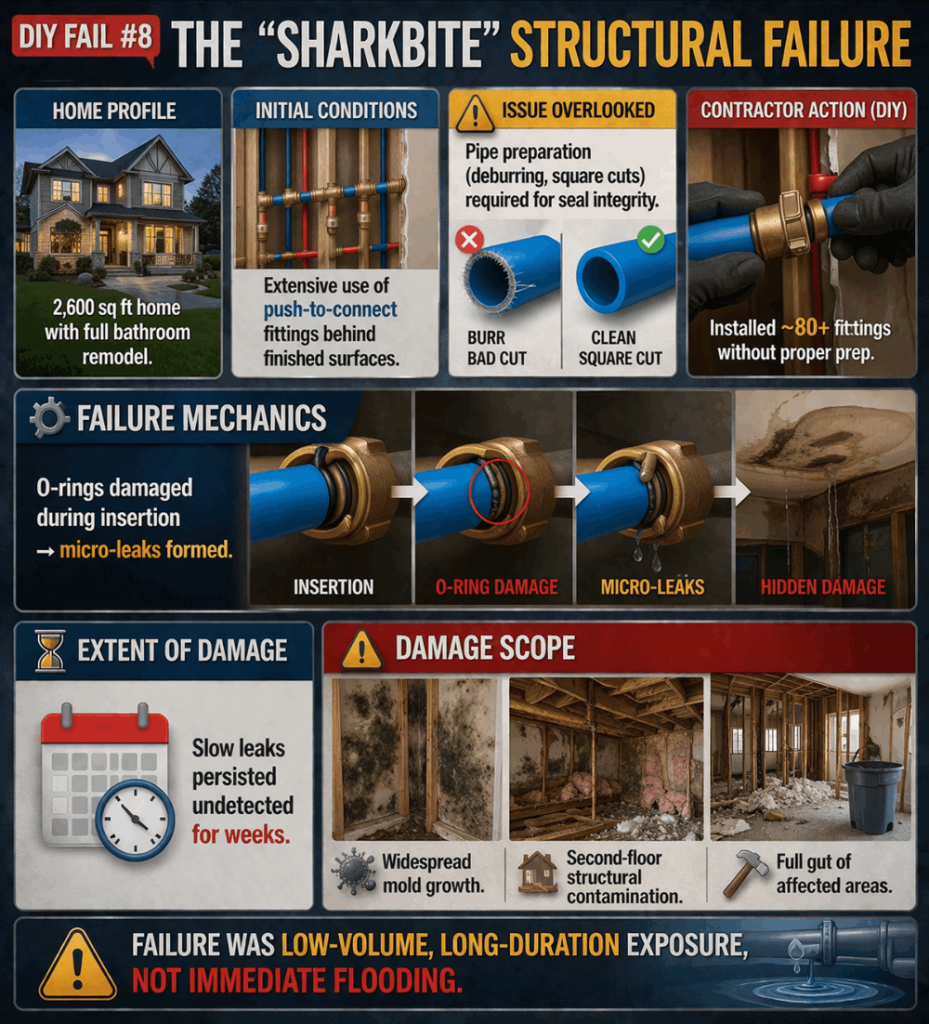
Within a 2,600 sq ft home undergoing a full bathroom remodel, plumbing upgrades were extensive.
Push-to-connect fittings were used throughout the system.
Pre-existing symptoms included low water pressure, fluctuating water temperature, and occasional water hammer.
Additionally, sediment in faucet aerators and minor pinhole leaks in copper sections had been observed.
Slow hot water delivery and intermittent noisy pipes indicated inconsistent system performance.
Over 80 fittings were installed behind walls and ceilings.
No systematic pipe preparation process was followed.
What the Homeowner Thought
From the homeowner’s perspective, push fittings simplified installation.
The fittings were marketed as requiring minimal effort.
Insertion appeared straightforward and repeatable.
The assumption was that the seal would form automatically.
Focus remained on completing connections quickly.
Preparation steps were viewed as optional rather than critical.
What Was Actually Happening
Push-to-connect fittings rely on internal O-rings for sealing.
These seals require clean, square, and deburred pipe ends.
Improper cuts created sharp edges.
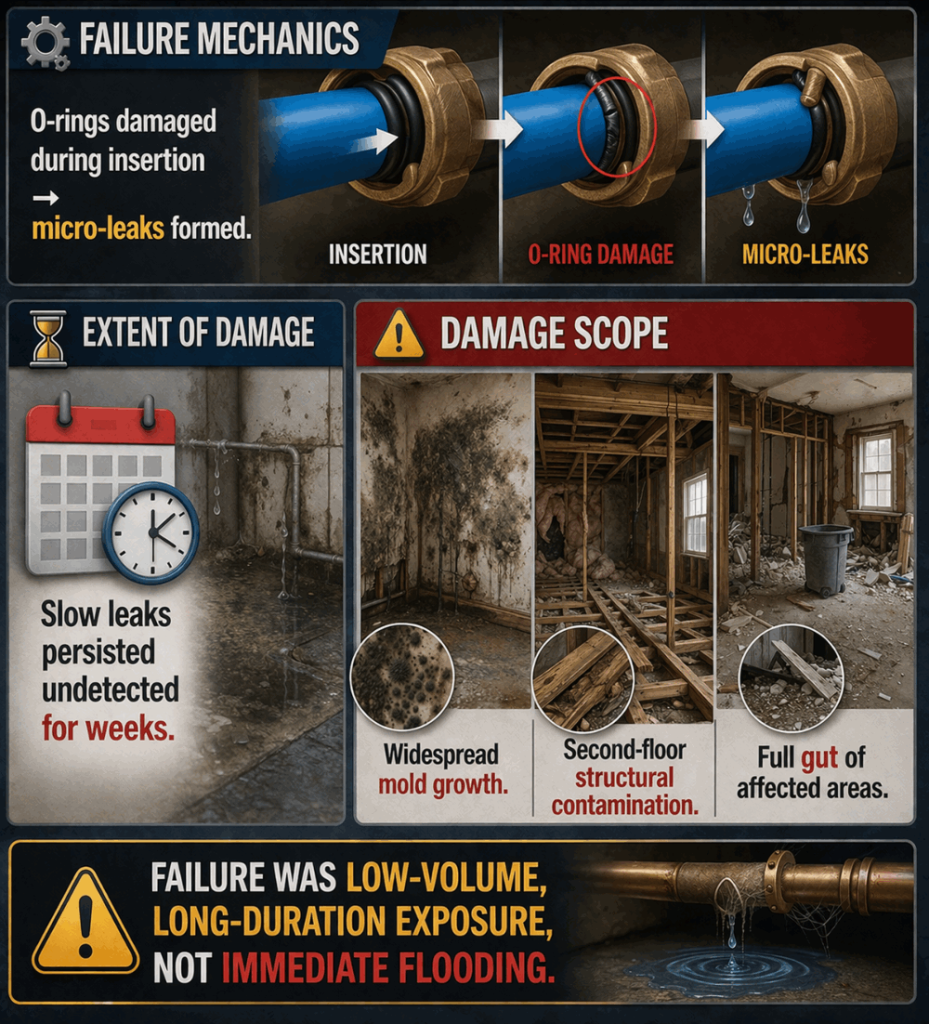
These edges damaged O-rings during insertion.
Micro-defects formed at connection points.
These defects allowed slow water seepage under pressure.
Unlike major leaks, these failures released minimal water over time.
However, continuous exposure led to cumulative damage.
Homeowner Action (DIY – No Contractor Involved)
No licensed plumber participated in this work.
The homeowner independently installed all fittings.
Pipe ends were not properly deburred.
Cuts were not consistently square.
No inspection of seal integrity was performed after installation.
Fittings were concealed behind finished surfaces without verification.

1. Finger-in-the-Dike Emergency Water Line Breach Control Failure
2. Refrigerant Line Misidentification During Plumbing Routing Failure
3. Copper-to-Galvanized Direct Connection Electrolysis Failure
4. Open-Flame Soldering Ignition Inside Concealed Wall Cavity
5. Improvised Hose-Based Main Supply Line Structural Failure
6. Water-to-Gas System Cross-Connection Infrastructure Contamination Event
7. Thermal Exposure-Induced PEX Deformation and Rupture Failure
8. Improper Push-Fitting Installation Seal Integrity Failure
9. Back-Pitched Drain Line Waste Accumulation and Pressure Failure
10. Plumbing System Grounding Interruption Electrical Shock Event
Failure Trigger
Over several weeks, micro-leaks developed at multiple connection points.
Water escaped slowly from compromised seals.
Continuous pressure maintained flow through damaged O-rings.
Moisture accumulated within wall cavities and ceiling spaces.
The failure remained undetected during early stages.
No immediate symptoms indicated system-wide leakage.
Why It Was Not Visible at Install
At installation, all fittings appeared secure.
Short-term pressure did not reveal seal damage.
Micro-leaks do not produce immediate visible signs.
Water disperses gradually into surrounding materials.
In homes like those in Los Gatos, finished surfaces conceal early-stage moisture.
Homeowners are not expected to detect sub-surface leakage without inspection tools.

Execution & Escalation
Over time, moisture accumulated behind walls and ceilings.
Drywall absorbed water without visible surface damage initially.
Mold began developing in concealed areas.
Structural components experienced prolonged exposure.
Eventually, damage reached visible thresholds.
By that point, contamination had spread across multiple zones.
Extent of Damage
Widespread mold growth developed behind finished surfaces.
Second-floor structural areas experienced moisture intrusion.
Drywall, insulation, and framing required removal.
Affected areas required full gut and remediation.
The damage extended beyond isolated fittings.
It became a system-wide contamination event.
What Professionals Verify
Professionals prepare pipe ends before installing push fittings.
They ensure cuts are square and edges are deburred.
Seal integrity is verified prior to concealment.
Pressure testing is performed under controlled conditions.
Material selection considers copper repipe vs PEX systems.
PEX-A systems using an Uponor expansion system reduce reliance on internal O-rings.
Verification includes both installation technique and post-install inspection.
Decision Distortion
The homeowner believed the decision involved choosing an easy connection method.
The actual decision involved executing precise preparation for seal integrity.
Visible simplicity suggested reliability.
Hidden installation requirements determined outcome.
This mismatch created delayed risk that was not apparent during installation.

Broader Pattern
In areas like Walnut Creek and across national markets such as Charlotte, push-fitting failures follow similar patterns.
High-volume installations increase the likelihood of cumulative defects.
Contractor standards data shows failures often emerge after several weeks or months.
Typical timelines include 30 days and extended exposure up to several months.
The system appears functional initially.
Failure develops through low-volume, long-duration leakage.
Process Context
A whole-house repipe is executed as a controlled system installation.
Connection methods are selected based on long-term reliability.
PEX-A or copper systems are installed with full preparation protocols.
Trunk and branch plumbing layouts or manifold systems are designed intentionally.
Drywall access is planned and limited.
Water bypass systems maintain service during installation.
Same-day water restoration is balanced with verification steps.
Permitting & Compliance
City plumbing permits require adherence to installation standards.
Building code inspections verify proper connection methods.
Improper installations may affect homeowners insurance coverage.
Resale value ROI can be impacted by concealed damage.
Licensed, bonded, and insured professionals provide documented compliance.
Outcome Shift
The failure did not originate from the fittings themselves.
It resulted from improper installation technique across multiple connections.
If pipe preparation had been performed correctly, seals would have remained intact.
The system would have operated without leakage.
Instead, minor defects compounded into widespread structural damage.

Cost & Decision Considerations
Costs extended into mold remediation and structural repair.
Drywall patching and texture matching increased scope significantly.
Second-floor damage added complexity and expense.
Project timelines expanded due to full gut requirements.
Financial exposure exceeded initial expectations.
Installation precision determined total cost.
Key Takeaway
No contractor was involved in this installation.
All work was performed by the homeowner.
The decision was not about choosing an easy connection method.
The decision was about executing precise installation for seal integrity.
Preparation determines performance.
Verification prevents hidden failure.
Assumption creates long-duration risk.