



Water-to-Gas System Cross-Connection Infrastructure Contamination Event
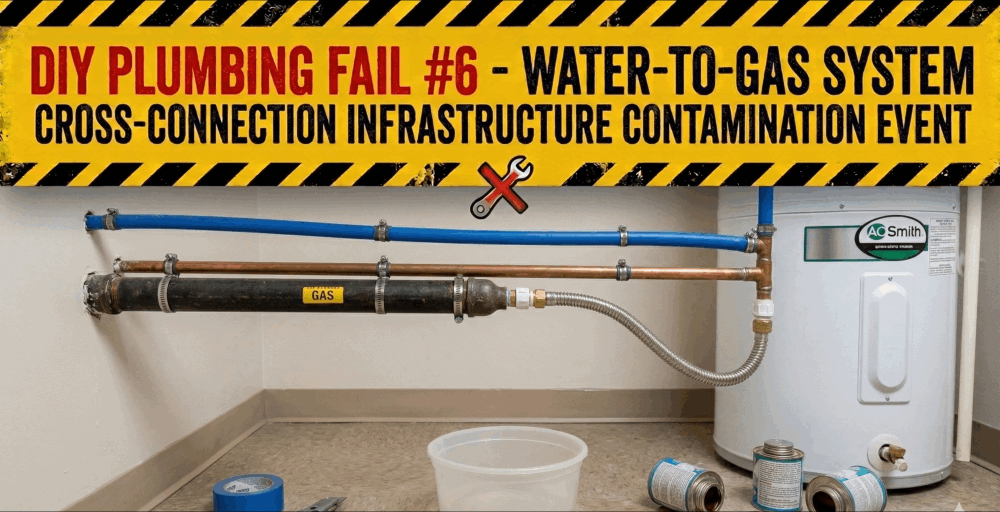
Throughout neighborhoods like Walnut Creek and Palo Alto, older homes often contain layered utility systems that have evolved over decades without full documentation.
At the same time, partial upgrades frequently leave behind inactive or misidentified lines within shared utility clusters.
Because of this, system identification becomes more complex than visual inspection suggests.
In markets such as Baltimore and St. Paul, similar legacy conditions exist where abandoned gas and water lines remain co-located.
When identification is not verified, cross-system interaction becomes possible.
No contractor was involved in this event.
All work was performed by the homeowner.
Initial Conditions
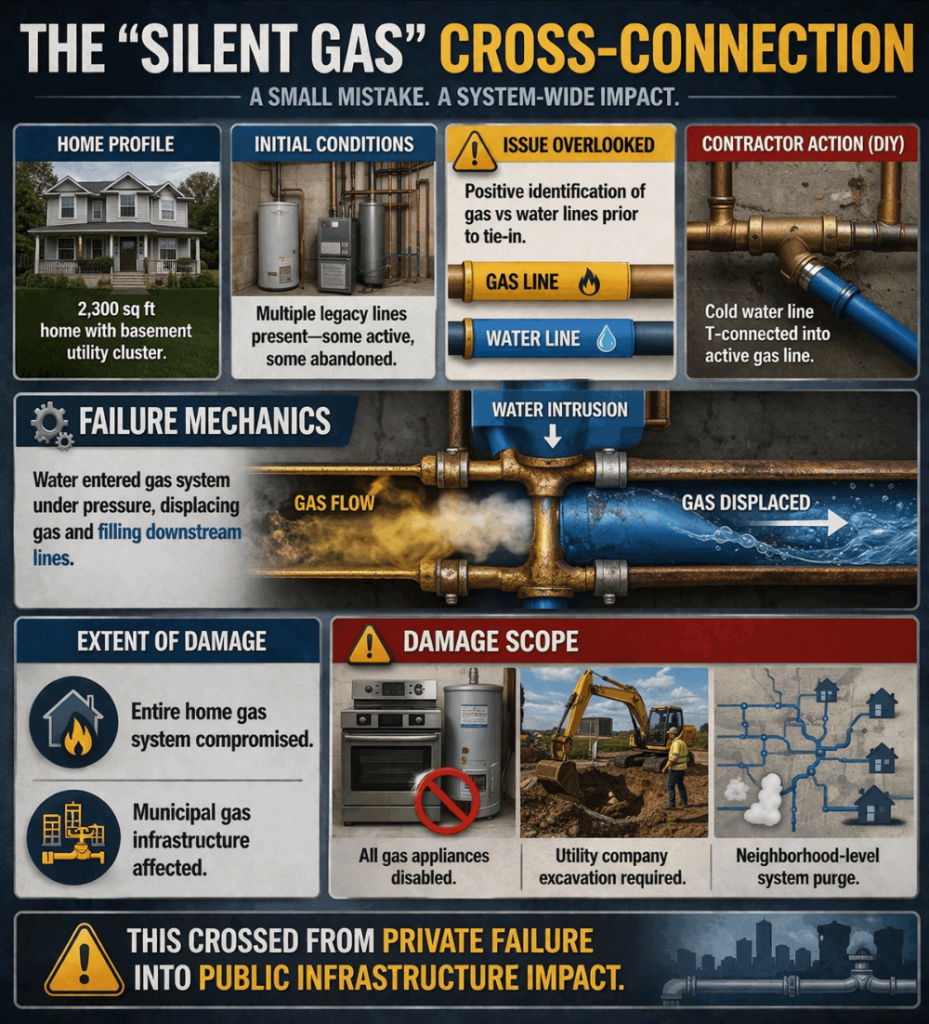
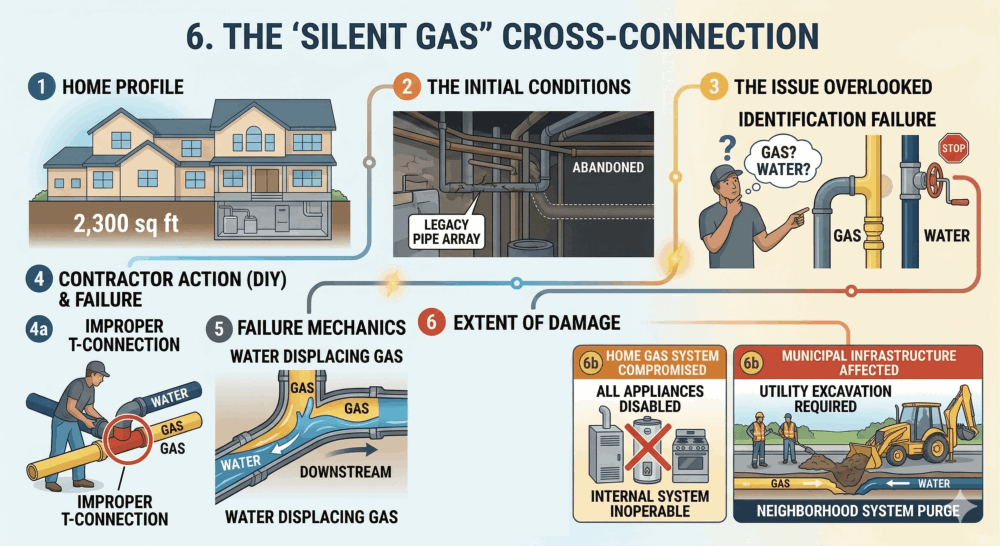
Inside a 2,300 sq ft home with a basement utility cluster, multiple legacy lines were present.
Some lines remained active, while others had been abandoned but not removed.
Prior symptoms included fluctuating water temperature, low water pressure, and occasional banging sounds.
Additionally, metallic tasting water and sediment in faucet aerators suggested aging potable water lines.
No issues were initially observed within the gas system.
Line labeling was incomplete.
Routing between potable water lines and gas lines overlapped within confined areas.
What the Homeowner Thought
From the homeowner’s perspective, the task involved extending a cold water supply line.
The connection appeared straightforward based on visible pipe access.
The assumption was that all accessible lines in the area were part of the water system.
Gas infrastructure was not considered part of the working zone.
The decision focused on restoring water routing, not verifying system identity.
What Was Actually Happening
Within the utility cluster, an active gas line ran adjacent to potable water lines.
Visual similarity between lines created ambiguity.
Gas systems operate under entirely different conditions than water systems.
They are not designed to handle liquid intrusion.
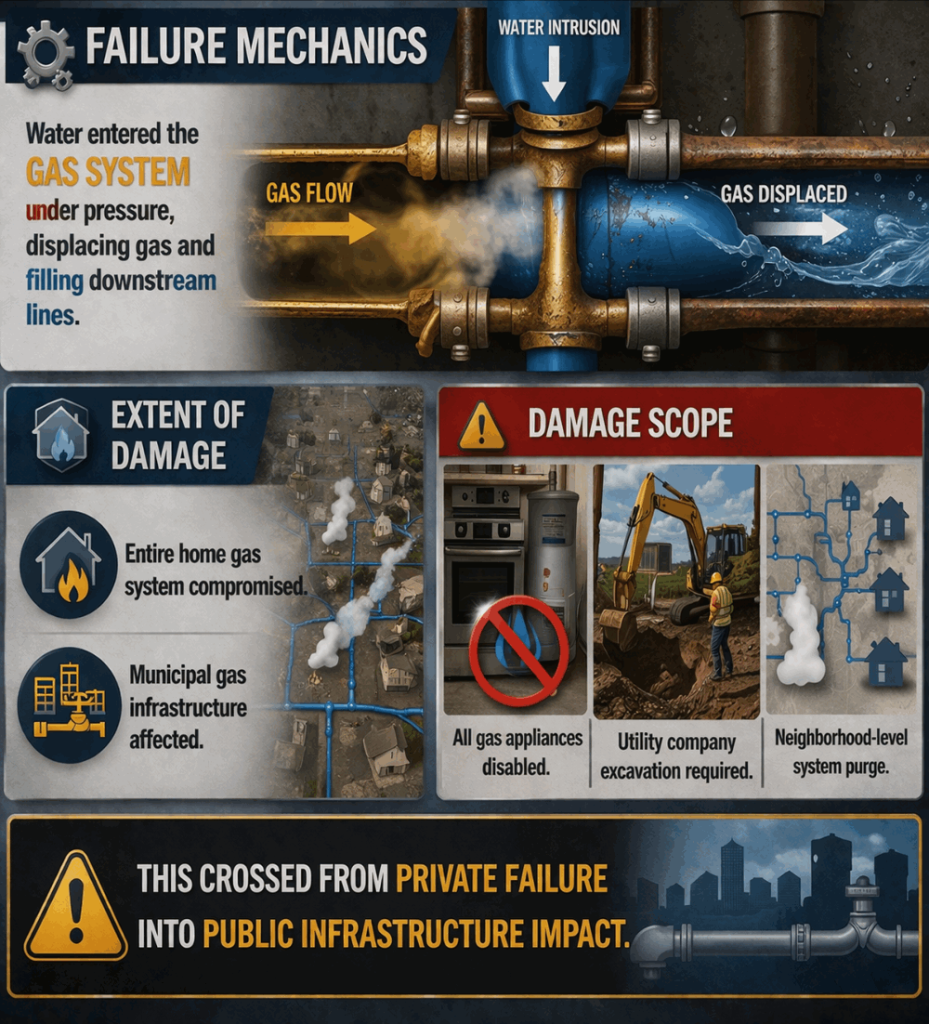
By connecting a water line into the gas system, pressurized water displaced gas within the network.
Water entered downstream gas lines and appliances.
The system transitioned from isolated plumbing work into cross-infrastructure contamination.
1. Finger-in-the-Dike Emergency Water Line Breach Control Failure
2. Refrigerant Line Misidentification During Plumbing Routing Failure
3. Copper-to-Galvanized Direct Connection Electrolysis Failure
4. Open-Flame Soldering Ignition Inside Concealed Wall Cavity
5. Improvised Hose-Based Main Supply Line Structural Failure
6. Water-to-Gas System Cross-Connection Infrastructure Contamination Event
7. Thermal Exposure-Induced PEX Deformation and Rupture Failure
8. Improper Push-Fitting Installation Seal Integrity Failure
9. Back-Pitched Drain Line Waste Accumulation and Pressure Failure
10. Plumbing System Grounding Interruption Electrical Shock Event
Homeowner Action (DIY – No Contractor Involved)
No licensed plumber or contractor participated in this work.
The homeowner independently performed the connection.
A cold water line was T-connected into what was believed to be a potable water line.
No verification was performed to confirm system type.
No testing or isolation procedures were conducted prior to connection.
Gas system identification protocols were not considered.
Failure Trigger
Once the connection was completed, pressurized water entered the gas line.
Water began displacing gas within the system.
Downstream gas piping filled with water.
Gas appliances lost function as supply lines became contaminated.
The failure extended beyond the immediate connection point.
It propagated through the entire gas distribution system.
Why It Was Not Visible at Install
Gas and water lines can appear similar in confined utility areas.
Aging materials and lack of labeling obscure identification.
In retrofit-heavy homes like those in Palo Alto, multiple generations of work overlap within the same space.
Visual inspection alone does not confirm system type.
Homeowners are not expected to distinguish between these systems without verification tools.
Execution & Escalation
Gas appliances began failing as water entered supply lines.
System pressure irregularities became apparent across multiple fixtures.
Utility providers detected abnormalities within the gas network.
The issue extended beyond the home into municipal infrastructure.
A full system shutdown was required.
Excavation and system purge procedures were initiated at the neighborhood level.
Extent of Damage
All gas appliances within the home were disabled.
Internal gas lines required clearing and inspection.
Municipal gas infrastructure was affected by contamination.
Utility crews were required to excavate and service affected sections.
The event expanded from a single connection error into a broader infrastructure issue.
Repair scope extended beyond private property.

What Professionals Verify
Professionals verify system identity before any connection is made.
They differentiate between gas lines and potable water lines using testing and labeling methods.
Isolation procedures are established prior to modification.
Cross-system interaction risks are evaluated before any tie-in occurs.
Licensed professionals coordinate with utility providers when working near gas infrastructure.
Verification extends beyond visible conditions.
Decision Distortion
The homeowner believed the decision involved connecting a water line.
The actual decision required identifying all systems within the utility cluster.
Visible access suggested simplicity.
Hidden system overlap introduced risk.
This mismatch created consequences that were not apparent at the time of work.
Broader Pattern
Across cities like San Mateo and Richmond, older homes frequently contain mixed and undocumented utility systems.
In colder regions such as St. Paul, additional layers of retrofits further complicate identification.
Contractor standards data shows that cross-connections, while rare, produce high-impact failures.
These events often escalate beyond the original work scope.
The initiating action is small.
The systemic impact is large.
Process Context
A whole-house repipe or system modification is performed as a controlled process.
All systems within the work zone are identified and verified prior to connection.
Potable water lines are clearly separated from gas infrastructure.
PEX-A or copper repipe systems are installed with full system awareness.
Water bypass systems maintain service during work.
Drywall access is controlled and limited.
System integrity is preserved through verification at each stage.
Permitting & Compliance
City plumbing permits and building code inspections require proper system identification.
Gas system work often requires coordination with utility providers.
Improper cross-connections may violate code and safety regulations.
Homeowners insurance coverage may be impacted by unlicensed work.
Licensed, bonded, and insured professionals provide compliance assurance.
Outcome Shift
The failure did not originate from the connection itself.
It resulted from connecting two incompatible systems.
If system identity had been verified, the gas line would not have been used.
The plumbing work would have remained isolated.
Instead, a single misidentification caused infrastructure-level impact.
Cost & Decision Considerations
Costs extended beyond plumbing into gas system restoration.
Utility excavation and system purge increased total expense.
Appliance replacement and system inspection added further cost.
Project timelines expanded due to coordination with utility providers.
Financial exposure exceeded typical residential repair scenarios.
Initial verification decisions determined total impact.

Key Takeaway
No contractor was involved in this event.
All work was performed by the homeowner.
The decision was not about connecting a water line.
The decision was about identifying every system within the utility cluster.
System interaction defines risk.
Verification prevents escalation.
Assumption creates infrastructure-level consequences.