sinkholeSF30 — Subsurface Erosion Mechanics
It just needs time and a path.
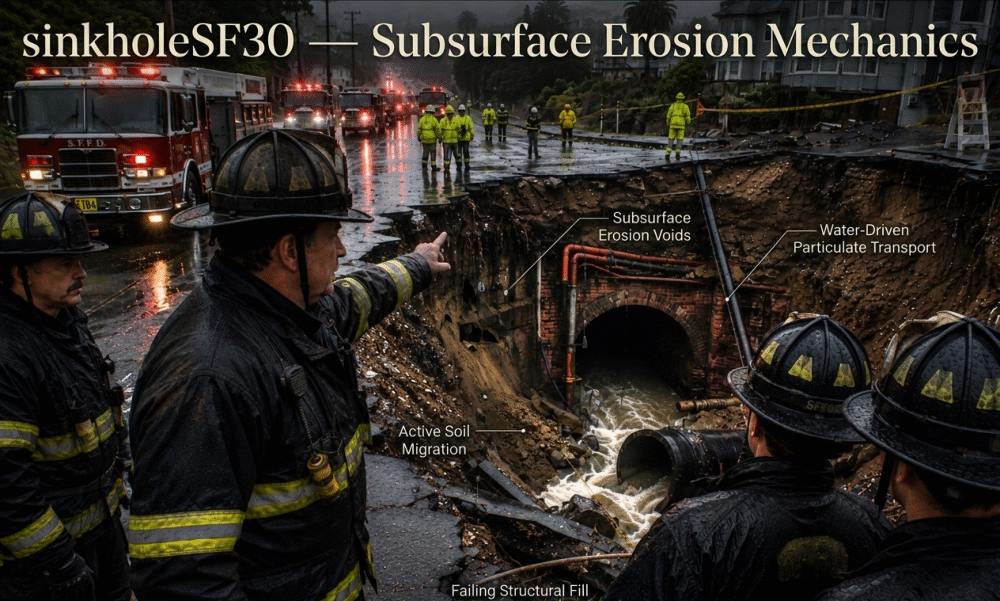
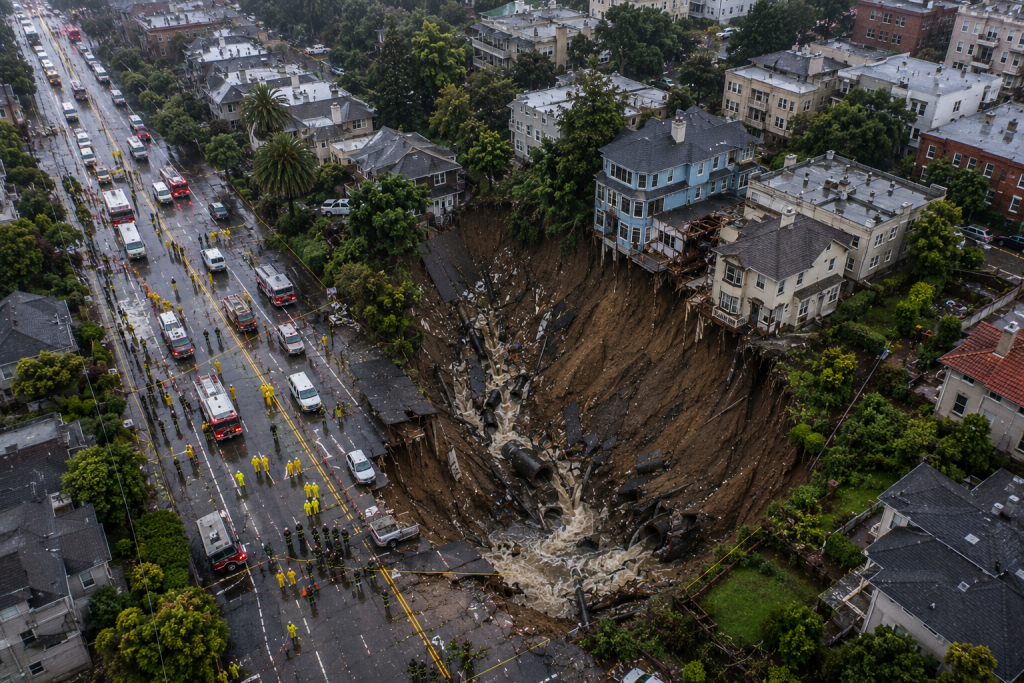
In 1995, a collapse in San Francisco wasn’t caused by sudden force.
A ~100-year-old sewer line failed during heavy rain.
Water found a way out.
Soil followed that path.
Support disappeared.
The structure didn’t fail first.
The ground was removed from beneath it.
SYSTEM VS SYMPTOM BREAKDOWN
Surface collapse is the outcome.
Erosion is the mechanism.
What shows up:
- Sinkholes
- Structural settlement
- Sudden instability
- Visible ground failure
What actually happened:
- Sewer line breach under pressure
- Continuous water migration into surrounding soil
- Soil particle displacement along flow paths
- Progressive loss of compaction beneath load zones
The system didn’t break the ground.
It carried it away.
FAILURE ORIGIN (NOT VISIBLE DAMAGE)
Subsurface erosion starts small.
It doesn’t require a major break.
In the San Francisco Bay Area:
- Soil contains fine particles that move with water
- Moisture changes alter soil cohesion
- Aging pipes create pathways for water escape
That creates a repeatable process:
- Pipe integrity weakens from age and pressure
- Small openings allow water to exit the system
- Water flows through surrounding soil
- Fine particles are carried away with that flow
- Soil structure loses density and cohesion
This is not visible.
But it is continuous.
WHY REPAIRS DON’T SOLVE UNDERLYING CONDITIONS
Repairs stop the leak.
They don’t reverse erosion.
Fixing a pipe section:
- Halts water flow at that point
- Does not return displaced soil
- Does not restore original compaction
- Does not address other leak pathways
The system remains:
- Structurally inconsistent
- Environmentally active
- At risk of continued erosion elsewhere
Even after repair:
- Existing voids remain
- Soil strength is reduced
- Additional leaks can restart the process
Repairs fix containment.
They don’t rebuild the ground.
SYSTEM ALIGNMENT VS PATCHWORK
Erosion control depends on containment consistency.
Aligned system:
- Fully contains water within pipes
- Maintains even pressure across the network
- Prevents unintended flow paths into soil
- Supports stable interaction with ground conditions
Patched system:
- Introduces multiple potential leak points
- Creates pressure variability
- Allows intermittent water escape
- Generates new erosion pathways
Every leak is a flow path.
Every flow path removes material.
Patchwork systems multiply both.
INFRASTRUCTURE → HOME (PATTERN TRANSLATION)
Subsurface erosion at infrastructure scale mirrors residential conditions.
Infrastructure scale → Home scale
- Sewer breach → Plumbing leak
- Water flow through soil → Subsurface erosion under the home
- Soil displacement → Loss of support beneath slab or foundation
- Collapse → Structural damage and instability
The mechanism is identical.
Only the volume changes.
SUBSURFACE EROSION IN RESIDENTIAL SYSTEMS
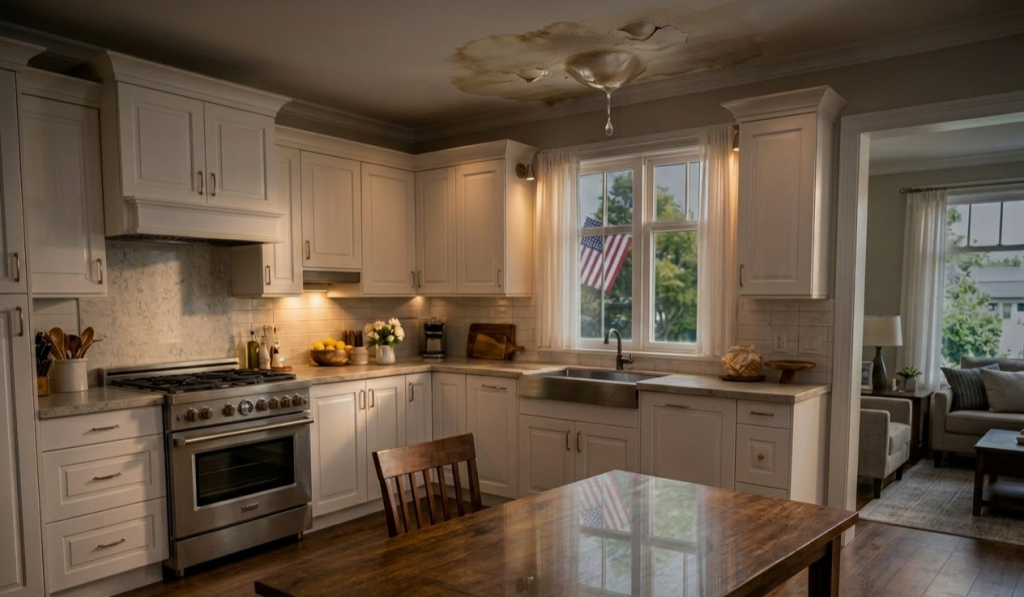
Most homes don’t detect erosion early.
Because it happens below visibility.
Early indicators:
- Persistent damp soil near the home
- Minor, recurring plumbing leaks
- Slight changes in ground firmness
Mid-stage indicators:
- Multiple leaks in different locations
- Noticeable settling or uneven surfaces
- Increased moisture in crawlspaces or slab areas
Late-stage indicators:
- Foundation cracking
- Floor movement
- Sudden structural issues
By the time the structure reacts—
material has already been removed.

THE DECISION POINT
You can respond to leaks.
Or you can prevent the erosion process.
One manages events.
The other controls the system.
STOP EROSION AT THE SOURCE
A full repipe eliminates the conditions that drive subsurface erosion.
- Replaces aging, compromised piping
- Restores full water containment across the system
- Removes hidden leak points
- Aligns system performance with environmental conditions
This is not a repair.
It’s erosion prevention.
Because once the ground begins to move—
the system has already failed.