sinkholeSF29 — Why Sewer Failures Destabilize Homes
Sewer failures don’t stay in the pipe.
They transfer into the structure.
That’s the part most people miss.
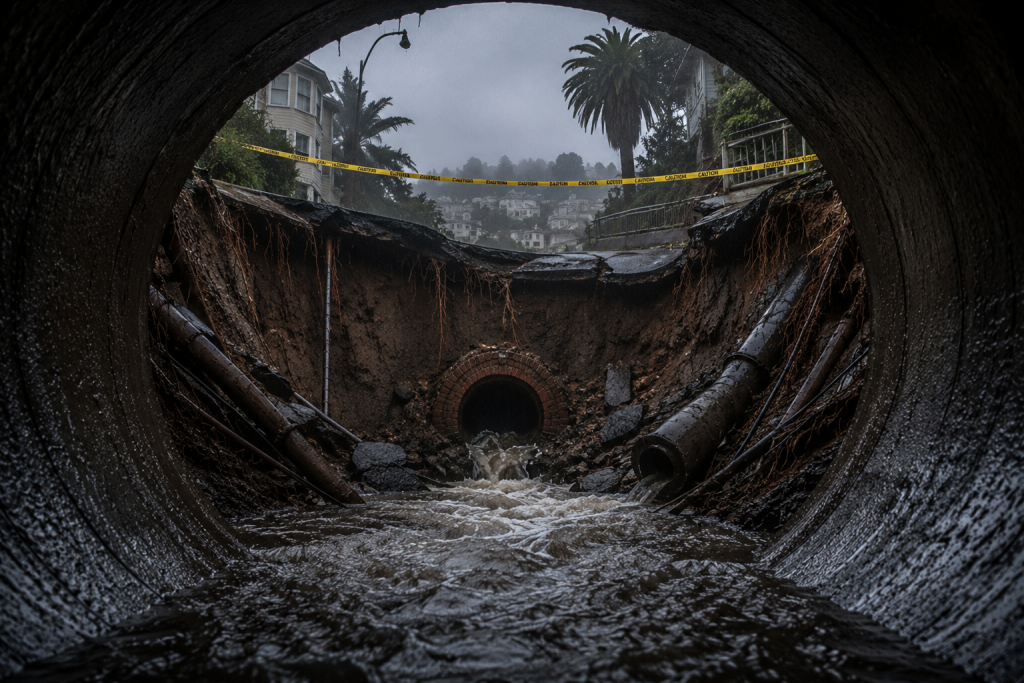
In 1995, a collapse in San Francisco wasn’t caused by the structure above.
A ~100-year-old sewer line failed during heavy rain.
Water left the system.
Soil followed the water.
Support disappeared.
The pipe failure triggered it.
The ground failure caused it.

SYSTEM VS SYMPTOM BREAKDOWN
The visible issue is structural.
The actual issue is system destabilization.
What shows up:
- Foundation cracks
- Floor movement
- Sudden ground collapse
- Structural instability
What actually happened:
- Sewer line breach under pressure
- Continuous water release into surrounding soil
- Soil displacement and loss of density
- Breakdown of load-bearing support
The structure reacts.
The system causes.

FAILURE ORIGIN (NOT VISIBLE DAMAGE)
Sewer systems are designed to contain movement.
Water moves through the pipe.
Not outside it.
When containment fails, the environment changes.
In the San Francisco Bay Area:
- Soil is responsive to moisture
- Ground movement is constant
- Infrastructure is aging
That creates a failure pathway:
- Pipe walls weaken from time and internal pressure
- Joints separate under ground movement
- Water escapes into surrounding soil
- Soil becomes unstable and begins to shift
- Load support beneath the structure is reduced
This doesn’t happen at the surface.
It happens below it.

WHY REPAIRS DON’T SOLVE UNDERLYING CONDITIONS
Repairing a sewer line restores flow.
It does not restore stability.
Fixing a section:
- Stops leakage at that point
- Does not rebuild displaced soil
- Does not reestablish uniform load support
- Does not address other aging sections
The system remains compromised:
- Soil may already be weakened
- Pressure conditions are unchanged
- Additional failure points still exist
So the instability continues.
Even if the pipe appears “fixed.”

SYSTEM ALIGNMENT VS PATCHWORK
Sewer systems depend on continuity.
Aligned system:
- Maintains full containment of water
- Distributes pressure evenly
- Supports stable soil interaction
- Operates as a single, consistent network
Patched system:
- Contains multiple connection points
- Introduces pressure variation
- Allows inconsistent water containment
- Creates localized stress zones
Every inconsistency increases risk.
Every weak point is a potential failure.
In movement-driven environments, those risks compound quickly.
INFRASTRUCTURE → HOME (PATTERN TRANSLATION)
What destabilized infrastructure applies directly to homes.
Infrastructure scale → Residential scale
- Sewer failure → Main drain line leak
- Water escaping → Soil weakening beneath the home
- Soil movement → Loss of foundation support
- Collapse → Structural damage and instability
Same system behavior.
Same outcome.
HOW SEWER FAILURES SHOW UP IN HOMES
Most homeowners don’t connect plumbing issues to structural risk.
They should.
Early indicators:
- Slow or recurring drain issues
- Isolated leaks near foundation areas
- Damp soil or persistent moisture
Mid-stage indicators:
- Multiple plumbing failures
- Minor foundation movement
- Uneven flooring or alignment changes
Late-stage indicators:
- Cracks in slab or walls
- Significant settling
- Sudden structural issues
By the time the structure shows damage—
the system has already destabilized it.

THE DECISION POINT
You can treat sewer failures as isolated plumbing issues.
Or you can recognize them as structural risk factors.
One minimizes the problem.
The other addresses it correctly.
ELIMINATE DESTABILIZATION AT THE SOURCE
A full repipe removes the condition that destabilizes the home.
- Replaces aging sewer and plumbing materials
- Restores full containment of water within the system
- Eliminates hidden leak points across all lines
- Aligns the system with environmental conditions
This is not a repair.
It’s system stabilization.
Because when a sewer system fails—
the structure is already being affected.