
sinkholeSF02 — Hidden Sewer Collapse Beneath a Perfect Home
False Stability
The home gave no warning.
Floors felt solid.
Walls were aligned.
The exterior looked undisturbed.
Nothing suggested instability.
Everything suggested normal.
Hidden Failure Trigger
The change started where no one was looking.
In 1995, a property in Sea Cliff, San Francisco was sitting above a sewer system that had reached the end of its functional life.
The line was nearly 100 years old.
During a period of heavy rain, the system absorbed more water than it could handle.
Internal pressure increased.
Material failure followed.
The pipe broke.
Water moved into surrounding soil.
That movement displaced the ground supporting the home.
A void began forming below the structure.
Above ground, nothing changed—yet.
The Moment Before Failure
There is a phase where systems are no longer stable, but still appear intact.
This is where most risk exists.
The ground still holds.
The structure still stands.
The signals are present—but subtle.
Then the support gives way.
Early Warning Signs Most Homeowners Miss
Early indicators rarely look urgent.
They appear as minor inconsistencies:
- Slight dampness along the foundation or in lower-level spaces
- Small shifts in outdoor surfaces like walkways or patios
- Occasional slow drainage or air bubbles in plumbing lines
- Faint cracking at corners of walls or door frames
- Intermittent drops or surges in water pressure
Each sign is easy to overlook.
Together, they reflect system stress.

Pattern Translation — Infrastructure → Home
The same failure sequence applies across systems.
Century-Old Sewer Failure → Aging Residential Pipe Breakdown
Materials degrade even without visible damage
Heavy Rain Load → Elevated Internal Plumbing Pressure
Higher volume exposes system weaknesses
Soil Displacement from Escaped Water → Slab or Foundation Movement
Water changes the structure of supporting soil
Underground Void Formation → Loss of Structural Support Below the Home
Failure begins below before reaching the surface
The difference is scale.
The pattern remains consistent.
Residential Examples of the Same Pattern
These conditions occur in homes every day:
- A slow leak beneath a slab gradually washing away soil support
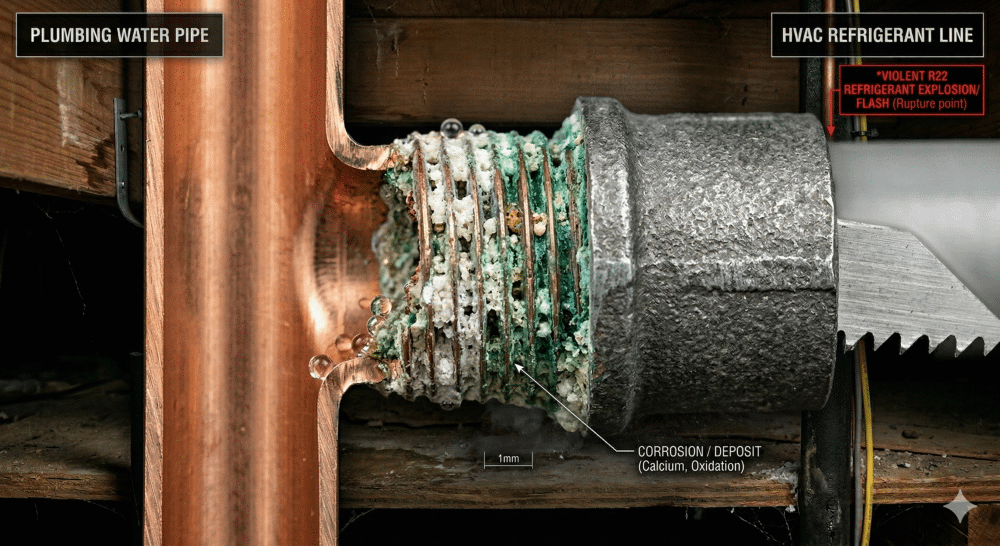
- Corroded pipes allowing constant, low-level water escape
- Pressure inconsistencies weakening fittings over time
- Drain line issues saturating soil near the foundation
- Crawlspace moisture reducing ground stability under load
Each condition develops quietly.
Each contributes to long-term structural risk.
Why These Problems Are Missed
Homeowners respond to visible change.
But system failure develops before visibility.
By the time damage appears:
- Soil may already be unstable
- Structural alignment may be affected
- Water damage may have spread beyond the source
The timeline between cause and effect creates the risk.
Bay Area Conditions That Reinforce the Pattern
Homes in the Bay Area operate within a consistent environment:
Ground movement
Seasonal moisture
Aging infrastructure systems
These factors increase the likelihood of hidden failure.
Especially in older neighborhoods with legacy plumbing.
A Shift in Approach
Waiting for visible damage leads to reactive repair.
A system-based approach looks earlier.
It evaluates:
- Pipe age and internal condition
- Pressure behavior across the system
- Signs of hidden water movement
- Interaction between plumbing and soil stability
This is how risk is identified before escalation.
Before the Surface Changes
The Sea Cliff collapse followed a clear pattern.
Pressure.
Water movement.
Time.
Structural loss.
That same sequence exists inside residential systems.
Understanding it early changes the outcome.
See how whole-home plumbing systems are evaluated before failure becomes visible:
👉 https://plumbingwholehomerepipe.com/ca/san-francisco-sinkhole-that-swallowed-a-mansion-san-francisco-california-1995/