
Summerlin Slab Leaks: How Soil Shifts Kill Copper Pipes
Summerlin
Driving Force: Soil Subsidence & Differential Settling
The Breakdown (unchanged core):
Summerlin is built on higher elevations with mixed soil depths. The extreme Las Vegas heat cycles (115°F+) cause the desert soil to contract and expand rapidly. This “differential settling” puts immense physical stress on copper pipes where they penetrate the concrete slab, leading to high rates of mechanical failure (slab leaks).
What Homeowners Notice First (Trigger Moments)
Warm or hot spots on the flooring
Hairline cracks in tile or slab
- Vegas Failure Map: Why Your Zip Code Predicts Your Next Leak
- Summerlin Slab Leaks: How Soil Shifts Kill Copper Pipes
- Henderson Corrosion: The Hidden Rot in Galvanized Pipes
- North Las Vegas Sewers: Why Clay Soil Causes Line Collapse
- Spring Valley Hard Water: How Scale Destroys Your Flow
- Enterprise Pressure Alert: The 5-Year PRV Failure Risk
- Sunrise Manor Root Damage: Stopping Total Sewer Breakage
- Paradise Polybutylene: The “Ticker” on Your Home’s Repipe
- Winchester Cast Iron: Signs Your Aging Lines are Failing
- Southern Highlands Copper: Solving Pinhole Leak Crises
Unexplained water bill increases
Sound of water running with no fixtures on
Time-to-Failure Window
Typically emerges: 10–20 years post-build
After symptoms appear: 3–12 months to active slab leak

System-Level Impact
Slab leak → foundation moisture → structural movement
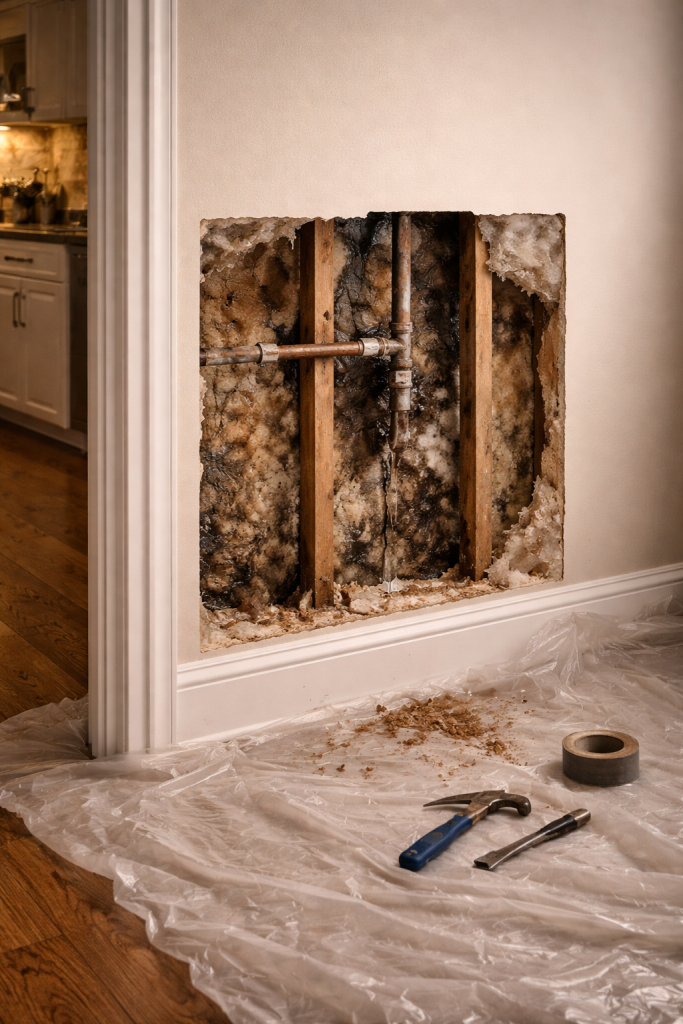
Continuous leak → mold + flooring damage
Pressure loss → strain the entire plumbing system
Where Most Plumbers Get It Wrong
Treat it as “just a leak.”
Patch one section instead of addressing movement stress zones.
Prevention / Control
Pressure regulation (reduce system stress)
Annual leak detection scan
Re-route lines through the attic (bypass the slab entirely)
What This Costs If Ignored
Slab leak repair: $6k–$15k
Flooring + structural damage: $10k–$30k+
Inspection Trigger Checklist
If you live in Summerlin and notice:
Warm floor areas
Cracks forming indoors
Rising water bills
👉 You’re likely in early-stage slab stress failure.
Plumbing Failure Symptoms in Summerlin, Nevada
Summerlin Slab Leaks: How Soil Shifts Kill Copper Pipes begins with a condition most homeowners never see forming.
Homes appear stable.
Floors feel solid.
Water pressure seems consistent.
In Summerlin, many homes built between 2000 and 2015 are now reaching a structural stress phase.
Elevated terrain introduces soil variation beneath slabs.
Desert heat cycles accelerate expansion and contraction.
Across Henderson and Spring Valley, similar slab stress is observed at different elevations.
In North Las Vegas, older copper systems experience the same failure pattern with shorter timelines.
Comparable conditions can be seen in Phoenix and parts of Inland California where soil movement and heat cycles overlap.
Summerlin Slab Leaks: How Soil Shifts Kill Copper Pipes is not a single-event failure.
It is a system-level condition tied to ground movement and pressure behavior.
Local Ground Movement and Structural Stress Conditions
Soil in Summerlin does not remain static.
Expansion occurs during heat cycles.
Contraction follows rapid cooling.
In elevated zones, soil depth varies.
Support beneath slabs becomes inconsistent.
Copper lines passing through concrete absorb that movement.
In Summerlin South, homes built on graded terrain experience uneven settlement.
In The Paseos and The Vistas, long slab runs increase exposure to shifting stress.
In nearby Henderson communities, similar movement patterns develop with different intensity due to elevation differences.
Across these areas, the slab becomes a stress transfer surface.
Pipes are not isolated.
They move with the structure.
High-Risk Zones in the Summerlin Area
Patterns repeat across subdivisions.
Homes built under similar conditions fail under similar timelines.
Elevated Terrain Zones (Differential Settling Risk):
- Summerlin South
- The Ridges
- Red Rock Country Club
- The Summit
- Canyon Gate
Mid-Elevation Subdivisions (Heat + Soil Expansion):
- The Trails
- The Arbors
- The Gardens
- The Willows
- Peccole Ranch
Adjacent Growth Areas (Mixed Soil and Structural Stress):
- Spring Valley
- Enterprise
- Southern Highlands
- Mountains Edge
- Rhodes Ranch
Each group shares soil behavior patterns.
Each experiences slab stress differently.
Failure timing aligns within neighborhoods.

How Slab Movement Translates Into Pipe Failure
Copper piping is rigid.
It does not flex with soil movement.
As the slab shifts:
- Pipe penetrations at concrete points absorb stress
- Connections weaken under repeated movement
- Pressure builds at fixed points
- Micro-fractures begin forming
In Summerlin, this process accelerates due to heat cycling.
Daily temperature swings expand and contract both soil and pipe.
In Henderson, similar conditions occur with less elevation-driven variation.
In Phoenix, comparable patterns develop under different soil compositions.
Summerlin Slab Leaks: How Soil Shifts Kill Copper Pipes is driven by repeated stress cycles, not a single break.
Hidden Triggers: Pressure and System Interaction
Slab movement alone does not cause immediate leaks.
Pressure behavior determines when failure becomes visible.
In many Summerlin homes:
- Pressure regulators drift out of range over time
- Mineral scaling restricts flow
- Internal pressure redistributes unevenly
Water heaters add another layer.
Sediment buildup creates backpressure.
Softener systems introduce brine-related stress downstream.
In North Las Vegas, pressure spikes often accelerate failure timelines.
In Spring Valley, mixed material systems amplify internal stress.
These triggers remain silent.
No visible issue appears at first.

Why These Failures Are Delayed
Initial installation conditions do not reflect real-world operation.
Systems pass inspection.
No leaks are detected.
Over time:
- Soil shifts gradually
- Pressure redistributes
- Copper weakens at stress points
- Internal conditions change
Typical timelines:
- Early stage: ~30 days
- Mid stage: ~6 months
- Late stage: ~1–2 years
In Summerlin, failure often appears after seasonal cycles repeat.
In Henderson, the distribution imbalance becomes visible under sustained demand.
In comparable Phoenix neighborhoods, similar delays occur due to heat-driven expansion.
Summerlin Slab Leaks: How Soil Shifts Kill Copper Pipes follows a predictable progression.
Recognition Signals Homeowners Notice First
Early signs rarely appear dramatic.
They build slowly.
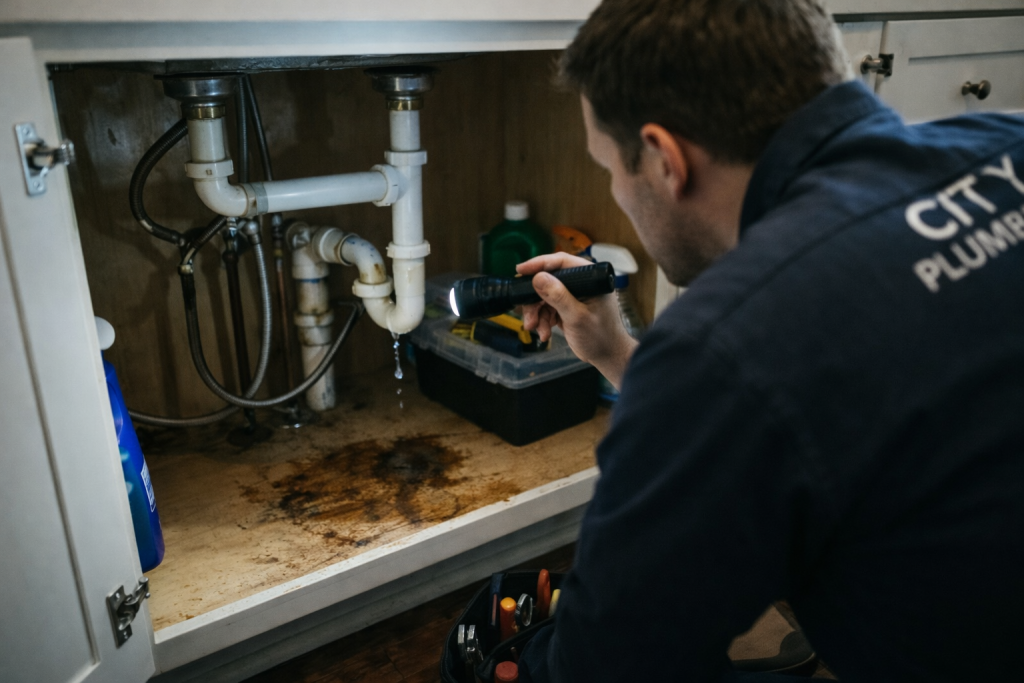
- Warm spots on the flooring
- Hairline cracks in tile or slab
- Unexplained increases in water bills
- Sound of water running with no fixtures on
- Subtle pressure loss across fixtures
In The Vistas, these signals often appear before visible leakage.
In Spring Valley, pressure inconsistency may precede structural symptoms.
In North Las Vegas, early-stage leaks emerge without warning.
These are recognition signals.
They indicate underlying system stress.
Decision Distortion in Slab Leak Scenarios
Homeowners often believe they are deciding between:
- Leak repair vs replacement
- Spot fix vs reroute
- Immediate cost vs delay
These are surface-level decisions.
Actual outcomes depend on:
- Extent of slab movement
- Number of stress points across the system
- Pressure behavior within piping
- Material condition over time
A single repair does not eliminate movement.
Stress transfers to the next weakest point.
Summerlin Slab Leaks: How Soil Shifts Kill Copper Pipes highlights this shift from visible repair to system behavior.
From Leak Repair to System-Level Correction
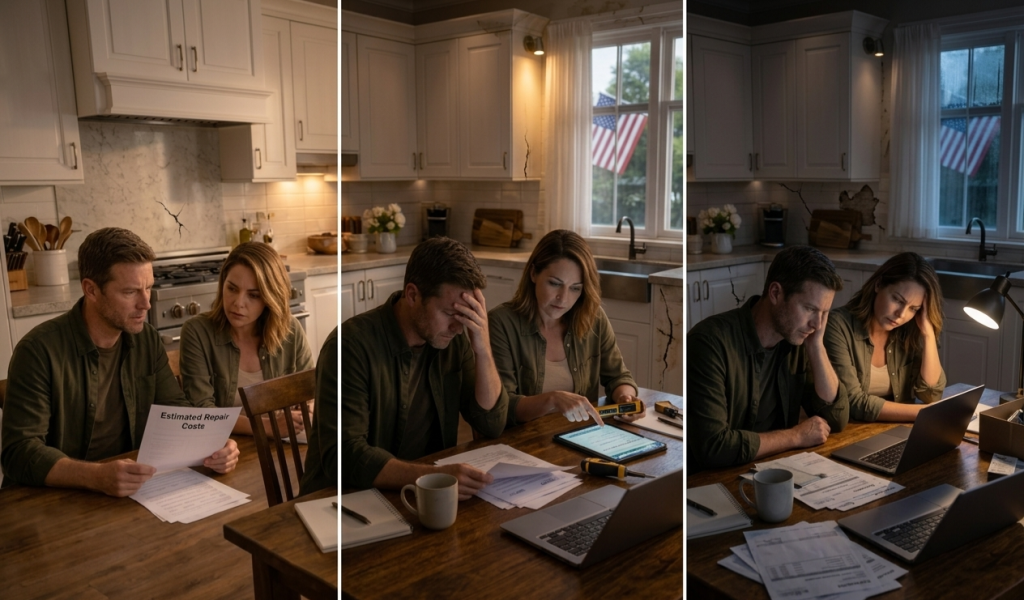
Repeated slab leaks indicate system instability.
The issue is not the leak.
It is the environment in which the system operates.
At this stage:
- Multiple leak points develop
- Pressure instability increases
- Structural stress persists
- Repair frequency rises
What begins as a single failure becomes a recurring one.
Structured repiping introduces control:
- Overhead rerouting to remove slab dependency
- Transition to PEX-A for flexibility or Type L copper for durability
- Isolation from soil movement
- Balanced pressure distribution
- Water bypass during installation
This is not patchwork.
It is a system redesign.
Process, Permits, and Structural Navigation
Repiping in Summerlin requires coordination across jurisdictions.
Permits vary between Las Vegas, Clark County, and Henderson.
Inspection layers ensure compliance.
Drywall access is planned with precision.
Minimal disruption strategies are used.
Water service is maintained through bypass systems.
Most homes regain water the same day.
Final inspections confirm system integrity.
Proper execution protects long-term value.
Insurance eligibility improves.
Future resale remains stable.

System Performance and Property Protection
Updated systems change outcomes.
Water pressure stabilizes.
Leak probability decreases.
Hot water delivery improves.
Metallic taste disappears.
Long-term costs become predictable.
Insurance risk is reduced.
Appraisal confidence increases.
In high-value areas such as Summerlin and Red Rock communities, plumbing stability directly affects asset protection.
Summerlin Slab Leaks: How Soil Shifts Kill Copper Pipes
Summerlin Slab Leaks: How Soil Shifts Kill Copper Pipes reflects a regional pattern rather than an isolated issue.
Across Summerlin, Henderson, Spring Valley, and surrounding zones, soil behavior shapes system outcomes.
Comparable stress appears in Phoenix and parts of Inland California, reinforcing the broader pattern.
Extended markets such as Reno and Sparks show similar delayed failure under different environmental conditions.
Plumbing Whole Home Repipe contractor standards operate as decision infrastructure within this environment.
They guide evaluation based on system behavior rather than surface-level symptoms.
Decisions should be based on:
- System age
- Leak history
- Material risk
- Pressure behavior
- Structural conditions
Summerlin Slab Leaks: How Soil Shifts Kill Copper Pipes provides a framework for understanding these variables.
It replaces reactive thinking with structured evaluation.
It aligns decisions with long-term system performance.
It connects plumbing behavior directly to property value protection.