Arkansas Home Failure Intelligence
How This Helps Arkansas Homeowners
Most plumbing failures in Arkansas do not come from one issue.
They come from overlap.
Moisture building around the system.
Soil shifting underneath the home.
Aging infrastructure weakening over time.
By the time a leak appears, the system has often been under pressure for years.
Understanding Arkansas’s failure environment helps homeowners:
- recognize why plumbing failures repeat across similar homes
- identify hidden moisture and soil-driven damage early
- understand how aging systems behave under environmental stress
- avoid repeated repairs that do not address root conditions
- see why crawlspace and underground failures are common
- make better long-term decisions about repair vs full-system replacement
The goal is not to react to plumbing problems.
The goal is to understand the system conditions creating them.
Because in Arkansas, plumbing systems fail where environment and aging infrastructure overlap.
Modeled from the national framework at Plumbing Whole Home Repipe Home Failure Intelligence.

Arkansas Is A Moisture + Soil Movement Environment
Arkansas plumbing systems operate inside a high-moisture environment with variable soil conditions.
Unlike desert regions or extreme cold climates, Arkansas introduces a different set of pressures:
- high humidity
- frequent rainfall
- saturated soil conditions
- clay-heavy soil movement
- vegetation and root pressure
- aging residential infrastructure
- crawlspace-heavy construction
These forces act continuously.
The system is not failing from one cause.
It is responding to layered environmental pressure.
Moisture Drives System-Wide Stress
Arkansas homes experience long-duration moisture exposure.
This affects both air and ground conditions.
Moisture interacts with:
- crawlspaces
- basements
- wall cavities
- underground piping
- structural materials
Over time, this leads to:
- corrosion on piping
- weakened supports and fasteners
- hidden leaks remaining undetected
- structural material degradation
Moisture does not just create damage.
It extends it.
Saturated Soil Conditions Affect Underground Systems
Frequent rainfall keeps soil conditions active.
Especially around foundations.
Saturated soil creates:
- constant contact with underground piping
- increased pressure on buried systems
- shifting ground conditions
- reduced stability at connection points
This leads to:
- pipe misalignment
- joint separation
- cracking in sewer lines
- underground leaks
In some areas, drainage challenges increase these effects.
Expansive Clay Movement Transfers Pressure
Many Arkansas regions contain clay-heavy soils.
These soils expand when wet and contract when dry.
This creates movement cycles beneath homes.
Which transfer stress into:
- slab-embedded piping
- sewer systems
- foundation penetrations
- underground water lines
Over time, this leads to:
- slab leaks
- pipe separation
- stress fractures
- recurring underground failures
The pipe is reacting to ground movement.
Not just aging.
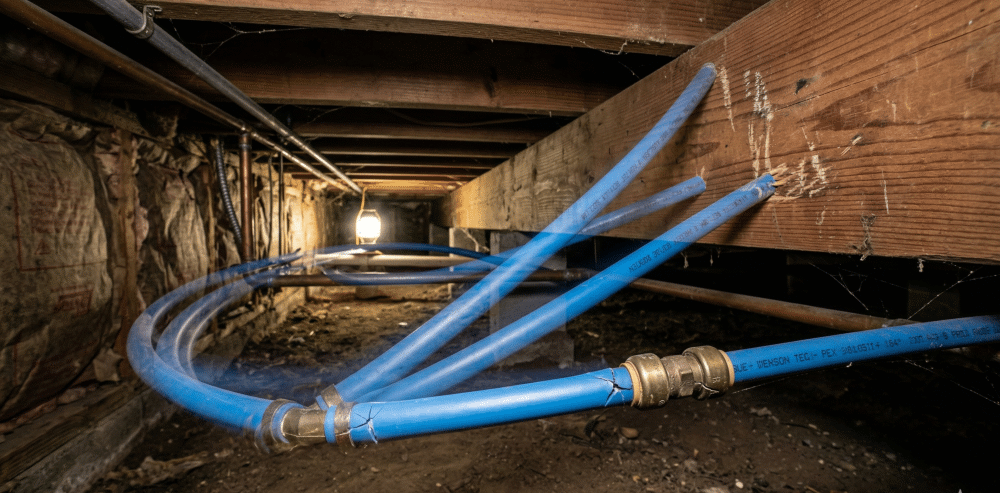
Crawlspaces Amplify Moisture Exposure
Many Arkansas homes are built on crawlspace foundations.
These environments often become moisture reservoirs.
They introduce:
- ground humidity
- poor ventilation
- temperature fluctuation
- biological activity
Plumbing systems installed in crawlspaces are exposed continuously.
Over time, this leads to:
- corrosion on exposed pipes
- weakened supports
- pipe misalignment
- sagging drain lines
- joint stress
These conditions often go unmonitored.
Which allows damage to develop without interruption.
Root Intrusion Is A Predictable Failure Pattern
Vegetation plays a major role in Arkansas plumbing failures.
Roots seek moisture.
And plumbing systems provide it.
Especially in:
- older neighborhoods
- homes with mature trees
- aging sewer systems
- clay or cast iron piping
Once a weakness forms, roots enter and expand the damage.
This leads to:
- recurring sewer backups
- slow drainage
- pipe collapse over time
- repeated cleaning without long-term correction
The problem is structural.
Not just blockage.
Aging Infrastructure Carries Layered Weakness
Many Arkansas homes operate on older plumbing systems.
Often including:
- galvanized piping
- cast iron drains
- older copper systems
- mixed-material repairs
Over time, repair layering creates:
- inconsistent materials
- weak transitions
- uneven pressure distribution
- unpredictable failure points
The system loses uniformity.
And becomes more vulnerable under environmental stress.
Why Failures Often Repeat
Many homeowners address visible issues individually.
But repairs do not remove:
- moisture exposure
- soil movement
- root pressure
- aging material conditions
This leads to:
- repeated leaks
- recurring sewer problems
- expanding failure zones
- increasing repair frequency
The system was repaired.
Not stabilized.
Why Problems Feel Sudden
Most Arkansas plumbing failures appear without warning.
But the system followed a progression:
- moisture exposure
- soil saturation and movement
- material weakening
- root intrusion or structural stress
- localized failure
- visible symptom
The final stage is visible.
The buildup is hidden.

Human-System Acceleration Factors
Environmental pressure sets the baseline.
Human decisions influence outcomes.
Common factors include:
- delaying maintenance
- ignoring early warning signs
- repeated spot repairs
- poor drainage management
- improper material upgrades
- DIY modifications
In Arkansas, moisture continues acting on the system daily.
Delay allows damage to expand.
Final Positioning Statement
Arkansas plumbing systems fail where moisture, soil movement, root pressure, and aging infrastructure overlap.
That pressure develops through:
- high humidity
- saturated soil conditions
- clay expansion and contraction
- crawlspace exposure
- vegetation intrusion
- system aging
The visible problem is only the final stage.
The real system stress builds over time.
Understanding Arkansas’s plumbing failure environment helps homeowners recognize risk earlier, reduce repeat failures, and make better long-term decisions about their home’s plumbing system.