Orlando Plumbing Systems Under Rapid Expansion and Water Stress
This helps Orlando homeowners understand how rapid growth, water demand, and system expansion create hidden plumbing stress, allowing earlier detection, better evaluation, and smarter decisions before failures spread across the home.
Most plumbing problems in Orlando do not originate from a single defect.
They develop from systems being pushed beyond their original design capacity.
Homes expand.
Communities grow.
Water demand increases.
Infrastructure adjusts under pressure.
Those changes introduce stress across both new and existing plumbing systems.
Homeowners often notice pressure inconsistency, delayed hot water delivery, or recurring system issues without realizing the system is operating under continuous demand strain.

Orlando Is A Growth-Driven Plumbing Environment
Orlando represents one of the fastest-expanding residential regions in the country.
Development occurs at scale.
New construction connects into existing infrastructure.
Older systems remain active alongside newer installations.
That overlap creates variation in pressure, supply consistency, and system performance.
Water demand rises faster than infrastructure can fully stabilize.
Plumbing systems inside homes begin absorbing that variability.

The Expansion And Water Stress Failure Stack
Failures in Orlando typically form through demand pressure interacting with construction and infrastructure variability.
Rapid Development And System Scaling
Large-scale development introduces high volumes of new plumbing systems in short timeframes.
Installation speed becomes a factor.
Consistency across builds becomes harder to maintain.
Minor deviations in slope, support, or layout may not appear immediately.
Over time, those small inconsistencies become stress points under real usage conditions.
Systems built for baseline demand often experience higher loads as occupancy increases.
Municipal Pressure Variation And Demand Load
Growing populations place additional strain on municipal water systems.
Pressure levels fluctuate based on time of day, usage patterns, and infrastructure capacity.
Homes located at different elevations or distances from supply points experience variation in delivery.
These fluctuations create internal stress within residential plumbing systems.
Valves, fittings, and pressure-regulating components absorb repeated changes.
Over time, that stress contributes to wear and early component fatigue.

Long-Run Distribution And System Imbalance
Modern Orlando homes often include extended plumbing layouts.
Larger square footage increases pipe length.
Water must travel further to reach fixtures.
This creates delay, imbalance, and pressure inconsistency across the system.
Hot water delivery systems become more complex.
Recirculation loops may be introduced to compensate.
Each added component increases system complexity and introduces additional points of potential failure.
Water Quality And Mineral Interaction
Water chemistry in the region can influence long-term system performance.
Mineral content contributes to gradual buildup inside pipes and fixtures.
Flow capacity changes over time.
Internal friction increases.
Components experience additional strain as water movement becomes less efficient.
Scale accumulation may not be immediately visible but contributes to long-term performance decline.

Thermal Expansion And Daily Load Cycles
Orlando’s climate introduces consistent temperature exposure across plumbing systems.
Pipes expand and contract during daily heating cycles.
Water usage patterns create repeated pressure changes.
Morning demand spikes.
Evening usage increases.
System recovery periods fluctuate.
These cycles place mechanical stress on system components.
Over time, expansion and contraction contribute to fatigue at connection points and vulnerable areas.
Infrastructure Overlap And System Interaction
Orlando contains a mix of older infrastructure and newly developed systems.
Transitions between these systems introduce variability.
Different materials, installation standards, and design assumptions interact within the same network.
This creates uneven performance conditions.
A stable section of plumbing may connect to a more variable segment, transferring stress across the system.
These interactions often remain hidden until a failure occurs.
Why Orlando Plumbing Failures Develop Gradually
Demand-driven stress rarely produces immediate failure.
Systems continue operating while absorbing pressure variation and load increases.
Components degrade incrementally.
Performance changes appear subtle at first.
Homeowners often attribute early symptoms to normal variation rather than system stress.
By the time consistent issues appear, the system has already experienced extended exposure to demand-related strain.
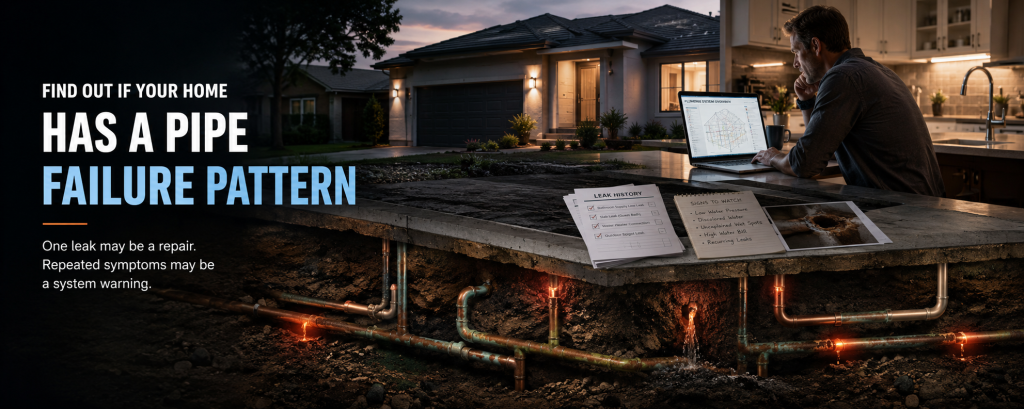
Construction Speed And Long-Term Reliability
High-volume construction environments prioritize completion timelines.
Quality control across installations can vary.
Small inconsistencies in alignment, support, or connection integrity may not present immediate problems.
Over time, those inconsistencies become focal points under expanding demand conditions.
Systems built without margin for future growth tend to degrade faster as usage increases.
Why These Conditions Often Go Unnoticed
Demand-related stress does not always produce visible warning signs.
Pressure fluctuations may appear intermittent.
Performance changes can seem minor or inconsistent.
Internal system strain remains hidden behind walls and beneath slabs.
Homeowners often recognize the problem only after repeated issues begin to surface.
The visible symptom reflects a longer-term pattern of system stress.
Orlando Homes Operate Under Continuous Expansion Pressure
Plumbing systems in Orlando function within an environment shaped by growth.
Demand load, infrastructure variation, construction speed, water chemistry, and system complexity all interact.
These forces do not operate independently.
They compound over time.
The same plumbing system behaves differently under stable conditions than it does under continuous expansion pressure.
Understanding these patterns allows homeowners to evaluate risk earlier, interpret performance changes more accurately, and act before demand-driven stress leads to system-wide failure.