

Pacifica Sewer Backup Incident — Full Breakdown Report
📍 Geographic + Structural Context (Pre-Event Environment)
The incident occurred at a coastal residential property in Pacifica, where homes sit near sea level and are tied into municipal sewer systems that are vulnerable to storm surge and inflow.
Critical preconditions:
- Topography: Low-elevation coastal zone with limited gravity advantage for drainage
- Sewer system type: Likely combined or partially combined system handling both wastewater and stormwater
- Home elevation: Fixtures (toilets, showers, floor drains) positioned below or near street sewer level
- Protection gap: No backflow prevention device installed on the main sewer line
- Infrastructure load: Municipal system already near capacity during heavy rain events
11 Plumbing/Pipe/Dam Disasters in California
1. Baldwin Hills Dam Collapse — Los Angeles, California (1963)
A hillside dam failed without warning, sending millions of gallons into a residential neighborhood in minutes.
2. San Francisco Sinkhole That Swallowed a Mansion — San Francisco, California (1995)
An aging sewer line collapsed underground, causing the street and an entire mansion to disappear into a 40-foot sinkhole.
3. Fresno Toxic Water Crisis From Corroded Pipes — Fresno, California (2016)
Internal pipe corrosion contaminated residential water supplies, exposing thousands of homes to unsafe drinking conditions.
4. Oroville Dam Spillway Failure Threatens Homes — Oroville, California (2017)
Structural failure at a major dam triggered mass evacuations as downstream residential areas faced catastrophic flood risk.
5. Yuba County High-Pressure Pipe Rupture Floods Area — Yuba County, California (2026)
A massive pressurized pipe burst released uncontrolled water, causing rapid flooding and structural damage.
6. Yuba–Sutter Levee Break Flood Disaster — Yuba City, California (1955)
A levee failure redirected floodwaters into residential zones, destroying homes and overwhelming entire communities.
7. Hillside Home Collapse From Hidden Water Line Leak — Studio City, Los Angeles (2000s)
A slow underground leak saturated the soil beneath a home, eventually causing the foundation to shift and collapse.
8. Slab Leak Erupts Beneath Home and Destroys Interior — San Jose, California (2010s)
A ruptured pipe under the slab forced water upward, buckling floors and flooding the entire interior.
9. Toilet Supply Line Burst Floods Entire Home During Vacation — Anaheim, California (2010s)
A small supply line failure ran unchecked for days, filling the home with water and causing total interior loss.
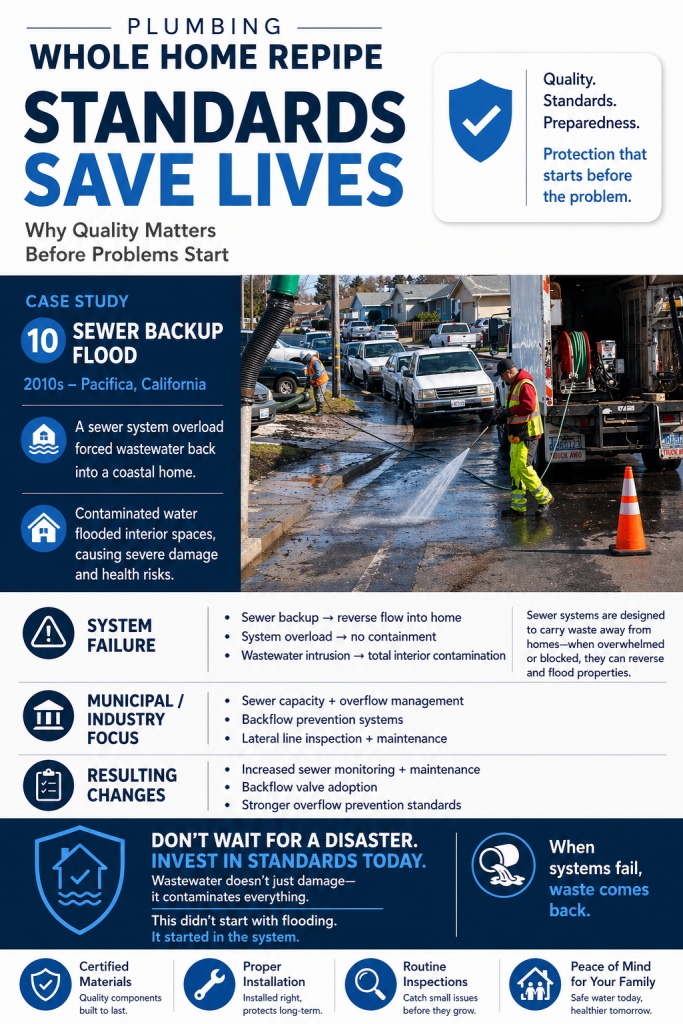
10. Sewer Backup Floods Coastal Home With Wastewater — Pacifica, California (2010s)
Storm overload forced sewage back through residential drains, contaminating the home from the inside out.
11. Attic Pipe Burst Sends Water Through Ceilings — Sacramento, California (Cold Snap Event)
A frozen pipe burst above the ceiling, sending water cascading down and destroying multiple rooms below.
🌧️ Weather + Environmental Conditions
This was a weather-driven system overload failure.
- Period of heavy rainfall
- Stormwater inflow increased dramatically
- The sewer system approached and exceeded capacity
👉 Key dynamic:
External water volume overloads the internal waste system
⚙️ Failure Mechanics (What Actually Broke)
Step-by-Step Breakdown
- System Surcharge (Load Condition)
- Sewer mains are filled beyond normal operating levels
- Water + waste volume exceeded pipe capacity
- Pressure Reversal in Sewer Line
- Instead of flowing away from homes, the system became pressurized
- Flow direction destabilized
- Absence of Backflow Protection
- No check valve or backwater valve to:
- Block reverse flow
- The house remained directly exposed to the main line conditions
- Reverse Flow Initiation
- Wastewater forced backward through:
- Sewer lateral
- Into the home plumbing system
- Entry Through Lowest Fixtures
- Wastewater entered through:
- Toilets
- Showers
- Floor drains
- Rapid Interior Contamination Spread
- Raw sewage spread across:
- Bathrooms
- Lower-level floors
- Continued inflow expanded the contamination zone

💥 The Event (Storm-Driven Backflow Incident)
- Timeline: Rapid onset during peak storm conditions
- Initial warning signs:
- Gurgling drains
- Slow drainage
- Unusual odors
Collapse Dynamics
- The system crossed the capacity threshold
- Pressure reversed → home became the discharge point
🏚️ Immediate Damage Profile
- Raw sewage-filled bathrooms and lower floors
- Complete contamination of affected areas
Damage characteristics:
- Biological contamination (Category 3 water)
- Saturation of:
- Flooring
- Drywall
- Insulation
Outcome:
- Full remediation required:
- Removal of contaminated materials
- Professional sanitation
🧠 System-Level Failure Analysis
1. System Overload Failure
- Sewer system designed for:
- Normal flow conditions
Exceeded by:
- Combined stormwater + wastewater volume
2. Flow Direction Dependency
- Plumbing systems rely on:
- One-way flow assumption
When reversed:
- The entire system becomes vulnerable
3. Missing Protection Layer
- Backflow prevention is:
- A critical barrier
Without it:
- Home is directly connected to system failure
🔁 Direct Aftermath (Short-Term)
- Immediate cessation of water use
- Emergency cleanup initiated
- Hazard containment required
- Remediation steps:
- Extraction of contaminated water
- Removal of porous materials
- Disinfection of all affected surfaces
🧱 Indirect Effects (Long-Term Changes)
🏗️ 1. Backflow Prevention Adoption
- Increased installation of:
- Backwater valves
- Check valves on sewer laterals
🌧️ 2. Stormwater Infrastructure Awareness
- Recognition of:
- Limits of municipal sewer systems during storms
📡 3. Early Warning Recognition
- Homeowners are more aware of:
- Drain behavior changes as early indicators
🏘️ 4. Coastal Risk Consideration
- Greater scrutiny of:
- Low-elevation properties tied to overloaded systems
🧩 Hidden Insights (What Most People Miss)
⚠️ 1. “Your Plumbing Is Not Isolated”
Homes are directly connected to:
- Municipal sewer systems
When they fail:
- Your house becomes part of the system
⚠️ 2. The Lowest Point Loses
Water (and waste) seeks:
- The lowest available exit
In homes:
- That’s often bathrooms or floor drains
⚠️ 3. This Is a Pressure Event, Not Just an Overflow
This isn’t slow seepage.
- It’s forced reverse flow under pressure
🧠 Contractor / System Thinking Translation
This event maps directly to residential risk patterns:
Sewer System | Residential Equivalent |
Main line surcharge | Overloaded drain system |
Reverse pressure | Backflow into the home |
No backflow valve | No system protection |
Fixture overflow | Interior contamination |
👉 Same equation:
System overload + no barrier + low elevation = interior failure
🎯 Final Takeaways (Mechanical Framing)
- Root Cause: Sewer system overload during heavy rainfall
- Trigger: Pressure reversal in the municipal line
- Failure Type: Backflow → interior contamination
- Impact Multiplier: Absence of backflow prevention + low elevation
- Lesson:
When the system overloads, your house becomes the exit point