



San Jose Slab Leak Flood Event — Full Breakdown Report
📍 Geographic + Structural Context (Pre-Event Environment)
The failure occurred in a residential property in San Jose, a region dominated by slab-on-grade construction, especially in post-1960s suburban developments.
Critical preconditions:
- Foundation type: Concrete slab-on-grade with plumbing lines embedded beneath
- Plumbing material: Copper supply lines routed under the slab
- Soil conditions: Expansive clay soils are common in parts of the region, capable of retaining moisture
- System layout: No crawlspace or basement → no visual access to plumbing lines
- Water pressure: Municipal supply delivering consistent pressurized flow into the home
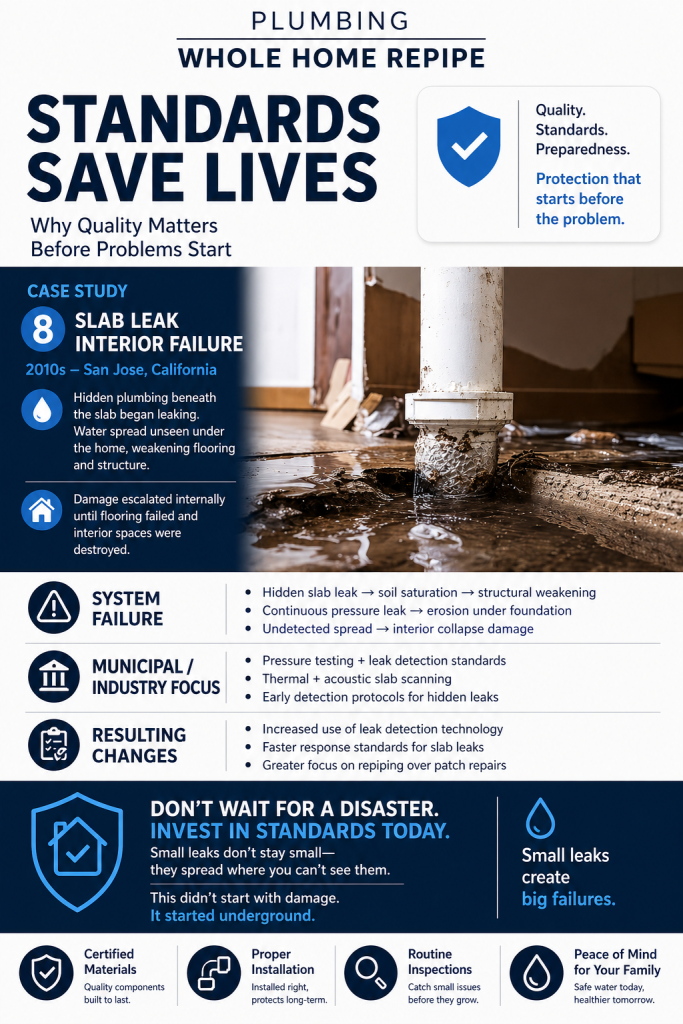
11 Plumbing/Pipe/Dam Disasters in California
1. Baldwin Hills Dam Collapse — Los Angeles, California (1963)
A hillside dam failed without warning, sending millions of gallons into a residential neighborhood in minutes.
2. San Francisco Sinkhole That Swallowed a Mansion — San Francisco, California (1995)
An aging sewer line collapsed underground, causing the street and an entire mansion to disappear into a 40-foot sinkhole.
3. Fresno Toxic Water Crisis From Corroded Pipes — Fresno, California (2016)
Internal pipe corrosion contaminated residential water supplies, exposing thousands of homes to unsafe drinking conditions.
4. Oroville Dam Spillway Failure Threatens Homes — Oroville, California (2017)
Structural failure at a major dam triggered mass evacuations as downstream residential areas faced catastrophic flood risk.
5. Yuba County High-Pressure Pipe Rupture Floods Area — Yuba County, California (2026)
A massive pressurized pipe burst released uncontrolled water, causing rapid flooding and structural damage.
6. Yuba–Sutter Levee Break Flood Disaster — Yuba City, California (1955)
A levee failure redirected floodwaters into residential zones, destroying homes and overwhelming entire communities.
7. Hillside Home Collapse From Hidden Water Line Leak — Studio City, Los Angeles (2000s)
A slow underground leak saturated the soil beneath a home, eventually causing the foundation to shift and collapse.
8. Slab Leak Erupts Beneath Home and Destroys Interior — San Jose, California (2010s)
A ruptured pipe under the slab forced water upward, buckling floors and flooding the entire interior.
9. Toilet Supply Line Burst Floods Entire Home During Vacation — Anaheim, California (2010s)
A small supply line failure ran unchecked for days, filling the home with water and causing total interior loss.
10. Sewer Backup Floods Coastal Home With Wastewater — Pacifica, California (2010s)
Storm overload forced sewage back through residential drains, contaminating the home from the inside out.
11. Attic Pipe Burst Sends Water Through Ceilings — Sacramento, California (Cold Snap Event)
A frozen pipe burst above the ceiling, sending water cascading down and destroying multiple rooms below.
🌡️ Weather + Environmental Conditions
This was a closed-system failure, independent of weather.
- No rainfall or external flooding
- The internal plumbing system created its own pressurized water environment beneath the slab
👉 Key dynamic:
The house became the container for its own flood—from below
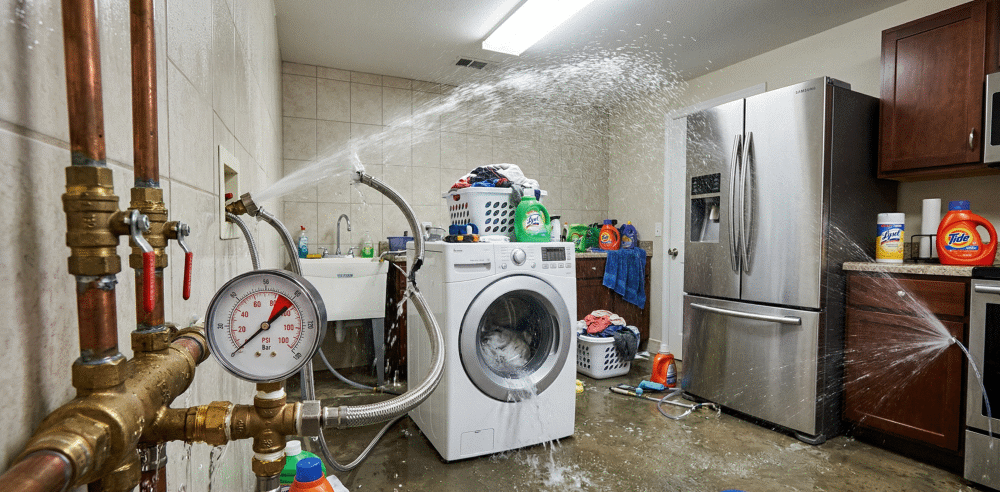
⚙️ Failure Mechanics (What Actually Broke)
Step-by-Step Breakdown
- Copper Pipe Degradation (Long-Term Setup)
- Copper lines under the slab experienced:
- Corrosion from soil chemistry
- Abrasion from minor ground movement
- Over time, the pipe wall thinned
- Pipe Rupture (Failure Initiation)
- A weak section of the hot water line failed under pressure
- The continuous leak began immediately
- Pressurized Water Release Beneath Slab
- Water is discharged into the confined soil space
- No drainage pathway → accumulation began
- Soil Saturation + Pressure Build-Up
- The surrounding soil became fully saturated
- Hydrostatic pressure developed beneath the slab
- Upward Water Migration
- Water sought the path of least resistance
- Forced upward through:
- Expansion joints
- Cracks
- Flooring seams
- Thermal + Moisture Expansion Effects
- Hot water accelerated:
- Material expansion
- Adhesive breakdown
- Flooring systems weakened rapidly
💥 The Event (Progressive → Full Interior Impact)
- Timeline: Gradual escalation over hours to days
- Initial warning signs:
- Warm spots on the floor
- Unexplained moisture
- Spike in water bill
Collapse Dynamics
- Water pressure beneath the slab reached a critical level
- The entire floor system began to fail upward

🏚️ Immediate Damage Profile
- Floors buckled across the entire home
- Moisture spreads wall-to-wall beneath the flooring systems
- Water intrusion extended into:
- Baseboards
- Drywall
- Structural framing edges
Outcome:
- Full interior demolition required:
- Flooring removal
- Drywall cuts
- Moisture remediation
🧠 System-Level Failure Analysis
1. Hidden System Failure Zone
- Failure occurred in the least visible location possible:
- Beneath the slab
👉 Detection lag = maximum damage potential
2. Pressure Without Release Path
- Water had:
- Constant supply
- No escape route
👉 Pressure redirected upward into the home
3. Thermal Acceleration Factor
- Hot water increased:
- Expansion rates
- Material degradation speed
👉 Damage progressed faster than cold-water leaks
🔁 Direct Aftermath (Short-Term)
- Emergency water shutoff required
- Moisture mapping and damage assessment
- Industrial drying equipment deployed
- Immediate actions included:
- Flooring removal
- Access cuts into the slab (in some cases)
- Plumbing reroute or repair
🧱 Indirect Effects (Long-Term Changes)
🏗️ 1. Repipe Consideration
- Increased shift toward:
- Overhead reroutes (attic runs)
- PEX repiping systems
📡 2. Leak Detection Awareness
- Adoption of:
- Smart leak detection devices
- Pressure monitoring systems
🧪 3. Material Selection Evolution
- Reduced reliance on:
- Direct-buried copper under slabs
- Increased use of:
- Sleeving or alternative routing
🏘️ 4. Insurance + Risk Recognition
- Slab leaks are recognized as:
- High-cost, high-impact residential failures

🧩 Hidden Insights (What Most People Miss)
⚠️ 1. “The House Fills From Below”
Flooding doesn’t always come from above.
- This system forced water upward into the structure
⚠️ 2. Pressure Multiplies Damage
This wasn’t a passive leak.
- It was an active pressurized discharge
- Continuously feeding the problem
⚠️ 3. By the Time You See It, It’s Everywhere
Visible signs appear only after:
- Full subsurface saturation
- Pressure redistribution
👉 Damage is already system-wide
🧠 Contractor / System Thinking Translation
This event maps directly to residential failure patterns:
System Condition | Residential Equivalent |
Under-slab pipe rupture | Hidden supply line failure |
Soil saturation | Subfloor moisture spread |
Hydrostatic pressure | Upward water intrusion |
Floor buckling | Structural response to pressure |
👉 Same equation:
Hidden leak + pressure + confinement = full-system damage
🎯 Final Takeaways (Mechanical Framing)
- Root Cause: Copper pipe corrosion beneath the slab
- Trigger: Pressurized hot water line rupture
- Failure Type: Subsurface saturation → upward intrusion
- Impact Multiplier: Pressure + heat + confinement
- Lesson:
The leak wasn’t in the walls… it was under the house, pushing up