
Anaheim Toilet Supply Line Burst Flood — Full Breakdown Report
📍 Geographic + Structural Context (Pre-Event Environment)
The incident occurred in a residential property in Anaheim, typical of suburban Southern California homes with multi-bathroom layouts and a pressurized municipal water supply.
Critical preconditions:
- Fixture connection: Braided stainless-steel toilet supply line connecting shutoff valve to tank
- Component type: Low-cost, mass-produced flexible connector with crimped metal fittings
- Water pressure: Municipal supply typically ranges from 60 to 80 PSI
- Occupancy condition: Home left unattended for multiple days
- System dependency: Continuous pressurized water with no automatic shutoff system in place
11 Plumbing/Pipe/Dam Disasters in California
1. Baldwin Hills Dam Collapse — Los Angeles, California (1963)
A hillside dam failed without warning, sending millions of gallons into a residential neighborhood in minutes.
2. San Francisco Sinkhole That Swallowed a Mansion — San Francisco, California (1995)
An aging sewer line collapsed underground, causing the street and an entire mansion to disappear into a 40-foot sinkhole.
3. Fresno Toxic Water Crisis From Corroded Pipes — Fresno, California (2016)
Internal pipe corrosion contaminated residential water supplies, exposing thousands of homes to unsafe drinking conditions.
4. Oroville Dam Spillway Failure Threatens Homes — Oroville, California (2017)
Structural failure at a major dam triggered mass evacuations as downstream residential areas faced catastrophic flood risk.
5. Yuba County High-Pressure Pipe Rupture Floods Area — Yuba County, California (2026)
A massive pressurized pipe burst released uncontrolled water, causing rapid flooding and structural damage.
6. Yuba–Sutter Levee Break Flood Disaster — Yuba City, California (1955)
A levee failure redirected floodwaters into residential zones, destroying homes and overwhelming entire communities.
7. Hillside Home Collapse From Hidden Water Line Leak — Studio City, Los Angeles (2000s)
A slow underground leak saturated the soil beneath a home, eventually causing the foundation to shift and collapse.
8. Slab Leak Erupts Beneath Home and Destroys Interior — San Jose, California (2010s)
A ruptured pipe under the slab forced water upward, buckling floors and flooding the entire interior.
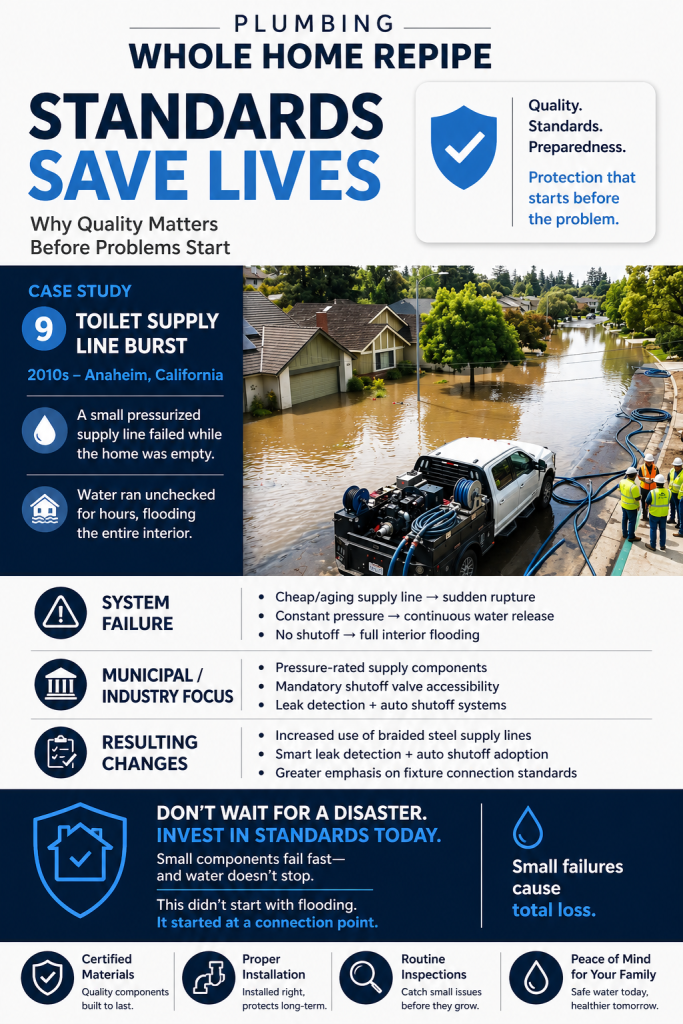
9. Toilet Supply Line Burst Floods Entire Home During Vacation — Anaheim, California (2010s)
A small supply line failure ran unchecked for days, filling the home with water and causing total interior loss.
10. Sewer Backup Floods Coastal Home With Wastewater — Pacifica, California (2010s)
Storm overload forced sewage back through residential drains, contaminating the home from the inside out.
11. Attic Pipe Burst Sends Water Through Ceilings — Sacramento, California (Cold Snap Event)
A frozen pipe burst above the ceiling, sending water cascading down and destroying multiple rooms below.
🌡️ Weather + Environmental Conditions
This was a closed-system internal failure, unaffected by weather.
- No rain, flooding, or environmental trigger
- The entire event is driven by pressurized plumbing inside the home
👉 Key dynamic:
The house flooded itself without any external event
⚙️ Failure Mechanics (What Actually Broke)
Step-by-Step Breakdown
- Component Degradation (Long-Term Setup)
- Braided line experienced:
- Internal rubber hose fatigue
- Corrosion or weakening at the crimped metal fitting
- Over time, the integrity of the connection degraded
- Crimp Fitting Failure (Initiation Point)
- The metal crimp securing the hose to the fitting failed suddenly
- Hose separated or ruptured at the weakest point
- Full-Pressure Water Discharge
- Municipal supply continued delivering 60–80 PSI water nonstop
- No restriction or shutoff triggered
- Continuous Unchecked Flow
- Water discharged at full volume:
- Into bathroom
- Onto flooring
- Spread rapidly to adjacent rooms
- Vertical Water Migration
- Water penetrated:
- Subfloor
- Floor cavities
- Began moving downward through the ceilings below
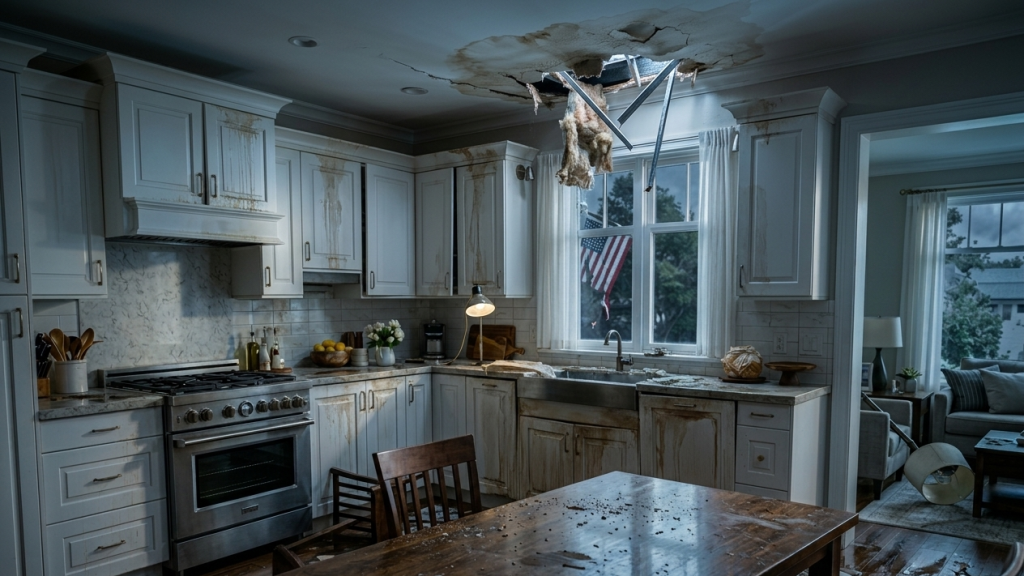
- Structural Saturation + Material Failure
- Drywall absorbed water → lost integrity
- Ceiling assemblies weakened → eventual collapse
- Wood framing and cabinetry absorbed moisture
💥 The Event (Unattended Flood Over Time)
- Timeline: Continuous discharge over multiple days (~72 hours)
- Initial warning signs: None observed due to absence of occupants
Collapse Dynamics
- First phase: Localized flooding (bathroom)
- Second phase: Whole-home spread
- Final phase: Structural materials failing under saturation
🏚️ Immediate Damage Profile
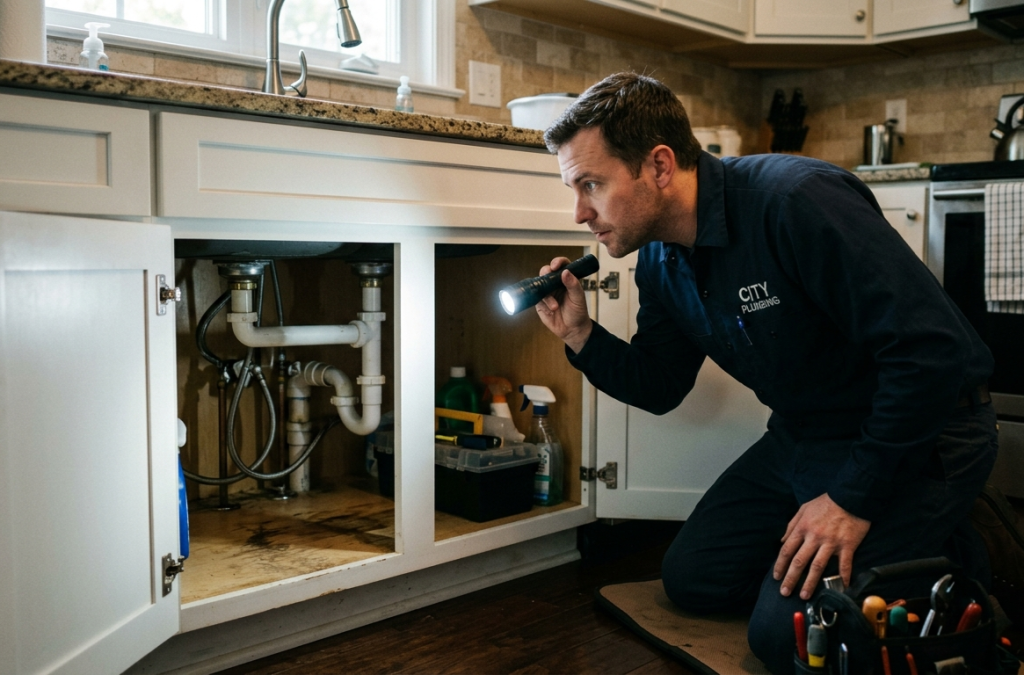
- Water flowed continuously for days
- Ceilings collapsed in the affected lower areas
- Moisture spread throughout the entire structure
Outcome:
- Full interior gut required:
- Flooring removal
- Drywall demolition
- Cabinet replacement
🧠 System-Level Failure Analysis
1. Small Component, Full-System Exposure
- Failure originated in a single low-cost part
- System response:
- Full pressure
- Unlimited water supply
👉 No scaling of risk to component size
2. Unattended Condition Multiplier
- No occupant = no intervention
- Leak duration extended from:
- Minutes → days
👉 Time became the primary damage amplifier
3. Continuous Pressure System
- Unlike a tank:
- The system never runs out
- The water supply is effectively infinite until manually stopped
🔁 Direct Aftermath (Short-Term)
- Emergency water shutoff upon discovery
- Immediate mitigation:
- Water extraction
- Drying equipment deployment
- Damage assessment revealed:
- Widespread saturation
- Structural compromise
🧱 Indirect Effects (Long-Term Changes)
🏗️ 1. Supply Line Awareness Increase
- Greater emphasis on:
- Replacing low-quality braided lines
- Using higher-grade or reinforced connectors
📡 2. Smart Leak Detection Adoption
- Increased use of:
- Automatic shutoff valves
- Water sensors near fixtures
🧪 3. Pressure Regulation Focus
- Installation of:
- Pressure-reducing valves (PRVs)
- To limit stress on components
🏘️ 4. Vacation Protocol Changes
- Homeowners are more likely to:
- Shut off the main water supply when away
- Install monitoring systems

🧩 Hidden Insights (What Most People Miss)
⚠️ 1. “Failure Scale ≠ Component Size”
A $10 part controlled:
- Entire home water exposure
👉 Small failure point, massive consequence
⚠️ 2. Time Is the Real Multiplier
If discovered early:
- Minor cleanup
Left for days:
- Full structural damage
⚠️ 3. Water Moves Faster Than You Think
Initial assumption:
- “It’s just one room”
Reality:
- Water spreads:
- Horizontally
- Vertically
- Into every material
🧠 Contractor / System Thinking Translation
This event maps directly to residential risk patterns:
System Component | Residential Equivalent |
Braided supply line | Weak connection point |
Crimp failure | Sudden rupture |
Continuous pressure | Unlimited water supply |
Unattended leak | Maximum damage scenario |
👉 Same equation:
Small failure + pressure + time = total loss
🎯 Final Takeaways (Mechanical Framing)
- Root Cause: Failure of the braided toilet supply line at the crimp fitting
- Trigger: Continuous municipal pressure with no shutoff
- Failure Type: Instant rupture → prolonged uncontrolled discharge
- Impact Multiplier: Time (unattended) + pressure + interior confinement
- Lesson:
One $10 part destroyed an entire house in 72 hours