
Yuba–Sutter Flood — Full Breakdown Report
📍 Geographic + Structural Context (Pre-Event Environment)
The disaster unfolded across the low-lying agricultural and residential regions of Yuba and Sutter Counties, particularly near communities such as Yuba City and Marysville.
Critical preconditions:
- Topography: Flat floodplain sitting at or below river level in some areas
- Water system: Reliant on levees along the Feather and Yuba Rivers to hold back elevated water levels
- Soil composition: Soft alluvial soils prone to seepage and erosion under pressure
- Levee design: Earthen levees, many built or expanded incrementally over time
- Population exposure: Residential neighborhoods directly behind levee systems with minimal elevation buffer
11 Plumbing/Pipe/Dam Disasters in California
1. Baldwin Hills Dam Collapse — Los Angeles, California (1963)
A hillside dam failed without warning, sending millions of gallons into a residential neighborhood in minutes.
2. San Francisco Sinkhole That Swallowed a Mansion — San Francisco, California (1995)
An aging sewer line collapsed underground, causing the street and an entire mansion to disappear into a 40-foot sinkhole.
3. Fresno Toxic Water Crisis From Corroded Pipes — Fresno, California (2016)
Internal pipe corrosion contaminated residential water supplies, exposing thousands of homes to unsafe drinking conditions.
4. Oroville Dam Spillway Failure Threatens Homes — Oroville, California (2017)
Structural failure at a major dam triggered mass evacuations as downstream residential areas faced catastrophic flood risk.
5. Yuba County High-Pressure Pipe Rupture Floods Area — Yuba County, California (2026)
A massive pressurized pipe burst released uncontrolled water, causing rapid flooding and structural damage.
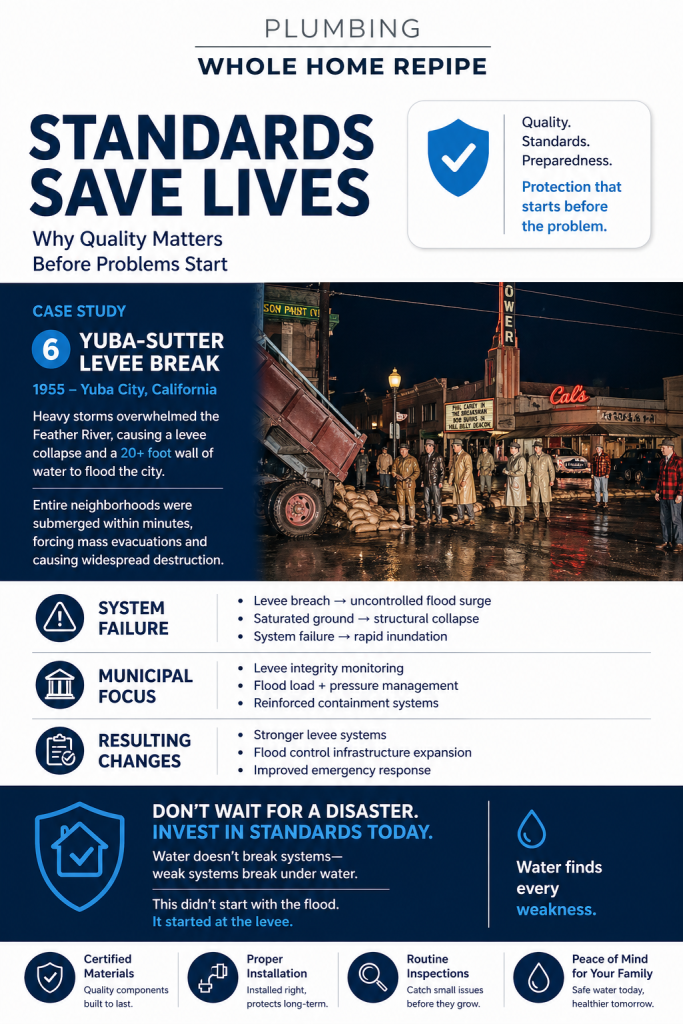
6. Yuba–Sutter Levee Break Flood Disaster — Yuba City, California (1955)
A levee failure redirected floodwaters into residential zones, destroying homes and overwhelming entire communities.
7. Hillside Home Collapse From Hidden Water Line Leak — Studio City, Los Angeles (2000s)
A slow underground leak saturated the soil beneath a home, eventually causing the foundation to shift and collapse.
8. Slab Leak Erupts Beneath Home and Destroys Interior — San Jose, California (2010s)
A ruptured pipe under the slab forced water upward, buckling floors and flooding the entire interior.
9. Toilet Supply Line Burst Floods Entire Home During Vacation — Anaheim, California (2010s)
A small supply line failure ran unchecked for days, filling the home with water and causing total interior loss.
10. Sewer Backup Floods Coastal Home With Wastewater — Pacifica, California (2010s)
Storm overload forced sewage back through residential drains, contaminating the home from the inside out.
11. Attic Pipe Burst Sends Water Through Ceilings — Sacramento, California (Cold Snap Event)
A frozen pipe burst above the ceiling, sending water cascading down and destroying multiple rooms below.
🌧️ Weather + Environmental Conditions
This was a classic weather-driven hydraulic overload event.
- Prolonged heavy rainfall across Northern California
- Significant snowmelt from the Sierra Nevada feeds the river systems
- Rivers swelled beyond normal capacity
👉 Key dynamic:
Sustained inflow exceeded what the levee system could safely contain

⚙️ Failure Mechanics (What Actually Broke)
Step-by-Step Breakdown
- System Overload (Hydraulic Pressure Build-Up)
- Rivers rose rapidly due to the combined rain + snowmelt
- Water levels pressed continuously against levee walls
- Seepage Through Levee Structure
- Water began to percolate through the earthen levees
- Internal saturation weakened structural integrity
- Erosion Within the Levee (Piping Begins)
- Moving water carried soil particles away internally
- Small channels formed → weakening the levee core
- Breach Formation
- A weak section of the levee failed under pressure
- The initial break allowed high-volume water to escape
- Rapid Breach Expansion
- Escaping water widened the gap quickly
- Flow increased exponentially as resistance dropped
- Floodwater Redirection Into Residential Areas
- Once containment failed, water followed natural low points
- Residential zones became the path of least resistance
💥 The Event (December 1955)
- Timeline: Rapid escalation during peak storm conditions
- Initial warning signs:
- Rising river levels
- Reports of seepage and levee stress
Collapse Dynamics
- The levee breach triggered an uncontrolled flood release
- Water surged into populated areas with little time to react
Flood Behavior
- Broad, fast-moving inundation
- Depth and spread increased quickly across flat terrain
🏚️ Immediate Damage Profile
- 74 fatalities
- Thousands of homes destroyed
- Entire neighborhoods submerged
Impact characteristics:
- Widespread structural loss
- Agricultural devastation
- Infrastructure damage (roads, utilities, access routes)
🧠 System-Level Failure Analysis
1. Containment System Failure
- Levees function as barriers
- Once breached → system shifts from controlled to uncontrolled instantly
2. Saturation + Pressure Combination
- Soil strength depends on:
- Dry density
- When saturated:
- Strength drops dramatically
👉 Water didn’t just push—it weakened the structure from within
3. Failure Propagation
- Small breach →
- Increased flow →
- Rapid enlargement
👉 This is a self-amplifying failure loop
🔁 Direct Aftermath (Short-Term)
- Emergency evacuations and rescues
- Large-scale displacement of residents
- Deployment of state and federal disaster response
- Immediate efforts included:
- Temporary levee repairs
- Water diversion attempts
🧱 Indirect Effects (Long-Term Changes)
🏗️ 1. Levee System Upgrades
- Reinforcement and redesign of levees across California
- Increased height, width, and structural integrity standards
📡 2. Flood Control Infrastructure Expansion
- Development of:
- Dams
- Bypass channels
- Controlled flood basins
🧪 3. Hydrologic Modeling Improvements
- Better forecasting of:
- River flow
- Flood risk zones
🏘️ 4. Floodplain Management
- Increased awareness of:
- Building in flood-prone areas
- Zoning and insurance systems evolved
🧩 Hidden Insights (What Most People Miss)
⚠️ 1. “Levees Don’t Stop Water—They Delay It”
They create:
- Temporary control
But once they fail:
- Water returns with greater force and volume
⚠️ 2. Water Exploits Weakness, Not Strength
Failure didn’t occur in the strongest section.
- It occurred at the weakest point under pressure
⚠️ 3. Flat Terrain Increases Damage Spread
In hilly areas:
- Water channels
In flat areas:
- Water spreads wide and deep
🧠 Contractor / System Thinking Translation
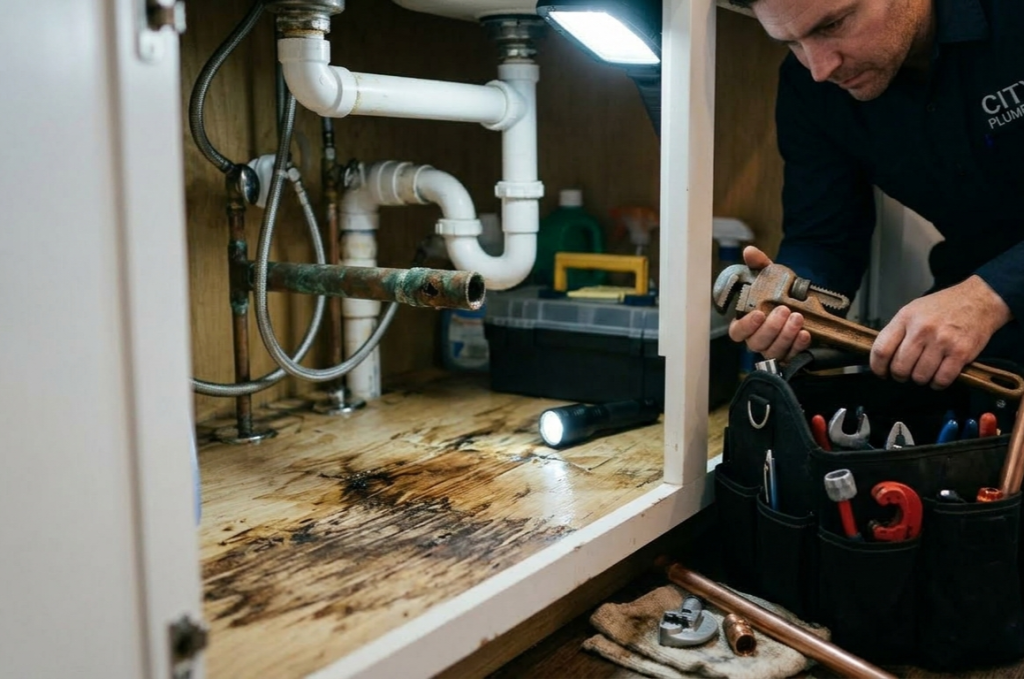
This event maps directly to residential system failures:
Flood System | Residential Equivalent |
Levee wall | Pipe wall/foundation barrier |
Seepage | Hidden leak inside the wall/slab |
Breach | Pipe burst/foundation crack |
Floodplain | Lowest point in the home (basement, slab low spot) |
👉 Same equation:
Containment failure + pressure + low elevation = total exposure
🎯 Final Takeaways (Mechanical Framing)
- Root Cause: Levee saturation and internal erosion
- Trigger: Extreme rainfall + snowmelt increasing hydraulic pressure
- Failure Type: Breach → rapid flood propagation
- Impact Multiplier: Flat terrain + dense residential exposure
Lesson:
Water always finds the lowest point — usually your house