



Yuba County Pipe Rupture & Flooding — Full Breakdown Report
📍 Geographic + Structural Context (Pre-Event Environment)
The rupture occurred in Yuba County, within a region tied to hydroelectric infrastructure and mountainous water conveyance systems that feed downstream communities.
Critical preconditions:
- Infrastructure type: High-pressure penstock system (large-diameter pipe transporting water downhill for energy generation)
- Elevation factor: Water stored and transported from higher elevations → significant gravitational pressure buildup
- Material stress: Steel pipeline subjected to constant internal pressure cycles over time
- Terrain: Steep slopes and mixed soil conditions are vulnerable to rapid erosion when exposed to high-flow discharge
- System role: Critical link between water storage and power generation facilities + downstream distribution
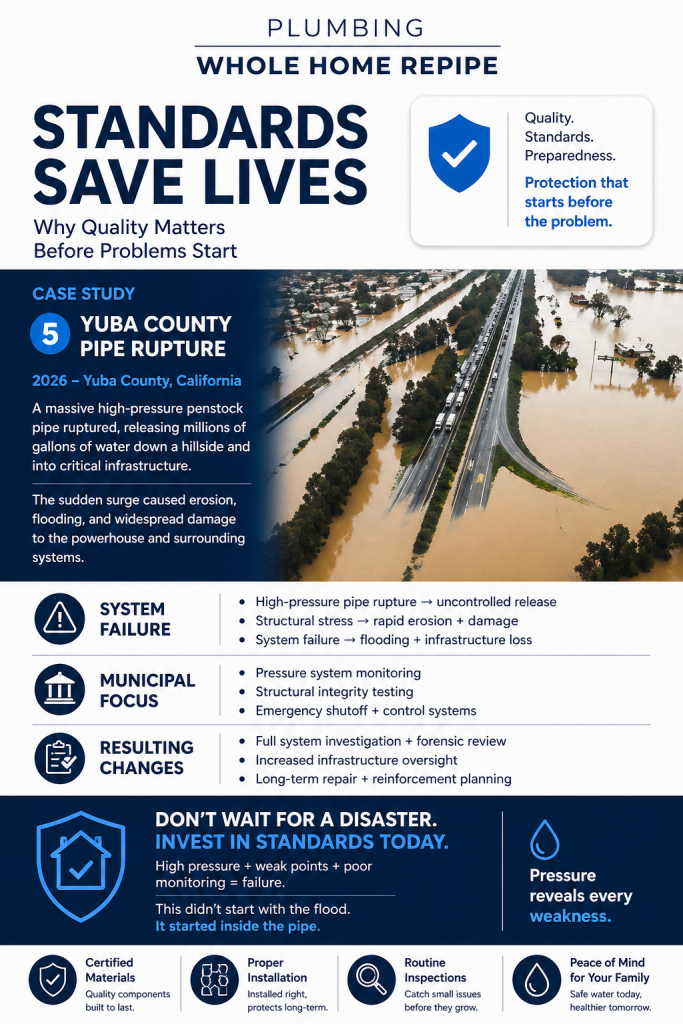
11 Plumbing/Pipe/Dam Disasters in California
1. Baldwin Hills Dam Collapse — Los Angeles, California (1963)
A hillside dam failed without warning, sending millions of gallons into a residential neighborhood in minutes.
2. San Francisco Sinkhole That Swallowed a Mansion — San Francisco, California (1995)
An aging sewer line collapsed underground, causing the street and an entire mansion to disappear into a 40-foot sinkhole.
3. Fresno Toxic Water Crisis From Corroded Pipes — Fresno, California (2016)
Internal pipe corrosion contaminated residential water supplies, exposing thousands of homes to unsafe drinking conditions.
4. Oroville Dam Spillway Failure Threatens Homes — Oroville, California (2017)
Structural failure at a major dam triggered mass evacuations as downstream residential areas faced catastrophic flood risk.
5. Yuba County High-Pressure Pipe Rupture Floods Area — Yuba County, California (2026)
A massive pressurized pipe burst released uncontrolled water, causing rapid flooding and structural damage.
6. Yuba–Sutter Levee Break Flood Disaster — Yuba City, California (1955)
A levee failure redirected floodwaters into residential zones, destroying homes and overwhelming entire communities.
7. Hillside Home Collapse From Hidden Water Line Leak — Studio City, Los Angeles (2000s)
A slow underground leak saturated the soil beneath a home, eventually causing the foundation to shift and collapse.
8. Slab Leak Erupts Beneath Home and Destroys Interior — San Jose, California (2010s)
A ruptured pipe under the slab forced water upward, buckling floors and flooding the entire interior.
9. Toilet Supply Line Burst Floods Entire Home During Vacation — Anaheim, California (2010s)
A small supply line failure ran unchecked for days, filling the home with water and causing total interior loss.
10. Sewer Backup Floods Coastal Home With Wastewater — Pacifica, California (2010s)
Storm overload forced sewage back through residential drains, contaminating the home from the inside out.
11. Attic Pipe Burst Sends Water Through Ceilings — Sacramento, California (Cold Snap Event)
A frozen pipe burst above the ceiling, sending water cascading down and destroying multiple rooms below.
🌧️ Weather + Environmental Conditions
The weather was a secondary amplifier, not necessarily the root cause.
- Possible elevated water levels from seasonal runoff or reservoir management
- Increased system demand → higher sustained pressure within the pipeline
👉 Key dynamic:
The system was already under high pressure—environment may have pushed it closer to the threshold

⚙️ Failure Mechanics (What Actually Broke)
Step-by-Step Breakdown
- High-Pressure Load Condition (Baseline)
- Penstock operated under extreme internal pressure due to the elevation drop
- Continuous stress on pipe walls and joints
- Structural Weak Point Development
- Over time, factors such as:
- Material fatigue
- Corrosion
- Weld or joint degradation
Created a localized failure point
- Sudden Rupture Event
- Pipe wall or joint failed catastrophically
- Instant loss of containment
- Uncontrolled High-Velocity Discharge
- Water is released at extreme force
- Energy equivalent to a horizontal flood wave under pressure
- Ground Scouring + Erosion Cascade
- High-speed water flow stripped the soil immediately
- Rapid channel formation → widening destruction zone
- Secondary Infrastructure Impact
- Roads undermined
- Utility lines exposed or severed
- Additional localized failures triggered
💥 The Event (2026)
- Timeline: Immediate, high-impact event
- No gradual warning for surrounding residents
Collapse Dynamics
- Instant rupture → massive water release within seconds
- Flow behaved more like a blast of water under pressure than a typical flood
Event Characteristics
- Extremely high velocity
- Focused directional force
- Rapid expansion as the terrain eroded
🏚️ Immediate Damage Profile
- Flooding across affected zones
- Severe soil erosion and land destabilization
- Infrastructure damage, including:
- Roads
- Utility corridors
- Power outages due to system disruption
- Emergency response required:
- Rescues and evacuations in affected areas
🧠 System-Level Failure Analysis
1. Pressure System Failure
- Unlike gravity-only systems, penstocks operate under:
- Stored energy (pressure)
- When containment fails → energy releases instantly
2. Instantaneous vs Progressive Failure
- No slow leak phase
- No visible warning
👉 Failure mode: Immediate catastrophic release
3. Energy Conversion Event
- Stored hydraulic energy converted into:
- Kinetic force
- Destructive flow
👉 System effectively becomes a weaponized water discharge
🔁 Direct Aftermath (Short-Term)
- Emergency response deployment:
- Search and rescue
- Area stabilization
- Shutdown of connected systems:
- Hydroelectric operations impacted
- Damage assessment:
- Structural
- Environmental
🧱 Indirect Effects (Long-Term Changes)
🏗️ 1. Infrastructure Reinforcement
- Increased focus on:
- Penstock integrity monitoring
- Reinforcement or replacement of aging pipelines
📡 2. Monitoring + Pressure Control
- Implementation or upgrade of:
- Pressure sensors
- Real-time stress monitoring
🧪 3. Risk Modeling for High-Pressure Systems
- Enhanced modeling for:
- Failure scenarios
- Downstream impact zones
🏘️ 4. Zoning + Risk Awareness
- Greater awareness of:
- Risks tied to proximity to high-pressure water infrastructure
🧩 Hidden Insights (What Most People Miss)
⚠️ 1. “Pressure Stores Energy Invisibly”
The danger isn’t visible.
- Water looks stable inside a pipe
- But under pressure, it holds massive stored energy
⚠️ 2. Failure Is Instant, Not Gradual
Unlike corrosion leaks:
- No warning drip
- No slow escalation
👉 It goes from intact → catastrophic in seconds
⚠️ 3. Directional Force Multiplies Damage
This wasn’t a uniform flood.
- Initial discharge was focused and directional
- Caused deeper, more aggressive localized destruction
🧠 Contractor / System Thinking Translation
This event maps directly to residential and mechanical system risks:
Infrastructure System | Residential Equivalent |
High-pressure penstock | Main water supply line |
Sudden rupture | Pipe burst behind the wall/slab |
High-velocity discharge | Pressure blowout flooding |
Erosion + undermining | Foundation washout from leaks |
👉 Same equation:
Pressure + containment failure = instant damage
🎯 Final Takeaways (Mechanical Framing)
- Root Cause: Structural failure under sustained high pressure
- Trigger: Weak point breach in the pressurized system
- Failure Type: Instantaneous rupture → high-energy discharge
- Impact Multiplier: Pressure + volume + terrain
- Lesson:
Pressure + volume = instant catastrophe