
Northeast Fresno Toxic Water Crisis — Full Breakdown Report
📍 Geographic + Structural Context (Pre-Event Environment)
The issue emerged across residential neighborhoods in northeast Fresno, an area with large-scale suburban development built across multiple decades.
Critical preconditions:
- Housing stock mix: A combination of mid-century homes and newer developments tied into older distribution systems
- Plumbing materials: Widespread use of galvanized steel piping in older homes
- Water supply: Municipal system sourcing groundwater with variable mineral content
- System layering: City mains feeding into aging private plumbing systems inside homes
- Invisible risk: Internal pipe conditions are largely unmonitored by homeowners
11 Plumbing/Pipe/Dam Disasters in California
1. Baldwin Hills Dam Collapse — Los Angeles, California (1963)
A hillside dam failed without warning, sending millions of gallons into a residential neighborhood in minutes.
2. San Francisco Sinkhole That Swallowed a Mansion — San Francisco, California (1995)
An aging sewer line collapsed underground, causing the street and an entire mansion to disappear into a 40-foot sinkhole.
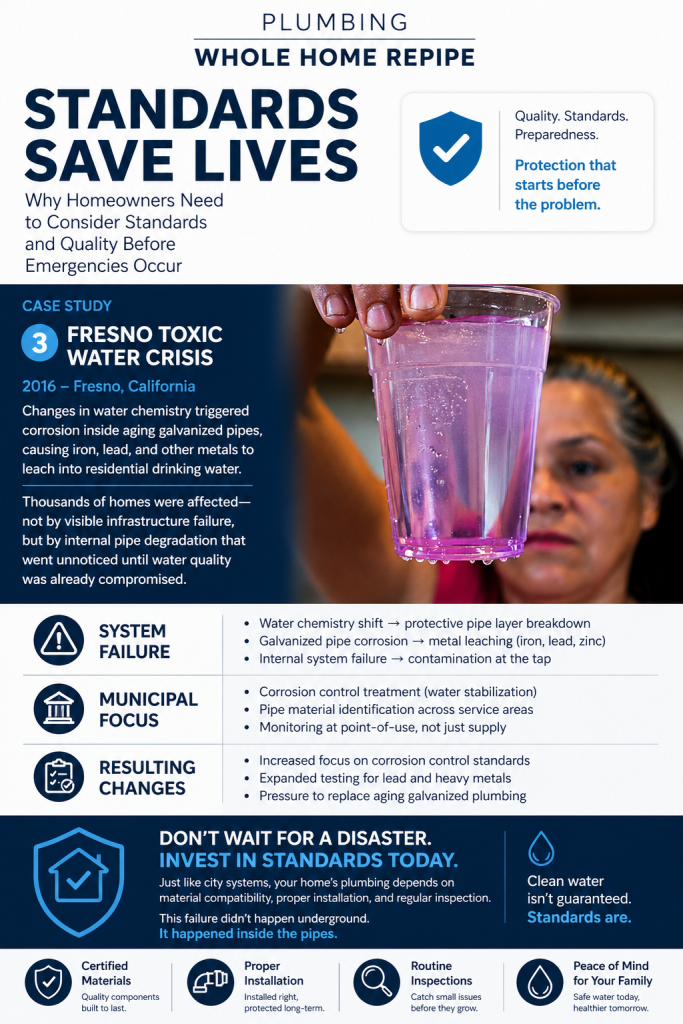
3. Fresno Toxic Water Crisis From Corroded Pipes — Fresno, California (2016)
Internal pipe corrosion contaminated residential water supplies, exposing thousands of homes to unsafe drinking conditions.
4. Oroville Dam Spillway Failure Threatens Homes — Oroville, California (2017)
Structural failure at a major dam triggered mass evacuations as downstream residential areas faced catastrophic flood risk.
5. Yuba County High-Pressure Pipe Rupture Floods Area — Yuba County, California (2026)
A massive pressurized pipe burst released uncontrolled water, causing rapid flooding and structural damage.
6. Yuba–Sutter Levee Break Flood Disaster — Yuba City, California (1955)
A levee failure redirected floodwaters into residential zones, destroying homes and overwhelming entire communities.
7. Hillside Home Collapse From Hidden Water Line Leak — Studio City, Los Angeles (2000s)
A slow underground leak saturated the soil beneath a home, eventually causing the foundation to shift and collapse.
8. Slab Leak Erupts Beneath Home and Destroys Interior — San Jose, California (2010s)
A ruptured pipe under the slab forced water upward, buckling floors and flooding the entire interior.
9. Toilet Supply Line Burst Floods Entire Home During Vacation — Anaheim, California (2010s)
A small supply line failure ran unchecked for days, filling the home with water and causing total interior loss.
10. Sewer Backup Floods Coastal Home With Wastewater — Pacifica, California (2010s)
Storm overload forced sewage back through residential drains, contaminating the home from the inside out.
11. Attic Pipe Burst Sends Water Through Ceilings — Sacramento, California (Cold Snap Event)
A frozen pipe burst above the ceiling, sending water cascading down and destroying multiple rooms below.
🌡️ Weather + Environmental Conditions
Unlike flood or pressure-driven failures, this was a chemical/environmental interaction failure.
- No extreme weather trigger
- No visible physical stress (no bursts, no leaks initially)
- Stable external conditions
👉 Key dynamic:
Water chemistry—not weather—drove the failure

⚙️ Failure Mechanics (What Actually Broke)
Step-by-Step Breakdown
- Long-Term Pipe Aging (Baseline Condition)
- Galvanized pipes developed internal corrosion over the decades
- Mineral scale formed inside pipes, creating a temporary protective barrier
- Water Chemistry Shift (Trigger Condition)
- Changes in municipal water composition (pH, mineral balance, disinfectants)
- The protective scale inside pipes became destabilized or dissolved
- Exposure of Raw Metal Surfaces
- Once the scale broke down, bare metal was exposed
- Accelerated corrosion began internally
- Metal Leaching into Water Supply
- Corroding pipes released:
- Lead (from legacy materials or fittings)
- Iron and other metals
- Contaminants entered household drinking water directly
- System-Wide Residential Impact
- The issue replicated across thousands of homes with similar plumbing
- No single failure point → distributed system failure
💥 The Event (2016)
- Timeline: Gradual escalation throughout the year
- Initial warning signs:
- Discolored water (brown/orange tint)
- Metallic taste
- Resident health concerns
Escalation Pattern
- Complaints increased rapidly as awareness spread
- Testing revealed elevated lead levels in multiple homes
- Problem expanded from isolated cases → regional concern
🏚️ Immediate Damage Profile
- 1,500+ resident complaints filed
- Tens of thousands of homes potentially affected
- Confirmed lead contamination in multiple properties
Non-structural but high-risk damage:
- Drinking water contamination
- Long-term exposure risks
- Loss of trust in the municipal water supply
🧠 System-Level Failure Analysis
1. Inside-the-Home Failure Zone
- The problem originated within private plumbing systems, not just city infrastructure
- Municipal supply was the trigger, but home systems were the failure point
2. Chemical Instability Over Physical Failure
- No pipe bursts
- No visible leaks
- Failure occurred through chemical interaction and corrosion
3. Legacy Material Risk
- Galvanized pipes acted as:
- Storage for contaminants
- Active corrosion sites once destabilized
👉 This is a time-delayed material failure
🔁 Direct Aftermath (Short-Term)
- Surge in water testing across affected neighborhoods
- Public health concern escalated
- Distribution of:
- Bottled water
- Filtration guidance
- Municipal response included:
- System flushing
- Water treatment adjustments
🧱 Indirect Effects (Long-Term Changes)
🏗️ 1. Accelerated Repipe Demand
- Increased awareness of risks tied to:
- Galvanized plumbing
- Surge in:
- Whole-home repiping (PEX, copper)
🧪 2. Water Chemistry Management Scrutiny
- Greater focus on:
- Corrosion control strategies
- pH balancing and treatment stability
📋 3. Regulatory + Testing Awareness
- Expanded emphasis on:
- Residential water testing
- Lead monitoring protocols
🏘️ 4. Homeowner Responsibility Shift
- Recognition that:
- Water quality is partly controlled inside the home, not just by the city
🧩 Hidden Insights (What Most People Miss)
⚠️ 1. “The Pipe Can Fail Without Breaking”
Most people associate failure with leaks.
- Here, pipes remained intact
- But internally:
- They became contamination sources
👉 Function failed before structure did
⚠️ 2. Protective Systems Can Reverse
The mineral scale once:
- Protected the pipe
After the chemistry change:
- Became unstable → triggered exposure
👉 Stability was conditional, not permanent
⚠️ 3. Distributed Failures Are Harder to Detect
- No single break point
- Thousands of micro-failures across homes
👉 Detection becomes reaction-based, not prevention-based
🧠 Contractor / System Thinking Translation
This event maps directly to residential plumbing risk patterns:
System Condition | Residential Equivalent |
Internal corrosion | Aging galvanized supply lines |
Chemical destabilization | Water heater/supply chemistry changes |
Metal leaching | Contaminated tap water |
Invisible failure | “Everything looks fine” scenario |
👉 Same equation:
Aging material + chemistry shift + time = hidden contamination
🎯 Final Takeaways (Mechanical Framing)
- Root Cause: Internal corrosion of galvanized plumbing
- Trigger: Change in water chemistry disrupting protective scale
- Failure Type: Chemical → systemic contamination
- Impact Multiplier: Number of homes with identical legacy systems
- Lesson:
Your pipes can poison your water before they ever leak