



Baldwin Hills Dam Collapse — Full Breakdown Report
📍 Geographic + Structural Context (Pre-Event Environment)
The Baldwin Hills Reservoir sat elevated above residential zones in Los Angeles, specifically overlooking working-class neighborhoods in Baldwin Hills and parts of Inglewood.
Event Type
Earthen Reservoir Dam Failure
Primary Pattern
STRUCTURAL
Secondary Pattern
HIDDEN DAMAGE
Modifiers
EXTERIOR / SUDDEN / INFRASTRUCTURE
What Happened
The dam began showing signs of distress through cracking and seepage.
Water slowly moved into areas it was never supposed to reach.
Inside the structure, material weakened.
Support systems lost stability.
Then the system failed.
A massive wall of water was released into surrounding neighborhoods, destroying homes and overwhelming everything in its path.
This failure did not begin at the moment of collapse.
It developed quietly, out of sight, until the structure could no longer hold.
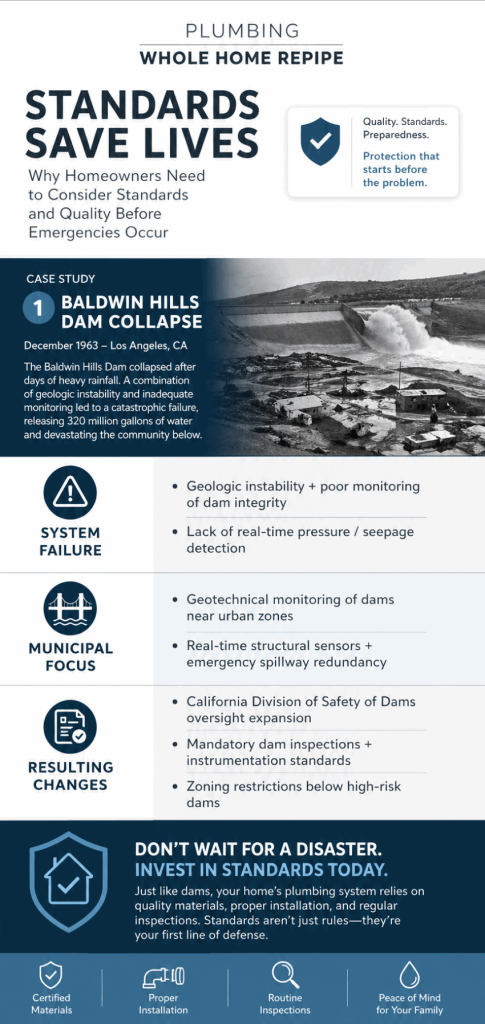
Pattern Translation™
Infrastructure → Residential Mapping
Dam system → Home plumbing system
Crest cracking → drywall or slab cracking
Seepage zones → pinhole leaks or pipe corrosion
Ground instability → pipe stress or slab leaks
Internal erosion → hidden leaks inside walls or under floors
Water displacement → unexplained moisture or rising water usage
Sudden breach → pipe burst or major interior flooding
Critical preconditions:
- Topography: Elevated reservoir directly above dense housing → gravity-driven risk
- Geology: Built on fault-influenced ground, part of the Newport-Inglewood Fault system
- Surrounding activity: Active oil extraction in the Inglewood Oil Field caused ground subsidence and shifting
- Construction type: Earth-fill dam (not reinforced concrete), more vulnerable to seepage and internal erosion
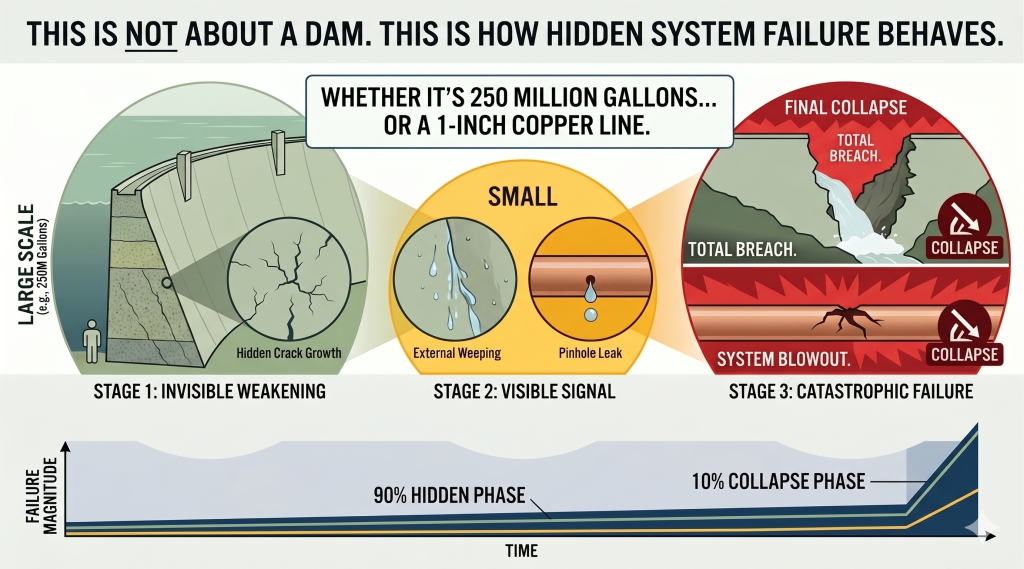
This is not about a dam. This is how hidden system failure behaves—whether it’s 250 million gallons or a 1-inch copper line.
11 Plumbing/Pipe/Dam Disasters in California
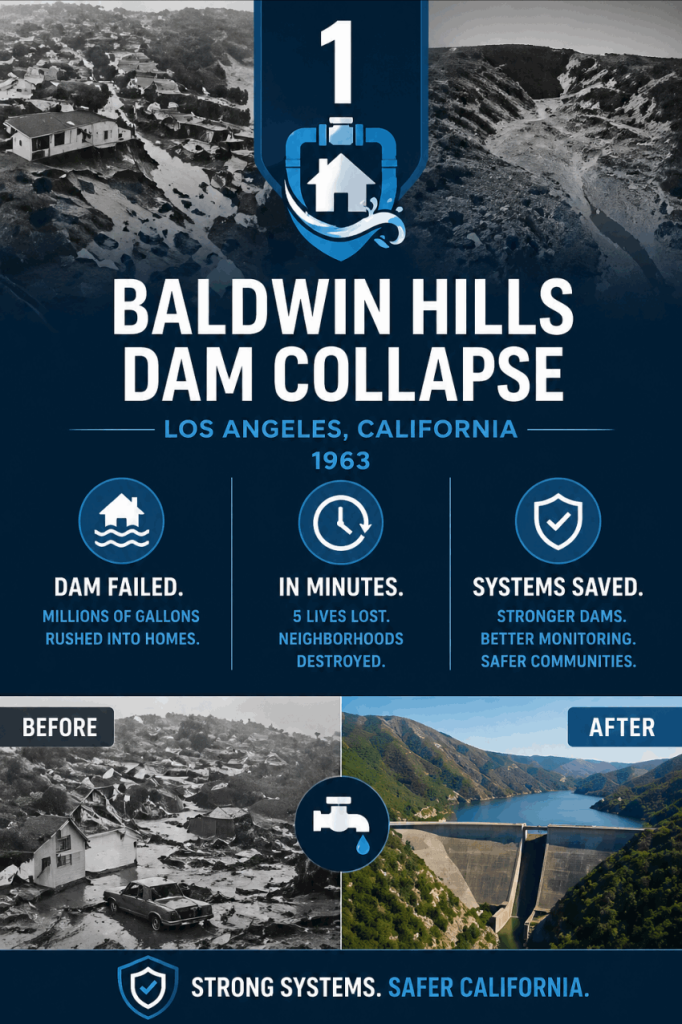
1. Baldwin Hills Dam Collapse — Los Angeles, California (1963)
A hillside dam failed without warning, sending millions of gallons into a residential neighborhood in minutes.
2. San Francisco Sinkhole That Swallowed a Mansion — San Francisco, California (1995)
An aging sewer line collapsed underground, causing the street and an entire mansion to disappear into a 40-foot sinkhole.
3. Fresno Toxic Water Crisis From Corroded Pipes — Fresno, California (2016)
Internal pipe corrosion contaminated residential water supplies, exposing thousands of homes to unsafe drinking conditions.
4. Oroville Dam Spillway Failure Threatens Homes — Oroville, California (2017)
Structural failure at a major dam triggered mass evacuations as downstream residential areas faced catastrophic flood risk.
5. Yuba County High-Pressure Pipe Rupture Floods Area — Yuba County, California (2026)
A massive pressurized pipe burst released uncontrolled water, causing rapid flooding and structural damage.
6. Yuba–Sutter Levee Break Flood Disaster — Yuba City, California (1955)
A levee failure redirected floodwaters into residential zones, destroying homes and overwhelming entire communities.
7. Hillside Home Collapse From Hidden Water Line Leak — Studio City, Los Angeles (2000s)
A slow underground leak saturated the soil beneath a home, eventually causing the foundation to shift and collapse.
8. Slab Leak Erupts Beneath Home and Destroys Interior — San Jose, California (2010s)
A ruptured pipe under the slab forced water upward, buckling floors and flooding the entire interior.
9. Toilet Supply Line Burst Floods Entire Home During Vacation — Anaheim, California (2010s)
A small supply line failure ran unchecked for days, filling the home with water and causing total interior loss.
10. Sewer Backup Floods Coastal Home With Wastewater — Pacifica, California (2010s)
Storm overload forced sewage back through residential drains, contaminating the home from the inside out.
11. Attic Pipe Burst Sends Water Through Ceilings — Sacramento, California (Cold Snap Event)
A frozen pipe burst above the ceiling, sending water cascading down and destroying multiple rooms below.
🌤️ Weather + Environmental Conditions
Unlike many infrastructure failures, the weather was NOT the primary trigger.
- No extreme storm event
- No flooding pressure from rainfall
- Typical Southern California December conditions (mild, dry)
👉 This is critical:
Failure was internally driven, not externally forced.

⚙️ Failure Mechanics (What Actually Broke)
Step-by-Step Breakdown
- Ground Instability (Long-Term Setup)
- Oil extraction caused land subsidence (sinking + shifting)
- Fault activity added micro-movements under the dam
- Structural Stress Accumulation
- The dam liner and foundation began to separate and distort
- Small cracks formed—initially invisible externally
- Progressive Leakage
- Water seeped through cracks
- Internal erosion began (known as “piping failure”)
- Accelerated Internal Erosion
- Flowing water widened internal channels
- Soil carried out → voids formed inside the dam
- Catastrophic Breach
- Structural integrity failed suddenly
- A full rupture released the reservoir
💥 The Event (December 14, 1963)
- Time: Afternoon
- Initial warning signs: Visible cracking + small leaks reported hours before collapse
- Authorities began a partial evacuation, but time was limited
Collapse Dynamics
- The dam breach widened rapidly
- ~290 million gallons of water released
- A massive flood wave traveled downhill
Timeline of Destruction
- First minutes: Initial surge destroys closest homes
- 30 minutes: Flood spreads across multiple neighborhoods
- ~90 minutes: Major destruction complete
🏚️ Immediate Damage Profile
- 277 homes destroyed
- Thousands displaced
- Entire residential blocks were wiped out
- Cars, structures, and debris were carried long distances
Casualties:
- Relatively low (5 fatalities) due to partial warning + evacuation
👉 This is considered a near-miss mass casualty event
🧠 System-Level Failure Analysis
1. Engineering Oversight Failure
- Known geological risks were underestimated
- The dam was not designed for long-term ground movement
2. Monitoring Failure
- Early warning signs (leaks, cracks) were not escalated fast enough
3. Human + Industrial Interaction
- Oil extraction directly impacted structural stability
👉 This is a cross-system failure (infrastructure + industry)
🔁 Direct Aftermath (Short-Term)
- Mass displacement and emergency sheltering
- Large-scale debris removal operation
- Insurance claims + legal disputes surged
- Immediate shutdown of similar reservoir systems for inspection
🧱 Indirect Effects (Long-Term Changes)
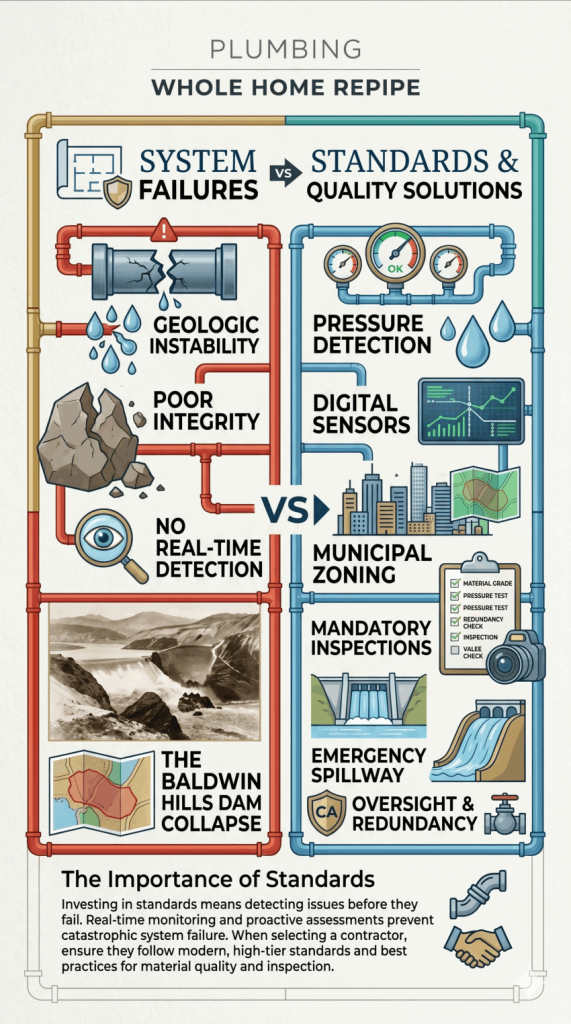
🏗️ 1. Infrastructure Policy Changes
- Stricter regulations on dam construction near faults
- Enhanced geotechnical surveys are required before building
🛢️ 2. Oil Extraction Regulation
- Greater scrutiny of subsidence impacts
- Monitoring requirements between industrial activity + infrastructure
📡 3. Monitoring + Early Warning Systems
- Implementation of:
- Leak detection systems
- Ground movement monitoring
- Emergency alert protocols
🏘️ 4. Urban Planning Shifts
- Reduced tolerance for high-risk infrastructure above residential zones
- Zoning laws evolved to separate hazard + population density

🧩 Hidden Insights (What Most People Miss)
⚠️ 1. “Slow Failure → Fast Disaster.”
This wasn’t sudden.
- Weeks/months of invisible degradation
- Minutes of catastrophic release
👉 Same pattern seen in:
- Plumbing failures (pipe corrosion → burst)
- Foundation failures (soil shift → collapse)
⚠️ 2. Elevation = Multiplier
Water stored above homes turns:
- Small failure → gravitational weapon
👉 Energy increases exponentially with height
⚠️ 3. Cross-System Risk Is Underestimated
- Oil drilling ≠ and dam construction
- But they interacted → failure
👉 Modern takeaway:
Systems don’t fail alone. They fail in combinations.
🧠 Contractor / System Thinking Translation
This event maps directly to residential failure patterns:
Dam System | Residential Equivalent |
Soil movement | Foundation shifting |
Internal seepage | Hidden pipe leaks |
Sudden rupture | Pipe burst / slab leak |
Elevated reservoir | Pressurized plumbing system |
👉 Same equation:
Hidden pressure + time + weak point = catastrophic release
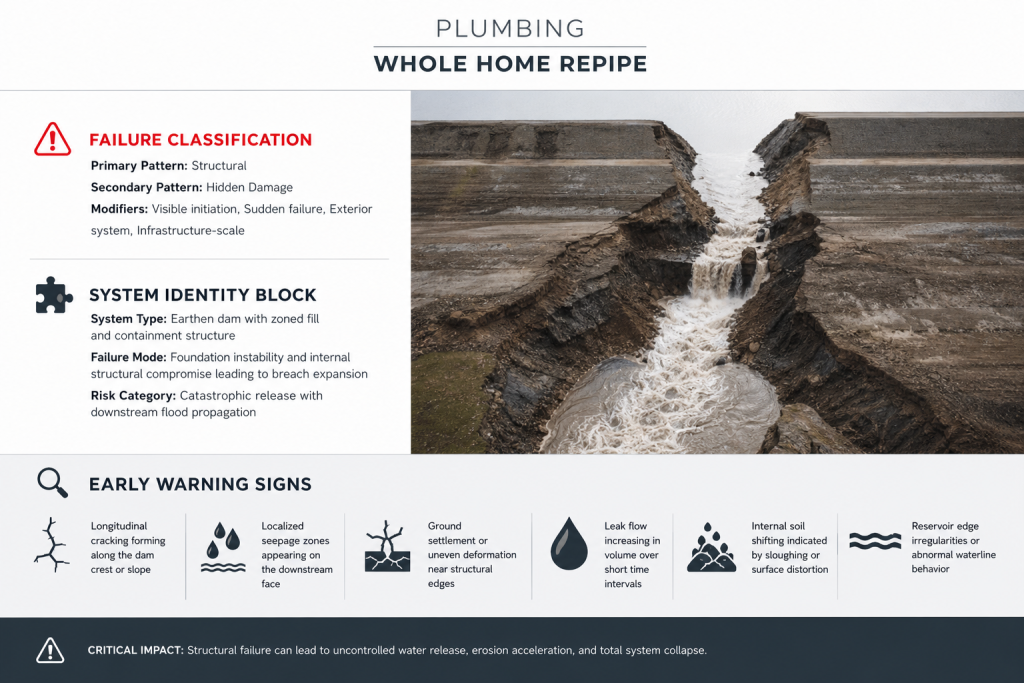
🚨 FAILURE CLASSIFICATION
Primary Pattern: Structural
Secondary Pattern: Hidden Damage
Modifiers: Visible initiation, Sudden failure, Exterior system, Infrastructure-scale
🧩 SYSTEM IDENTITY BLOCK
System Type: Earthen dam with zoned fill and containment structure
Failure Mode: Foundation instability and internal structural compromise leading to breach expansion
Risk Category: Catastrophic release with downstream flood propagation
🔍 EARLY WARNING SIGNS
Longitudinal cracking forming along the dam crest or slope
Localized seepage zones appearing on the downstream face
Ground settlement or uneven deformation near structural edges
Leak flow increasing in volume over short time intervals
Internal soil shifting indicated by sloughing or surface distortion
Reservoir edge irregularities or abnormal waterline behavior
👤 WHO THIS IS FOR / NOT FOR
Ideal homeowner:
Properties in hillside or elevation-driven environments
Homes below water-retaining systems or slope-fed infrastructure
Owners of aging or buried systems with hidden pressure exposure
Anyone evaluating system stress beyond visible condition
Not for:
New construction with verified structural engineering
Flat, low-pressure environments without elevation variables
Cosmetic plumbing concerns or fixture-level issues only
⚖️ SYSTEM COMPARISON
Typical Understanding: Failure begins when visible cracking or leakage becomes severe
System Reality: Failure begins internally through stress accumulation and unseen erosion long before visible damage
Typical Understanding: Small leaks are isolated issues
System Reality: Small leaks are pressure-release signals of active internal failure
Typical Understanding: Structural systems fail where damage is seen
System Reality: Structural systems fail at internal weak points, with visible damage appearing late
🔗 FORWARD PATH
This same structural stress pattern exists inside residential plumbing systems under pressure
Hidden erosion in dams mirrors pipe degradation behind walls and under slabs
Early seepage reflects micro-leak behavior in repipe failure patterns
Downhill flood release mirrors pressure-driven failure in whole-home systems
Slab leaks follow the same hidden damage progression before surface visibility
📝 NOTES
Failure Pattern Identified
System Stress Detected
Pre-Failure Indicators Present
Hidden Load Accumulation
Prevention Window: Before Visible Damage
🎯 Final Takeaways (Mechanical Framing)
- Root Cause: Ground instability + poor system isolation
- Trigger: Internal erosion (not weather)
- Failure Type: Progressive → Catastrophic
- Impact Multiplier: Elevation + volume
- Lesson:
Systems fail where movement + pressure + neglect intersect