

Vegas Failure Map: Why Your Zip Code Predicts Your Next Leak
Vegas Failure Map: Why Your Zip Code Predicts Your Next Leak reflects a system reality most homeowners never see at installation.
New builds look clean.
Water pressure feels strong.
Fixtures operate without issue.
Across Las Vegas, Henderson, and Summerlin, many homes built between 1995 and 2015 are now reaching failure thresholds.
Material choice alone does not explain it.
System behavior under desert conditions does.
In Reno and Sparks, similar patterns appear with different timing due to elevation and seasonal variation.
Comparable delayed failures can be observed in Phoenix and parts of Southern California, where mineral-heavy water and heat cycles create similar stress.
Vegas Failure Map: Why Your Zip Code Predicts Your Next Leak is not about isolated leaks.
It is about pattern recognition tied to location.
Downtown Las Vegas
Driving Force: Infrastructure Obsolescence
The Breakdown:
Aging systems past their lifespan, combined with outdated materials and modern demand, are a problem.
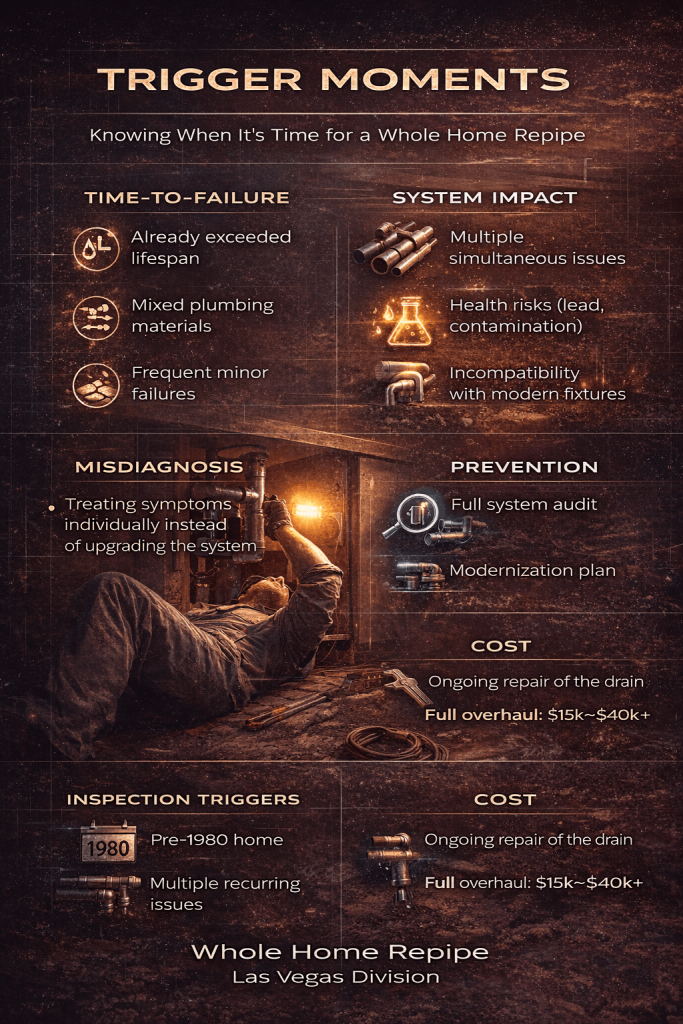
Trigger Moments
Inconsistent pressure
Mixed plumbing materials
Frequent minor failures
Time-to-Failure
Already exceeded lifespan
Failure = progressive + compounding
System Impact
Multiple simultaneous issues
Health risks (lead, contamination)
Incompatibility with modern fixtures
Misdiagnosis
Treating symptoms individually instead of upgrading the system
Prevention
Full system audit
Modernization plan
Cost
Ongoing repair of the drain
Full overhaul: $15k–$40k+
Inspection Triggers
Pre-1980 home
Multiple recurring issues.

The Failure Pattern Index for Desert Plumbing Systems
Every system follows predictable stress behavior.
Failure is not random.
Core pressure-driven conditions define the region:
Pressure spikes after repiping or fixture upgrades
Water hammer from rapid valve closure
Thermal expansion in closed desert systems
Flow restriction from mineral scaling
Air shock events during system fill
In North Las Vegas, elevated municipal pressure combines with internal restriction.
In Summerlin, higher elevation zones shift distribution patterns across the system.
In Spring Valley, aging subdivisions experience synchronized stress across similar builds.
Across these areas, pressure does not remain constant.
It redistributes.
Weak points absorb the load.
Why Las Vegas Systems Fail Differently
Desert environments accelerate internal system change.
Heat increases reaction speed.
Mineral content reshapes flow.
In Henderson, hard-water scaling reduces the internal pipe diameter.
In Summerlin, pressure variability increases stress on fixtures.
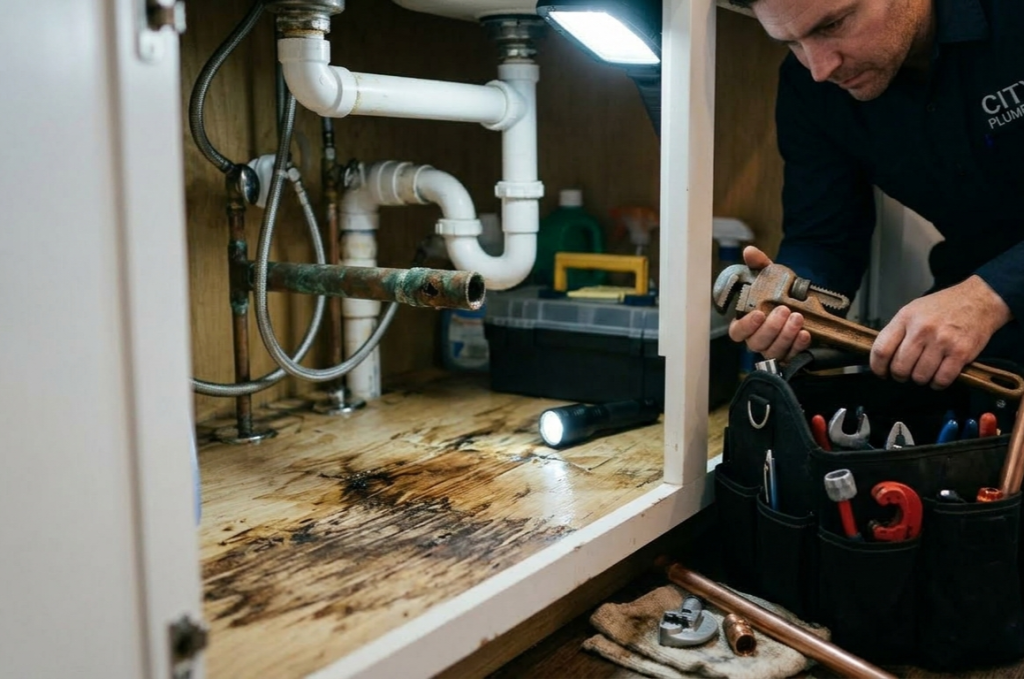
In North Las Vegas, older copper systems begin to show early-stage pinhole behavior.
Similar system stress appears in Phoenix and Salt Lake City.
However, Vegas combines heat, pressure, and mineral load in a tighter cycle.
Vegas Failure Map: Why Your Zip Code Predicts Your Next Leak highlights these compounded effects.
Local Zones of Failure Risk (Las Vegas Valley)
Different zones experience different failure timing.
Construction era, elevation, and water composition all play a role.
Older Core Areas (Aging Copper + High Mineral Load):
North Las Vegas
Sunrise Manor
Whitney
Paradise
Winchester
Mid-Age Subdivisions (Pressure Rebalancing + Material Transition):
Henderson
Green Valley
Spring Valley
Enterprise
Silverado Ranch
Newer High-Growth Zones (System Expansion + Hidden Stress):
Summerlin
Mountains Edge
Centennial Hills
Southern Highlands
Skye Canyon
Each group shares similar system behavior.
Homes fail in clusters.
Patterns repeat within subdivisions.
Hidden Triggers: Water Heaters and Softeners
Not all failures originate in piping.
In Las Vegas, water heaters accumulate sediment rapidly.
Mineral buildup creates internal pressure.
That pressure transfers into the system.
Softener systems introduce another layer.
Brine discharge alters downstream flow conditions.
Backpressure builds slowly.
In Henderson and Summerlin, these conditions often go unnoticed.
No visible leak appears.
Stress accumulates internally.
Similar behavior occurs in Phoenix and Inland California regions.
Vegas amplifies it through water composition.
Why Most Failures Are Delayed
Systems rarely fail immediately.
Initial conditions appear stable.
Water flows.
Pressure seems balanced.
Over time:
Pressure redistributes across the system
Mineral scaling alters internal flow
Materials expand under heat cycles
Connections weaken under repeated stress
Common timelines:
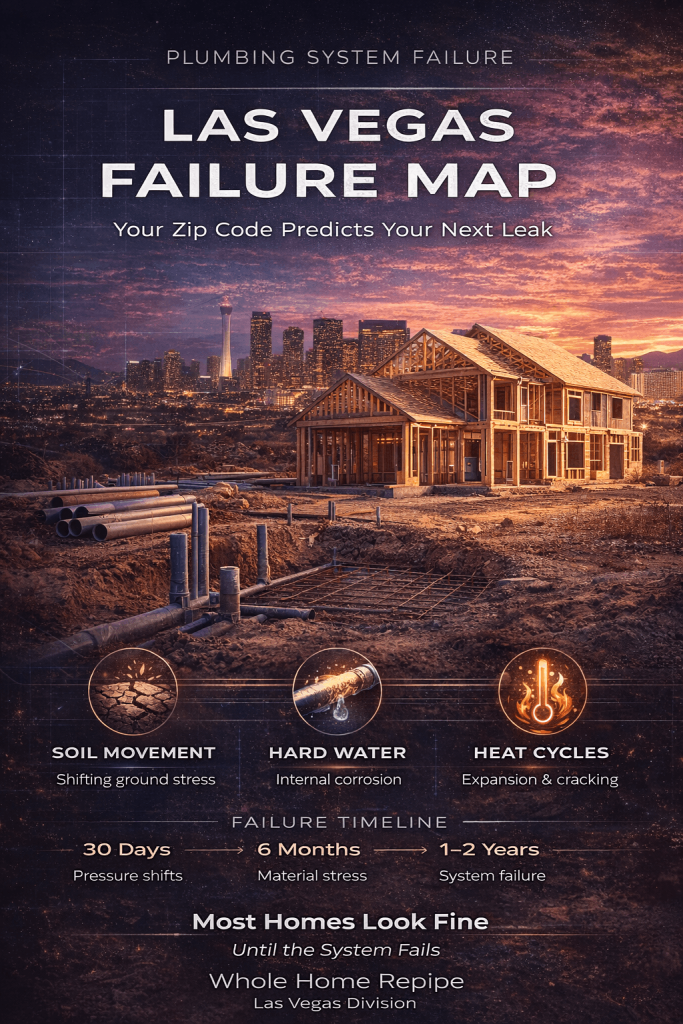
Early stage: ~30 days
Mid stage: ~6 months
Late stage: ~1–2 years
In Summerlin, pressure changes after upgrades often trigger delayed failures.
In North Las Vegas, aging systems collapse internally before leaks appear.
In Henderson, the distribution imbalance becomes visible only under sustained use.
Vegas Failure Map: Why Your Zip Code Predicts Your Next Leak shows that delay is the standard, not the exception.
Recognition Signals Most Homeowners Miss
Early indicators are subtle.
Fluctuating water pressure
Banging or knocking sounds
Metallic taste in water
Sediment in faucet aerators
Slow hot water delivery
Rising water bills
In Spring Valley, these signals often appear before fixture failure.
In Enterprise, distribution imbalance shows up as inconsistent pressure.
In Centennial Hills, mineral scaling reduces flow gradually.
These are not isolated issues.
They are system signals.
Decision Distortion in High-Growth Markets
Homeowners believe they are deciding between:
Copper vs PEX
Repair vs replacement
Cost vs scope
These are visible choices.
Actual outcomes depend on:
Pressure behavior across the system
Mineral interaction within pipes
Load distribution across fixtures
Connection integrity under stress
Environmental exposure over time
In Las Vegas, visibility does not equal reliability.
System behavior determines outcome.
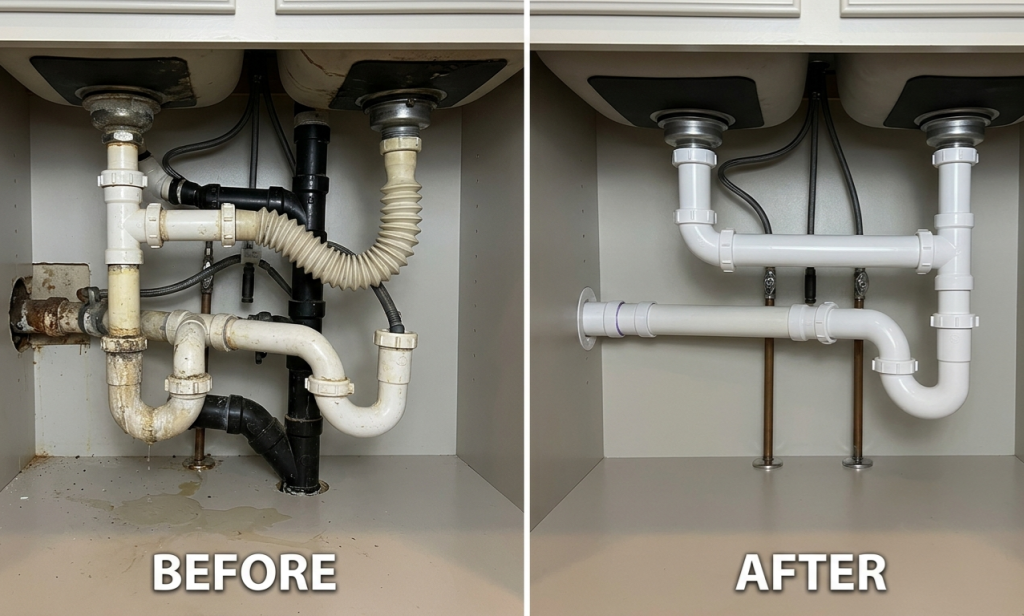
From Reactive Repairs to System-Level Control
Repeated repairs do not stabilize the system.
They shift stress elsewhere.
Over time:
Leak frequency increases
Pressure imbalance worsens
Material degradation accelerates
What appears to be an isolated failure becomes a system-wide instability.
Vegas Failure Map: Why Your Zip Code Predicts Your Next Leak reframes the decision.
Structured repiping introduces control:
Full system rerouting
Transition to PEX-A or Type L copper
Balanced distribution systems
Water bypass during installation
Controlled pressure management
This is not patchwork.
It is a system correction.
Process, Permits, and Long-Term Stability
Repiping in Las Vegas requires coordination.
Permitting varies across jurisdictions.
Inspection layers ensure compliance.
System layout must align with code requirements.
Drywall access is planned, not reactive.
Water service is maintained through bypass systems.
Most homes regain water the same day.
Proper execution reduces long-term liability.
Insurance eligibility improves.
Resale stability increases.

System Performance and Property Value
Updated systems shift outcomes.
Water pressure stabilizes.
Flow becomes consistent.
Metallic taste disappears.
Appliance performance improves.
Long-term costs decline.
Insurance risk decreases.
Appraisal confidence increases.
In high-equity zones such as Summerlin and Henderson, plumbing stability directly affects asset value.
Vegas Failure Map: Why Your Zip Code Predicts Your Next Leak
Vegas Failure Map: Why Your Zip Code Predicts Your Next Leak is not about predicting a single event.
It is about understanding system behavior tied to location.
Across Las Vegas, Henderson, Summerlin, North Las Vegas, and surrounding zones, patterns repeat.
Homes built under similar conditions fail under similar timelines.
Extended markets such as Reno and Sparks exhibit similar behavior under different environmental stressors.
Comparable system patterns appear in Phoenix and Southern California, reinforcing the broader regional model.
Plumbing Whole Home Repipe contractor standards operate as decision infrastructure within this environment.
They do not function as a marketing layer.
They provide a framework for evaluating system condition based on pressure behavior, material risk, and long-term durability.
Decisions should be based on:
System age
Leak history
Material condition
Pressure stability
Environmental exposure
Vegas Failure Map: Why Your Zip Code Predicts Your Next Leak connects these variables into a single framework.
It replaces guesswork with clarity.
It shifts decisions from reaction to control.
It aligns homeowners with long-term system performance rather than short-term visibility.