
Marin County
Verified Plumbing Contractor
Reliability Standards

Property values across the San Francisco Bay Area have increased dramatically during the past decade. Construction systems have grown more sophisticated. Digital contractor visibility expanded across search engines and directories. Meanwhile, the number of plumbing companies advertising services has multiplied.
However, standards enforcement did not expand at the same pace. As a result, homeowners must now navigate a complex marketplace. Infrastructure decisions often occur under uncertainty. The stakes are especially high in premium real estate markets such as Marin County, Silicon Valley, and the Peninsula.

Marin County: Verified Plumbing Contractor Reliability Standards was created to restore clarity in that environment. The framework helps homeowners evaluate plumbing contractors through infrastructure performance criteria rather than marketing claims.

This guidance originates from Plumbing Whole Home Repipe, a standards-focused resource developed to help homeowners understand plumbing infrastructure risk across the San Francisco Bay Area and other high-value Western housing markets.

Top 10 Plumbing & Water Disasters in Marin County
1. The Corte Madera Creek Flood (1982 Major Event)
Severe winter storms caused Corte Madera Creek to overflow, flooding parts of Larkspur and Corte Madera.
System Failure Breakdown:
- Channel Capacity Overload: Creek exceeded design limits
- Tidal Influence Compounding: Bay tides slowed drainage discharge
- Floodplain Encroachment: Development increased exposure
Why This Matters:
When discharge is blocked, water backs up—same as drainage systems in homes.
2. The 1998 El Niño Flooding (Countywide Impact)
Heavy storms caused widespread flooding across Marin, especially in low-lying areas like Mill Valley and San Rafael.
System Failure Breakdown:
- Storm Convergence: Rainfall + runoff overwhelmed systems
- Backflow Conditions: Drainage systems reversed
- Soil Saturation: Ground reached full capacity
Why This Matters:
Backflow and saturation create compounding failures—mirroring sewer backups in homes.
3. The Ross Valley Flooding (Recurring — Worst Impacts: 1982, 2005, 2017)
Communities in San Anselmo, Fairfax, and Ross experience recurring flooding.
System Failure Breakdown:
- Undersized Creek Channels: Ross Valley creeks exceed capacity
- Urban Runoff Amplification: Development increases flow
- Drainage Bottlenecks: Choke points trigger overflow
Why This Matters:
Bottlenecks define failure points—same as undersized plumbing systems.
4. The Mill Valley Drainage Failures (Recurring — Worst Impacts: 1998, 2017, 2023)
Hillside runoff frequently overwhelms drainage systems in Mill Valley.
System Failure Breakdown:
- Gravity-Driven Runoff: Water accelerates downhill
- Soil Saturation: Causes instability and pipe stress
- Drainage Design Gaps: Systems not built for peak flow
Why This Matters:
Drainage failure + soil = structural risk—same as leaks undermining foundations.
5. The San Rafael Creek Flooding (Recurring — Worst Impacts: 1982, 1998, 2023)
Flooding along San Rafael Creek impacts downtown San Rafael.
System Failure Breakdown:
- Channel Capacity Limits: Creek overflows during heavy storms
- Tidal Backflow: Bay conditions slow discharge
- Urban Density Pressure: Increased runoff volume
Why This Matters:
Backflow + limited discharge creates flooding—same as clogged or overwhelmed drains.
6. The Marin Coastal Sewer Failures (Recurring — Worst Impacts: 2010, 2017, 2023)
Coastal areas like Stinson Beach and Bolinas face recurring sewer issues.
System Failure Breakdown:
- Saltwater Corrosion: Accelerated pipe degradation
- High Groundwater Levels: Reduced drainage efficiency
- System Exposure: Infrastructure vulnerable to erosion
Why This Matters:
Corrosion + exposure leads to long-term system breakdown—same as coastal home plumbing.
7. The Mount Tamalpais Runoff Flooding (Recurring — Worst Impacts: 1982, 1998, 2017)
Runoff from Mount Tamalpais impacts surrounding communities.
System Failure Breakdown:
- Rapid Elevation Runoff: Water gains speed downhill
- Soil Saturation: Leads to instability
- Drainage Overload: Systems exceeded during storms
Why This Matters:
Elevation increases pressure and flow—same as multi-level plumbing stress.
8. The 2014–2015 Drought Water System Stress
Drought conditions stressed water supply systems across Marin County.
System Failure Breakdown:
- Pressure Variability: Supply changes affect system stability
- Ground Settlement Risk: Soil shifts with reduced moisture
- Material Stress Cycling: Systems forced into fluctuation
Why This Matters:
Inconsistent pressure weakens systems over time—same as residential plumbing stress.
9. The Atmospheric River Flooding (2023)
Severe storms caused flooding across Marin County, impacting multiple drainage systems.
System Failure Breakdown:
- Extreme Inflow Events: Rainfall exceeded system capacity
- Multi-System Overload: Creeks and drains failed simultaneously
- Localized Flooding Hotspots: Weak points exposed
Why This Matters:
Modern systems still fail under peak load—same as undersized plumbing.
10. The Aging Water Main Failures (Countywide — Worst Impacts: 2015, 2019, 2023)
Recurring water main breaks across cities like Novato and San Rafael highlight infrastructure challenges.
System Failure Breakdown:
- Material Degradation: Aging pipes weaken
- Pressure Cycling: Daily use stresses systems
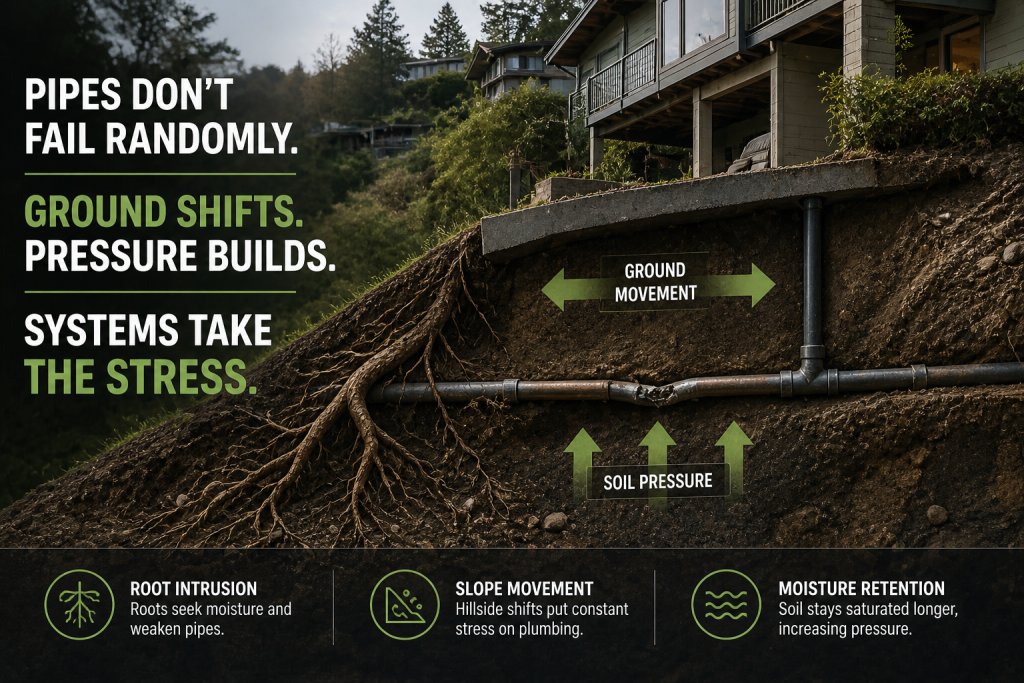
- Ground Movement: Soil shifts strain underground lines
Why This Matters:
Aging systems fail without warning—same as older home plumbing systems.

Act Now
These failures happen at county scale.
Inside homes across Marin County, they follow the same patterns—just smaller, slower, and harder to detect.
- Pressure overload
- Backflow and blockage
- Corrosion and material failure
- Drainage design issues
- Soil movement and instability
If your home was built decades ago, these risks already exist—just not visible yet.
Full system failure analysis
Whole-home repipe planning based on real-world failure patterns
Contractor alignment based on verified standards—not marketing claims
Explore Marin County areas:
San Rafael • Mill Valley • Novato • Larkspur • Corte Madera • Fairfax • San Anselmo