Florida Plumbing Systems Under Saturation, Corrosion, and Coastal Pressure
This helps Florida homeowners identify combined environmental risks early, understand why plumbing failures escalate faster in coastal conditions, and make better decisions before hidden system stress turns into widespread damage.
Most plumbing failures across Florida are not caused by a single condition.
They form through multiple environmental forces acting on the system at the same time.
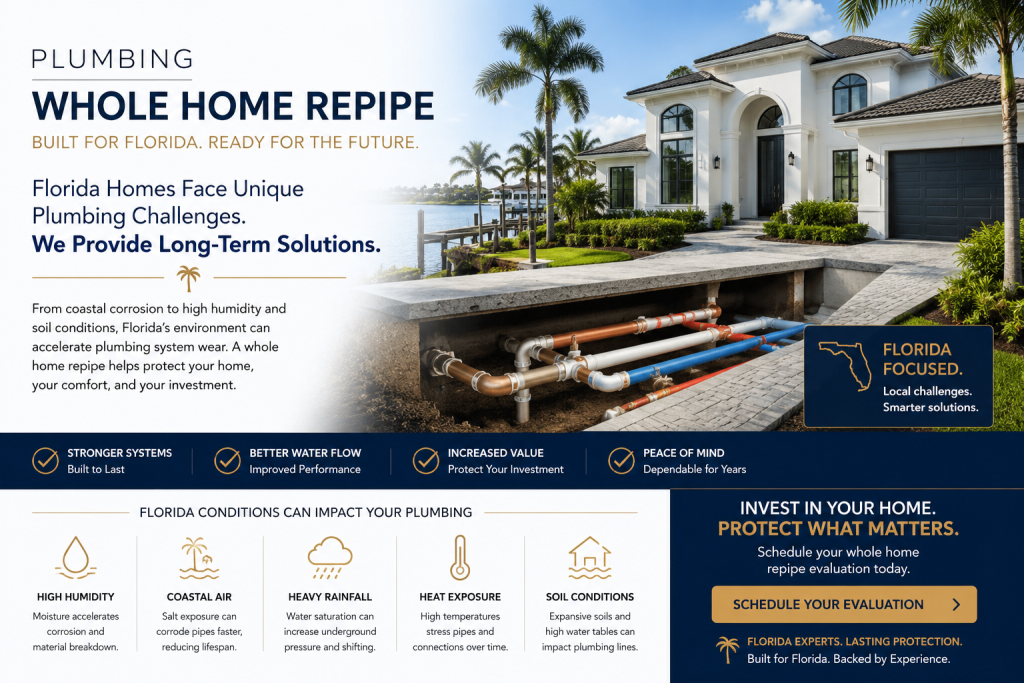
Moisture surrounds the structure.
Salt moves through the air.
Heat accelerates material breakdown.
Groundwater applies pressure below the slab.
Soil conditions shift under saturation.
These forces do not operate independently.
They interact.
That interaction changes how plumbing systems age and fail.
Florida Is A Multi-Layer Environmental Stress System
Florida plumbing systems operate inside a continuous exposure cycle.
Saturation affects underground stability.
Corrosion weakens materials from the outside.
Coastal conditions introduce salt into the environment.
Thermal cycles create expansion and pressure variation.
Each force compounds the effect of the others.
A system that might tolerate one condition often fails when exposed to all of them together.
The Combined Failure Stack
Failures across Florida typically develop through overlapping pressure zones rather than isolated defects.
Saturation And Groundwater Pressure
High water tables keep groundwater close to the foundation across much of the state.
Storm cycles repeatedly saturate the soil.
Saturated ground loses consistency.
Underground plumbing systems depend on stable support to maintain alignment.
As soil conditions shift, pipes begin to move.
Slope integrity changes gradually.
Connections experience stress under uneven load.
Drainage performance declines over time.
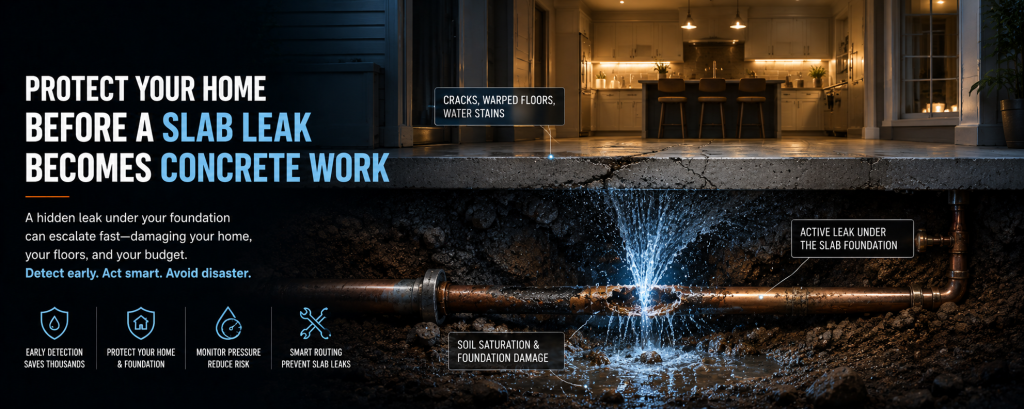
Moisture also masks early-stage leakage.
Water escaping beneath the slab blends into an already wet environment, delaying detection.
Coastal Corrosion And Salt Exposure
Salt exposure plays a major role in Florida plumbing deterioration, especially in coastal regions.
Salt particles travel through the air and settle on exposed components.
Humidity holds those particles in place.
Moisture activates corrosion continuously.
Metal components degrade from the surface inward.
Valves weaken.
Fittings lose integrity.
Supports deteriorate under long-term exposure.
Failures often occur at connection points where structural strength has already been reduced.
Humidity As A Continuous Activation Layer
Humidity does not simply accompany coastal conditions.
It sustains them.
Moisture remains present on surfaces for extended periods.
Materials do not fully dry.
Corrosion processes remain active rather than cycling on and off.
This shortens the lifespan of plumbing components across the system.
Protective coatings degrade faster.
Exposure becomes continuous rather than intermittent.
Thermal Expansion And Pressure Interaction
Florida heat creates repeated expansion and contraction within plumbing systems.
Humidity traps thermal energy around the structure, increasing exposure duration.
Pipes expand during peak temperatures and contract as conditions change.
Closed systems build internal pressure when expansion is not controlled.
Components already weakened by corrosion experience additional stress.
This interaction increases the likelihood of failure at vulnerable points.
Subsurface Instability And Soil Movement
Florida’s subsurface conditions introduce another layer of complexity.
Limestone regions create potential for void formation.
Saturated soil shifts under load.
Ground support beneath pipes can change over time.
Plumbing systems absorb that movement.
Drain lines may lose pitch.
Connections can separate gradually.
Repairs that address only the visible issue may not resolve the underlying instability.
Recurring problems often indicate ongoing subsurface movement rather than isolated defects.
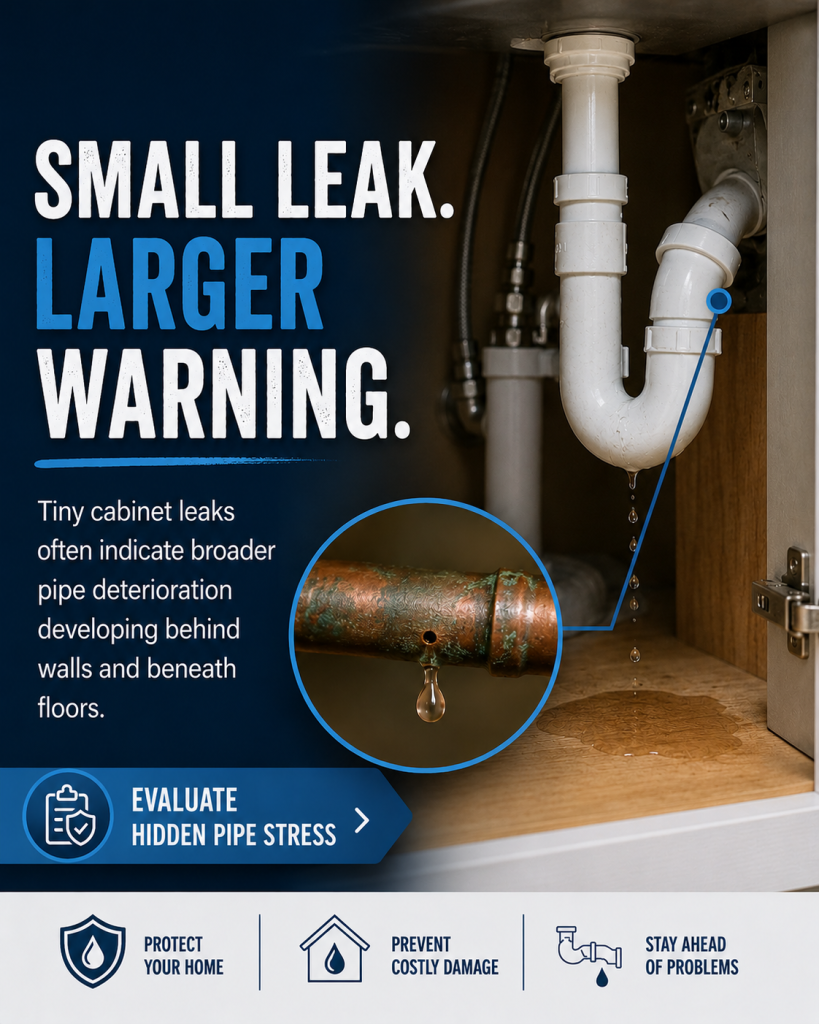
Legacy Infrastructure And Material Degradation
Many homes across Florida still rely on older plumbing systems.
Cast iron drainage lines and aging supply components operate deep into their lifecycle.
Moisture exposure accelerates internal and external corrosion.
Scaling reduces flow capacity.
Structural integrity declines across multiple sections simultaneously.
Localized repairs often fail because the surrounding system remains in the same stage of deterioration.
Construction Pressure And System Variability
Rapid growth across Florida has introduced variability in plumbing system installation.
High-volume construction environments prioritize speed.
Consistency across installations becomes more difficult to maintain.
Minor deviations in support, slope, or connection quality may not appear immediately.
Over time, those conditions become failure points under environmental stress.
Systems built without margin for movement or expansion degrade faster in saturated and coastal conditions.
Why These Failures Develop Quietly
Combined environmental forces reduce the visibility of early-stage failure.
Moisture blends into humid conditions.
Corrosion weakens components before leaks appear.
Subsurface movement remains hidden beneath the slab.
By the time visible symptoms develop, the system has often been under sustained stress for an extended period.
Homeowners typically encounter the outcome rather than the cause.
Florida Homes Operate Under Continuous Environmental Load
Plumbing systems across Florida function inside a constant interaction of saturation, corrosion, and coastal pressure.
Groundwater, salt exposure, humidity, heat, and structural movement all contribute to system behavior.
These forces do not act separately.
They compound over time.
The same plumbing system performs differently in this environment than it would in a dry or stable region.
Understanding these patterns allows homeowners to identify risk earlier, evaluate system condition more accurately, and act before combined environmental stress leads to full system failure.